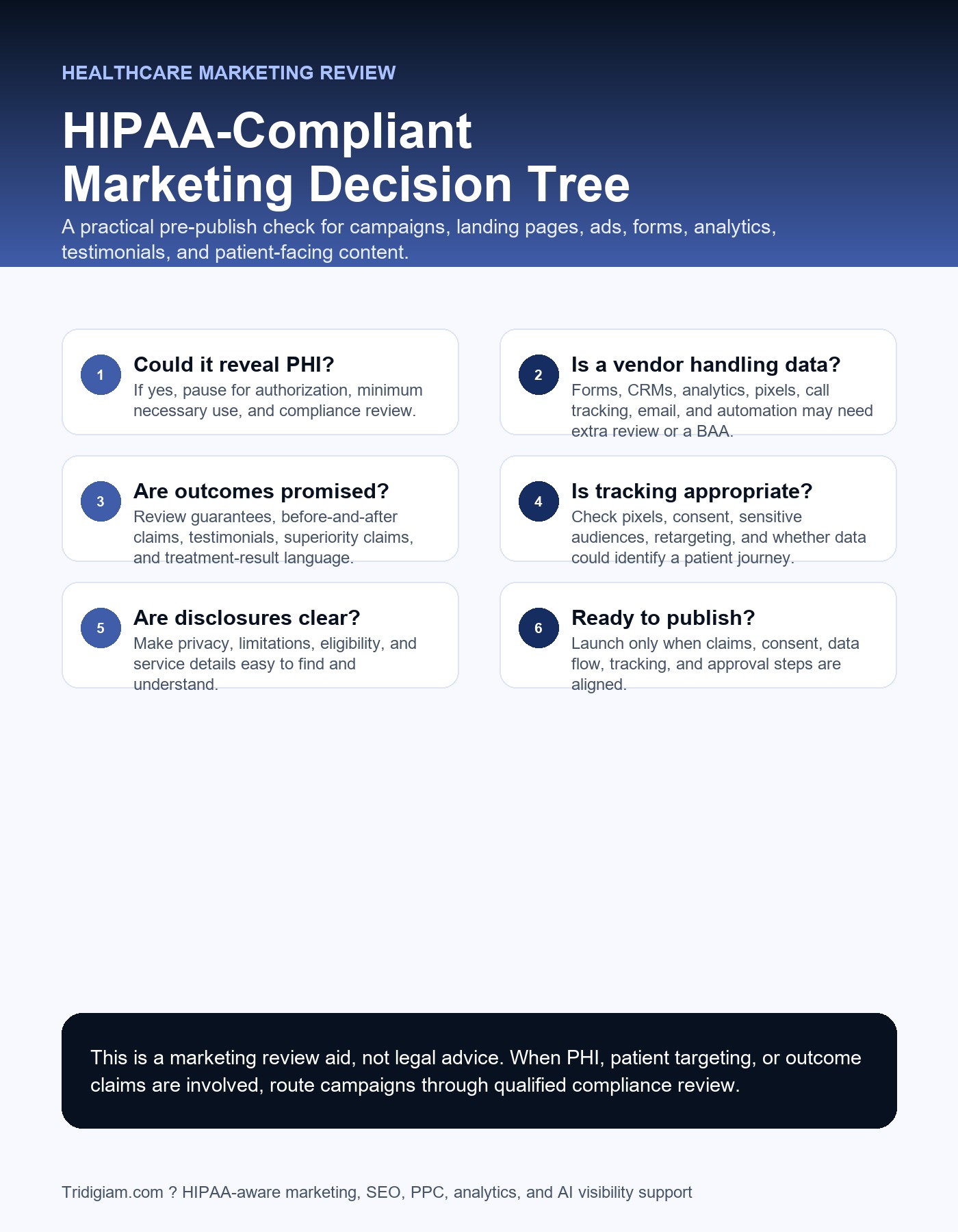
Quick answer: HIPAA-compliant marketing is digital marketing for healthcare, behavioral health, addiction treatment, and aesthetics brands that keeps protected health information (PHI) out of the tracking, ad platforms, forms, and analytics tools that were never built to handle it. Tridigiam builds and runs this kind of marketing, including signing a BAA when we handle PHI, for regulated brands from Las Vegas and nationwide.
Most marketing agencies treat HIPAA as an afterthought. We treat it as the starting line.
Tridigiam builds and runs marketing for healthcare, behavioral health, addiction treatment, and medical aesthetics brands, the kind of organizations where a sloppy tracking pixel or an unguarded email isn’t just a bad look, it’s a reportable breach. We help you grow patient volume and brand authority without putting protected health information, your accreditation, or your standing with the OCR at risk.
If you’ve ever had an agency wave off your compliance questions, you already know the problem. We start there instead.
Talk to a compliance-aware team
HIPAA-compliant marketing answer map
HIPAA-compliant marketing is allowed, but it has to be built around PHI protection from the start. The safest approach is to separate marketing performance from protected health information: keep sensitive identifiers and condition-revealing behavior out of ad platforms, analytics tools, retargeting audiences, email systems, call tracking, forms, and AI tools that are not configured to handle PHI.
- Website and forms: avoid exposing condition-revealing URLs, form details, or patient identifiers to third-party scripts.
- Ads and retargeting: do not build audiences or conversion events from PHI, treatment status, appointment details, or sensitive page behavior.
- Analytics: measure aggregate performance without sending PHI into tools that lack the right safeguards or agreements.
- Email, SMS, and CRM: confirm whether the platform can support healthcare communication requirements and whether a BAA is needed.
- Reviews and testimonials: avoid confirming a patient relationship unless the person has provided appropriate authorization.
Useful source anchors include HHS guidance on HIPAA marketing, HHS guidance on consumer health information, HHS HIPAA Privacy Rule resources, and the FTC’s privacy and security guidance. Tridigiam connects this work to AI Search Optimization, healthcare digital marketing, HIPAA-conscious analytics, and HIPAA-conscious paid ads.
Questions healthcare teams ask before choosing a HIPAA-conscious marketing partner
What is HIPAA-compliant marketing?
HIPAA-compliant marketing means marketing activity is designed so protected health information is not used or disclosed for marketing without the required authorization or applicable exception. It also means the website, forms, analytics, ads, email, SMS, reviews, and vendor workflows are reviewed for privacy and data-handling risk.
How do I choose a HIPAA-compliant marketing agency?
Choose an agency that understands PHI, can explain where healthcare marketing data leaks usually happen, is willing to sign a BAA when it handles PHI, avoids casual pixel and retargeting setups, documents review workflows, and can show how it measures performance without sending sensitive information into the wrong tools.
Can healthcare businesses still run SEO, ads, email, and social media?
Yes. HIPAA does not ban marketing. It changes how marketing has to be configured, reviewed, measured, and documented. The goal is not to stop growth; it is to remove avoidable PHI exposure from the growth system.
Key Takeaways
- HIPAA doesn’t prohibit healthcare marketing, it governs how protected health information (PHI) is used and disclosed across the channels you use.
- The most common PHI leaks come from ad platform tracking, web analytics, forms/email/SMS, retargeting audiences, and reviews, not from running ads themselves.
- Any vendor, including your marketing agency, that creates, receives, stores, or transmits PHI generally needs a signed Business Associate Agreement (BAA).
- Tridigiam builds compliant marketing for addiction treatment, behavioral health, medical aesthetics, medical and dental practices, telehealth, pharmacy, and medical device brands.
- Compliance and patient acquisition aren’t in tension when tracking, forms, and campaigns are built correctly from the start rather than patched after a scare.
What HIPAA-compliant marketing actually means
HIPAA-compliant marketing is the practice of promoting a healthcare organization without exposing protected health information anywhere in the marketing stack: the website, ad platforms, analytics, forms, email, SMS, call tracking, and reviews.
In plain terms, it’s marketing that can withstand a privacy audit.
That covers the obvious things, like not naming patients in a testimonial without a signed release. It also covers the quiet things that sink most healthcare marketing programs: a Meta Pixel quietly transmitting appointment data, a Google Analytics property logging a URL that reveals a condition, a contact form emailing PHI in plain text, or a retargeting audience built from people who visited a treatment page. Those are the failures that show up in enforcement actions, and they’re almost always invisible until someone goes looking.
Why it matters more than most agencies admit
The risk isn’t theoretical, and it isn’t rare. Regulators have made it clear that tracking technologies on healthcare websites can disclose PHI to third parties, and organizations have paid for it.
Here’s where healthcare marketing programs most often leak PHI:
- Ad platform tracking. Conversion pixels and tags from Meta, Google, and others can transmit the pages a user viewed and the actions they took, which, on a healthcare site, can constitute PHI.
- Web analytics. Default analytics setups capture full URLs, IP addresses, and user identifiers that, combined, can identify a patient and their condition.
- Forms, email, and SMS. Intake forms and follow-up messages routinely carry PHI through tools that were never built to handle it and whose vendors never signed a Business Associate Agreement.
- Retargeting and audiences. Building an audience from visitors to a specific treatment or diagnosis page can expose that those individuals sought that care.
- Reviews and testimonials. Responding to a patient review can confirm a treatment relationship, a disclosure in itself.
A Business Associate Agreement (BAA) is the contract that makes a vendor, including your marketing agency, accountable for protecting PHI. If a partner touches your PHI and won’t sign one, that’s your answer about whether they should be touching it at all.
| Where PHI Leaks | The Risk |
|---|---|
| Ad platform tracking | Conversion pixels and tags from Meta, Google, and others can transmit the pages a user viewed and the actions they took, which on a healthcare site can constitute PHI. |
| Web analytics | Default analytics setups capture full URLs, IP addresses, and user identifiers that, combined, can identify a patient and their condition. |
| Forms, email, and SMS | Intake forms and follow-up messages routinely carry PHI through tools that were never built to handle it and whose vendors never signed a BAA. |
| Retargeting and audiences | Building an audience from visitors to a specific treatment or diagnosis page can expose that those individuals sought that care. |
| Reviews and testimonials | Responding to a patient review can confirm a treatment relationship, a disclosure in itself. |
When you're in addiction treatment, HIPAA isn't the whole rulebook
If your facility treats substance use disorder, standard HIPAA compliance is the floor, not the ceiling. Two more rulebooks apply, and most agencies never get past name-dropping them.
42 CFR Part 2 protects SUD patient records more strictly than HIPAA does. It used to require separate consent just to confirm someone was a patient. HHS's 2024 final rule moved it toward a single-consent model closer to HIPAA's own framework, and as of February 16, 2026 that's actively enforced, not a future date on a compliance calendar. EKRA goes further still. It's a federal criminal statute banning payment for patient referrals to recovery and treatment facilities, and a 2025 Ninth Circuit ruling confirmed it reaches marketing intermediaries paid on a per-referral basis, not just providers paid directly.
If you're running ads, LegitScript certification isn't optional either. Google, Meta, Microsoft Ads, Nextdoor, and Recovery.com all require it before an addiction treatment ad account can run at all.
None of this is legal advice, and no agency can certify you through it alone. It's why our addiction treatment work gets built around these three rules from day one instead of retrofitted later. See our full Addiction Treatment Marketing guide for the deep dive.
Industries we market for
We focus where compliance and patient acquisition collide. Each link below goes deeper on that vertical.
- Addiction treatment and recovery: HIPAA, LegitScript, and 42 CFR Part 2 all apply at once. See Marketing Addiction Treatment Centers.
- Behavioral and mental health: what you can and cannot say in ad copy and landing pages. See Behavioral Health Marketing Compliance.
- Medical aesthetics and cosmetic: FTC rules on before-and-after photos, testimonials, and claims. See Medical Aesthetics Marketing.
- Medical and dental practices: local patient acquisition without leaking PHI. See Healthcare Digital Marketing: A Complete Guide and Dental Marketing.
- Telehealth: attracting and retaining virtual patients across state lines. See Telehealth Marketing.
- Pharmacy and pharmaceutical: digital advertising rules that change by product and channel. See How to Market a Pharmacy and Pharmaceutical Marketing Regulations.
- Medical device: marketing FDA-regulated products without overstepping a cleared claim. See Medical Device Marketing.
HIPAA-compliant marketing services we provide
We build the whole program to be defensible from day one, not patched after a scare.
- Compliant website design and development: privacy-first architecture, consent handling, and forms that don’t move PHI through the wrong pipes. See HIPAA-Compliant Website Design: The Complete Guide and ADA Website Compliance.
- Paid search and paid social without PHI leakage: campaigns configured so conversion tracking and audiences capture performance, not protected information. See HIPAA-Compliant Google and Meta Ads and Meta Advertising Without a Pixel.
- Privacy-safe analytics: measurement that gives you real numbers (traffic, conversions, ROI) while keeping identifiers and condition-revealing URLs out of third-party tools. See Website Analytics Without Violating HIPAA.
- Email and SMS marketing within a BAA: patient communication on platforms and workflows built to handle PHI appropriately. See Email Marketing for Healthcare and HIPAA-Compliant Email and SMS.
- Reputation and review management: growing your reviews and responding to them without confirming treatment relationships. See HIPAA-Compliant Patient Reviews and Reputation Management.
- SEO and content: authority content that ranks and earns trust, written to the compliance line your industry actually has to hold. See Healthcare Content Marketing and Local SEO for Medical Practices.
Who we do this for
- Medical practices balancing patient acquisition with HIPAA obligations.
- Behavioral health providers marketing sensitive services defensibly.
- Addiction treatment centers that also have to navigate LegitScript certification and 42 CFR Part 2 on top of HIPAA. We help you market within those rules, we don’t sell the certifications themselves.
- Medical aesthetics practices managing HIPAA alongside FTC rules on before/after imagery and endorsements.
How we keep your marketing compliant
We start every engagement with an audit of where PHI could be leaking today: pixels, analytics, forms, and vendors. We map what’s exposed, fix the pipes, and put agreements in place where we handle PHI, including signing a Business Associate Agreement. From there we build campaigns on that compliant foundation and review them as platforms and regulations change, because both do.
You get marketing that grows the practice and documentation you can hand to a compliance officer without flinching.
Why Tridigiam
Tridigiam is a Las Vegas marketing and advertising agency built for businesses that need results without compliance risk. We work with regulated-industry clients every day, and we serve healthcare brands in Las Vegas and nationwide.
We’re not a treatment provider and we don’t sell certifications. We’re the marketing partner that already speaks the language of your compliance team, so you spend less time translating and more time growing.
Frequently Asked Questions
Is digital marketing even allowed under HIPAA?
Yes. HIPAA doesn’t prohibit marketing, it governs how protected health information is used and disclosed. You can run ads, SEO, email, and social media; you just have to keep PHI out of the tools and audiences that aren’t built to protect it.
Does my marketing agency need to sign a BAA?
If the agency creates, receives, stores, or transmits PHI on your behalf, it generally needs a Business Associate Agreement. If an agency handles that data and won’t sign one, that’s a meaningful red flag.
Can I use the Meta Pixel or Google Analytics on a healthcare website?
Sometimes, but only when configured carefully. Default setups can transmit PHI to third parties. We implement tracking that measures performance while keeping condition-revealing URLs, identifiers, and audiences compliant.
Are patient testimonials and reviews allowed?
Testimonials require a signed authorization, and even responding to a review can improperly confirm a treatment relationship. We help you grow and manage reviews without making a disclosure.
Do you market addiction treatment and behavioral health?
Yes. Those verticals add LegitScript and 42 CFR Part 2 considerations on top of HIPAA. We market within those rules, we help you stay compliant, we don’t issue or hold the certifications.
Do you only work with clients in Las Vegas?
No. We’re based in Las Vegas and know the local market well, but compliant healthcare marketing is the same discipline anywhere, and we work with regulated brands across markets.
Is this page legal advice?
No. It’s educational. Compliance specifics depend on your situation, so we work with your legal and compliance teams rather than replacing them.
Resources
Need HIPAA-compliant marketing that actually moves the needle?
Tridigiam is a Las Vegas marketing and advertising agency built for regulated and growth-focused businesses. Call (702) 748-7005 or request a consultation.
Related Reading
- Compounded GLP-1 Marketing: What Changed
- Do You Need a BAA With Your Marketing Agency?
- Google Ads Healthcare Certification
- How to Choose a HIPAA-Compliant Marketing Agency - Tridigiam
- Medical Marketing: In-House vs Agency
- Specialty-Specific SEO for Medical Practices
- TRT & Hormone Clinic Marketing Rules
- Therapist Testimonials: FTC & HIPAA Rules
- Tracking Admissions Under 42 CFR Part 2