Free AI Visibility Audit Tool
To check if your website is visible to ChatGPT, Perplexity, and Google AI Overviews, run this free scan — it reads your site the way an AI crawler does and returns a Discoverability, Clarity, Authority, and Trust score in about 10 seconds. No cost, no catch. Run the Free ScanWhy this matters right now
Your prospects are asking AI assistants the questions they used to type into Google, and those assistants answer with one recommendation instead of ten blue links. If your practice or business is not the one named in that answer, you are losing the lead before your website ever gets a click.
Most sites have no idea where they stand. This tool checks the same signals AI crawlers and language models actually use: whether they can reach your pages, whether your content is structured to be understood and quoted, whether your site reads as a credible source, and whether the technical basics are in place. You get a real score, not a guess.


What the scan actually checks
We score four categories — Discoverability, Clarity, Authority, and Trust — pulled straight from the same framework we use in paid AI-visibility audits. Discoverability checks whether AI crawlers can reach and read your site at all. Clarity looks at whether your content is structured so an AI can parse it into a clean answer. Authority weighs the signals that make a source worth citing. Trust checks the technical and credibility basics that separate a real business from a spam result.
Under the hood, the scan reads your robots.txt and sitemap, checks how your homepage renders, and runs a structural health pass across performance, SEO, accessibility, and best-practices signals, all in real time against the URL you enter.
- No third-party citations, press mentions, or backlinks from authoritative sources found — one of the biggest factors in whether AI systems recommend a brand over a competitor.
Sample result using example data — enter your own details below to get your real score.
Run Your Free Scan
Enter your URL and email below. Takes about 10 seconds.The Four Scoring Categories
- Discoverability
- Whether AI crawlers and agents (GPTBot, ClaudeBot, PerplexityBot, Google-Extended) can actually reach, fetch, and index your pages without being blocked.
- Clarity
- Whether your content is structured in a way a language model can parse cleanly into a direct answer — clear headings, direct answers, minimal ambiguity.
- Authority
- The signals that make a source worth citing: original expertise, credentials, consistent entity information, and content depth beyond generic filler.
- Trust
- The technical and credibility basics AI systems weight before citing a source — site performance, accessibility, security, and a legitimate technical footprint.
Training option
Learn the framework first
Not ready to hire an agency yet? Start with Tridigiam Marketing Academy, a $20/month membership for regulated and approval-sensitive teams that want practical SEO, GEO, AEO, and AI visibility training.
The membership currently includes 23 courses spanning AI search, visibility audits, content systems, reporting, off-page authority, conversion paths, paid search, marketing operations, AI workflow governance, offer pages, reputation systems, compliance-safe content review, proof-of-work publishing, campaign planning, Meta ads, display ads, campaign reporting, Google Ads, GA4/GTM measurement, CRO, technical SEO, customer research, CRM, retention, and lifecycle marketing. Together, they give your team templates, prompts, scorecards, checklists, worksheets, release logs, reporting outlines, and implementation trackers for safer regulated-growth execution.
Use it to understand the framework, train your team, or prepare for a stronger strategy conversation with Tridigiam.
Key Terms
AI Crawler (GPTBot, ClaudeBot, PerplexityBot)
An automated bot that fetches publicly accessible web pages so an AI system can use them for model training, search indexing, or answering a user's question in real time. Each AI lab runs its own crawler under a distinct user-agent token, and most now separate training bots from search/retrieval bots (for example ClaudeBot vs. Claude-SearchBot).
llms.txt
A plain-Markdown file placed at a site's root (similar in spirit to robots.txt) that gives large language models a concise map of what the site covers and how to interpret it, so AI tools can use the site more accurately at inference time.
robots.txt Disallow Directive
A rule in a site's robots.txt file that names a specific bot's user-agent token and tells it which paths it may or may not crawl. Compliant AI crawlers honor these directives per-bot, so blocking one (like GPTBot) does not automatically block a related bot (like OAI-SearchBot).
Structured Data (Schema Markup)
Machine-readable markup, usually written in JSON-LD, that describes what a page's content actually means (an article, a service, an FAQ, a review). Search engines and AI answer engines use it to understand and, more often, to directly quote a page.
AI Overview / Generative Engine Optimization (GEO)
The practice of shaping content so it gets surfaced or cited inside AI-generated answers, such as Google's AI Overviews, ChatGPT, or Perplexity, rather than only ranking in a traditional list of blue links.
AI Visibility Audit Tool FAQ
Is this scan really free?
Yes. Enter a URL and an email and you get the score immediately, no credit card, no sales call required to see your results. We'll also send the results to your email.
What do you do with my email address?
We use it to send you the results and, occasionally, related AI-visibility content. We do not sell or share your information. You can unsubscribe from any email at any time.
Can you guarantee my score, or that AI will start recommending me?
No, and you should be cautious of anyone who does. AI engines are probabilistic and change frequently. This tool measures your current technical and content signals against the same framework we use in paid audits — it is a diagnostic, not a guarantee of future placement or citation.
How is this different from a regular SEO audit?
A traditional SEO audit focuses on ranking a link in a list of search results. This scan focuses on the separate set of signals that determine whether an AI system can reach your content and choose to cite or recommend it directly inside a generated answer.
What if my score comes back low?
A low score just means there are specific, fixable gaps — often technical ones, like AI crawlers being blocked or a missing sitemap. The results include the categories driving the score, and you're welcome to book a free strategy call if you want help prioritizing the fixes.
Is this safe to run on a healthcare or regulated-industry website?
Yes. The scan only reads publicly available information (your homepage, robots.txt, and sitemap) the same way any search engine or AI crawler already does. It doesn't touch your backend, your patient data, or anything behind a login.
Resources & References
- llms.txt Specification — the open community specification defining the /llms.txt file format.
- Anthropic: How Site Owners Can Block Claude's Crawlers — Anthropic's own explainer on ClaudeBot, Claude-User, and Claude-SearchBot, and how to control each one.
- OpenAI: Overview of OpenAI Crawlers — OpenAI's official documentation on GPTBot and OAI-SearchBot behavior and robots.txt control.
- Google Search Central: Intro to Structured Data — Google's official guide to implementing structured data markup correctly.

Built and reviewed by Chris Goodman, CEO of Tridigiam
Founder of a Las Vegas marketing agency building AI-visibility and compliance-aware marketing systems for regulated industries — healthcare, addiction treatment, and aesthetics. LinkedIn
Related Free Tools
Getting cited in ChatGPT, Perplexity, or an AI Overview depends on more than your DCAT score — these three feed directly into it.
- AI Overview & Featured Snippet Readiness Checker — checks whether your content is actually formatted for AI extraction (direct answers, lists, FAQ schema), the companion piece to this tool’s broader visibility score.
- Schema & Structured Data Checker — clean, valid schema is one of the clearest signals AI crawlers use to understand what your page is actually about.
- Sitemap & Robots.txt Health Checker — if AI crawlers can’t find or reach your pages in the first place, none of the rest of this matters.
How It Compares
A few other free AI visibility checkers have popped up recently. Here is how this one differs, based on what each publishes about itself.
| Tridigiam Grader | AmIVisibleOnAI | AEOCheck | CheckVibe | |
|---|---|---|---|---|
| Framework | DCAT: Discoverability, Clarity, Authority, Trust | 4-part technical checklist | Brand-mention tracking + URL audit | Security + SEO + AEO scan |
| Cost | Free | Free | Paid tiers | Free scan, paid fixes |
| Signup | Email only | None | Account for tracking | None for scan |
| Built for | Regulated-industry sites (healthcare, aesthetics, legal, finance) | General business sites | SaaS brand tracking | AI-coded apps |
Comparison based on each tool’s own public feature and pricing pages as of July 2026. We are not affiliated with any of the tools listed.
Built by the people who do this for regulated industries every day
Tridigiam specializes in marketing for addiction treatment, behavioral health, aesthetics, and medical practices — industries where a wrong claim has real consequences. We built this tool because most of our clients had no idea where they stood with AI search before we ran a full audit for them.
If your score points to real gaps, or you just want a second set of eyes on the results, a strategy call is free and there is no obligation.
Free Guide
Is Your Practice Invisible to ChatGPT?
Get the free guide healthcare marketers are using to find out if AI assistants recommend them, or a competitor, when patients ask for help.
Quick answers
What buyers and AI answer engines need to know
What does an AI visibility audit tool check?
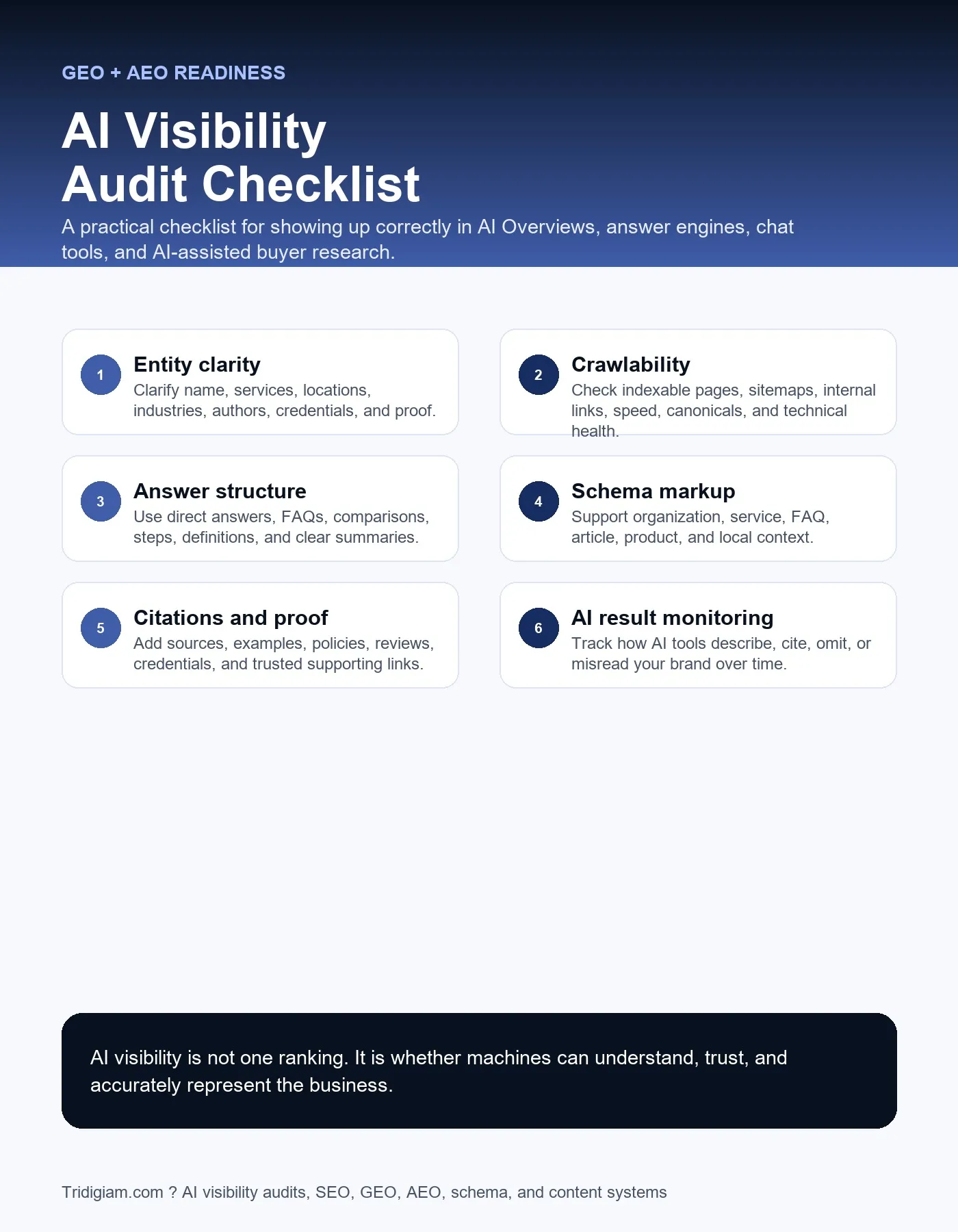
An AI visibility audit tool checks whether key pages have the technical, content, schema, and internal-link signals needed to be understood by search engines and AI answer systems.
How is an AI visibility audit different from a normal SEO audit?
A normal SEO audit focuses heavily on rankings and crawl health, while an AI visibility audit adds entity clarity, answer readiness, source usefulness, and citeable proof assets.
What should happen after an audit?
After an audit, prioritize fixes that improve crawlability, clarity, structured data, trust signals, internal links, and conversion paths before expanding into new content.
AI visibility benchmark
See the 2026 AI visibility readiness benchmarks
Review Tridigiam's original findings on metadata hygiene, structured data, internal links, crawlability, and answer-ready content for SEO, AEO, and GEO.
Read the AI visibility reportUse the checklist