Quick answer: HIPAA-compliant email marketing for healthcare nurtures patients and referrals through segmented, consent-based campaigns sent from a platform covered by a Business Associate Agreement. Keep protected health information out of subject lines and bodies, honor opt-outs, and use secure messaging for anything that reveals a condition or appointment.
Email marketing has become an indispensable tool for businesses across various industries, and healthcare is no exception. As healthcare providers increasingly adopt digital communication strategies, they face the challenge of executing effective healthcare email marketing campaigns while adhering to strict regulatory requirements like HIPAA (Health Insurance Portability and Accountability Act). This comprehensive guide explores strategies for building HIPAA-compliant email marketing campaigns, emphasizing the importance of patient outreach and engagement in the healthcare sector. By understanding current trends, best practices, and the potential pitfalls of non-compliance, healthcare providers can leverage email marketing to enhance patient relationships and improve healthcare outcomes.
Healthcare email marketing answer map
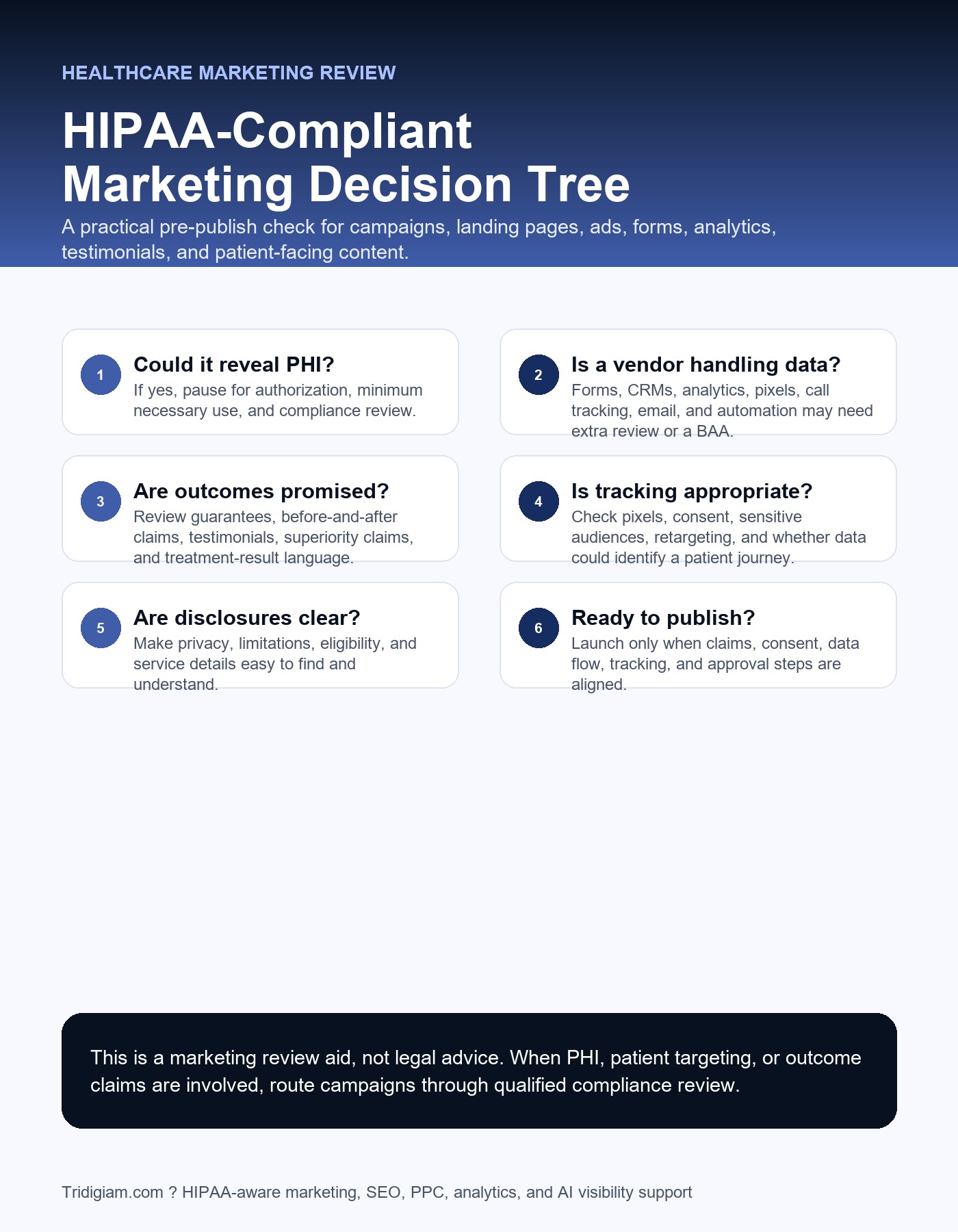
HIPAA-compliant healthcare email marketing depends on consent, message purpose, protected health information controls, secure systems, opt-out handling, and clear separation between patient care communications and promotional marketing. Email can be useful for education, reminders, referrals, and patient nurturing, but campaigns should avoid exposing conditions, appointments, diagnoses, treatment details, or other sensitive information in subject lines, bodies, segmentation, or analytics.
- Classify the message first: appointment logistics, care coordination, patient education, newsletter content, and promotional marketing may trigger different HIPAA and consent requirements.
- Keep PHI out of risky places: avoid sensitive details in subject lines, preview text, campaign names, list names, UTM parameters, merge fields, and email analytics events.
- Use approved vendors and workflows: healthcare email platforms, CRMs, automation tools, and analytics systems should be reviewed for BAAs, access controls, retention, auditability, and permitted use.
- Honor opt-outs and preferences: HIPAA, CAN-SPAM, patient expectations, and state privacy rules all make preference management part of the compliance workflow.
- Measure safely: track engagement, appointments, referrals, and revenue outcomes without sending protected health information into ad platforms, email analytics, or non-approved reporting tools.
Useful source anchors include HHS guidance on using email to discuss health issues with patients, HHS guidance on HIPAA marketing, HHS HIPAA FAQ guidance on marketing authorizations, and the FTC CAN-SPAM Act compliance guide for business. Tridigiam connects healthcare email strategy to HIPAA-compliant email and SMS, HIPAA-compliant marketing, HIPAA-compliant analytics, healthcare content marketing, and healthcare digital marketing.
Questions to answer before launching healthcare email marketing
Is this message treatment, operations, education, or marketing?
Classify the email before building the campaign. A care reminder, general newsletter, referral update, promotional offer, and condition-specific nurture sequence may require different consent, authorization, review, and vendor controls.
Could the email reveal protected health information?
Review subject lines, preview text, body copy, personalization, segmentation rules, list names, campaign names, tracking links, and analytics events. If the message could reveal a diagnosis, appointment, treatment interest, or patient relationship, use a safer workflow or secure communication channel.
Which vendors and data flows need a BAA or review?
Map the email platform, CRM, forms, landing pages, analytics, call tracking, automation tools, and reporting dashboards. Any vendor that creates, receives, maintains, or transmits PHI for a covered entity may require a business associate agreement and role-based controls.
Key Takeaways
- Healthcare email marketing continues to see strong annual growth.
- Most healthcare professionals report improved patient engagement through email marketing.
- Many healthcare organizations struggle with understanding HIPAA email marketing regulations.
- Healthcare email marketing boasts an average ROI of $38 for every $1 spent.
- A significant share of consumers prefer email communication for health-related information.
- Personalized email content is broadly appreciated by patients, emphasizing the importance of segmentation.
- HIPAA violations related to email remain a persistent risk for healthcare organizations.
- Best practices include obtaining explicit consent, encrypting sensitive data, and offering opt-out options.
The Growing Importance of Healthcare Email Marketing
The healthcare industry is experiencing a digital transformation, and email marketing is at the forefront of this shift. The sector continues to see strong annual growth in email marketing efforts. This growth is fueled by the increasing reliance on digital communication and the need for more personalized patient outreach. In a sector as sensitive as healthcare, where trust and confidentiality are paramount, email provides a direct, reliable, and flexible medium for communication.
Healthcare professionals commonly note a significant increase in patient engagement and retention through well-executed medical email campaigns. This comes as no surprise considering the direct nature of email, which allows for timely and personalized communication.
Moreover, with healthcare email marketing delivering an impressive average ROI of $38 for every $1 spent, it’s clear why more providers are allocating resources to enhance their email strategies. The potential for high engagement and return on investment makes email marketing a vital component of any healthcare provider’s patient outreach efforts.
Understanding HIPAA Regulations in Email Marketing
While the benefits of email marketing are clear, healthcare providers must navigate the complexities of HIPAA compliance to avoid costly violations. The HIPAA Privacy Rule mandates that healthcare providers protect sensitive patient information from unauthorized access, which extends to email communications. However, many healthcare organizations report struggling to understand these regulations fully.
To ensure compliance, healthcare providers must obtain explicit consent from patients before sending them emails. This consent should include information about what types of emails they will receive and how their data will be used. Furthermore, all emails containing protected health information (PHI) must be encrypted to prevent unauthorized access.
Healthcare organizations must also provide patients with clear and easy opt-out options to avoid infringing on their privacy rights. By adhering to these guidelines, providers can maintain trust and safeguard patient information, thereby reducing the risk of HIPAA violations related to email communications.
Strategies for Effective Medical Email Campaigns
Creating impactful medical email campaigns requires a strategic approach that considers the unique needs of the healthcare sector. One key strategy is personalization. Patients generally appreciate personalized email content, which can significantly enhance engagement rates. Segmentation is crucial in this process, allowing healthcare providers to tailor their messages to specific patient groups based on demographics, medical history, and preferences.
Another effective strategy is automation. By automating email workflows, healthcare providers can ensure timely delivery of messages, such as appointment reminders or follow-up care instructions, which are crucial for patient adherence and satisfaction.
Moreover, integrating email marketing with other digital platforms, such as patient portals and social media, can create a seamless communication experience for patients. This integration not only enhances the reach of medical email campaigns but also reinforces trust and continuity in patient-provider relationships.
Trends in Patient Email Outreach
The landscape of patient email outreach is continually evolving, with several emerging trends shaping the future of healthcare email marketing. One significant trend is the increasing preference for email communication among consumers. Consumer preference for receiving health-related information through email continues to grow, underscoring the need for healthcare providers to prioritize this channel.
Additionally, the trend towards mobile optimization cannot be ignored. With more patients accessing their emails via smartphones, healthcare providers must ensure their emails are mobile-responsive to enhance accessibility and engagement.
Finally, there’s a growing emphasis on data-driven insights to refine email marketing strategies. By analyzing patient behavior and engagement metrics, healthcare providers can optimize their campaigns to better meet the needs of their audience, ultimately improving patient satisfaction and outcomes.
| Best Practice | Why It Matters |
|---|---|
| Obtain Explicit Consent | Get patient consent before sending emails, clearly outlining what they’ll receive and how their data will be used |
| Encrypt PHI-Containing Emails | Encryption protects sensitive information from unauthorized access and keeps campaigns within HIPAA requirements |
| Provide Easy Opt-Out Options | Clear unsubscribe options respect patient preferences and reduce the risk of violations |
| Train Staff Regularly | Ongoing HIPAA and email-marketing training helps prevent inadvertent breaches |
Best Practices for Building HIPAA-Compliant Email Campaigns
To build HIPAA-compliant email campaigns, healthcare providers must adhere to several best practices. First, obtaining explicit consent from patients before initiating email communications is crucial. This consent should clearly outline the nature of the emails and how patient data will be used.
Encryption of emails containing PHI is another critical practice. Encryption ensures that sensitive information is protected from unauthorized access, thereby safeguarding patient privacy and meeting HIPAA requirements.
Providing patients with easy opt-out options is also essential to maintain compliance and trust. This not only respects patient preferences but also reduces the risk of HIPAA violations.
Lastly, regular staff training on HIPAA regulations and email marketing best practices can help prevent inadvertent breaches and ensure that all team members are aligned with compliance standards.
Conclusion
Email marketing presents a significant opportunity for healthcare providers to enhance patient outreach and engagement, provided they navigate the complexities of HIPAA compliance effectively. By understanding the importance of consent, encryption, and patient preferences, healthcare organizations can build successful email campaigns that safeguard patient information while driving engagement and retention.
At Tridigiam, we specialize in helping healthcare providers develop and implement HIPAA-compliant email marketing strategies that resonate with patients and achieve desired outcomes. Contact us today to learn how we can support your digital marketing efforts in the healthcare sector.
FAQ
What is healthcare email marketing?
Healthcare email marketing refers to the use of email communications by healthcare providers to engage with patients, share health-related information, and promote services. It is an effective tool for improving patient engagement and retention, provided it complies with regulations like HIPAA.
How can healthcare providers ensure HIPAA compliance in email marketing?
Healthcare providers can ensure HIPAA compliance by obtaining explicit patient consent, encrypting emails that contain PHI, and providing easy opt-out options. Regular staff training on HIPAA regulations and best practices is also crucial.
What are the benefits of email marketing in the healthcare sector?
Email marketing offers numerous benefits in the healthcare sector, including improved patient engagement and retention, high ROI, and the ability to personalize communications. It also allows for direct, timely communication with patients, enhancing the overall patient experience.
Why is personalization important in healthcare email marketing?
Personalization is important in healthcare email marketing because it leads to higher engagement rates. Patients appreciate content that is tailored to their specific needs and preferences, which can improve satisfaction and adherence to medical advice.
What trends are shaping the future of healthcare email marketing?
Key trends in healthcare email marketing include the increasing preference for email communication among patients, the need for mobile-optimized emails, and the use of data-driven insights to refine marketing strategies. These trends underscore the importance of staying current with technological advancements and patient preferences.
Related guides from Tridigiam
- HIPAA-compliant website design — How to extend HIPAA email rules into the website that captures the contact.
- Telehealth marketing — Channels and retention plays for telehealth practices.
Related service: Learn more about Tridigiam’s marketing for regulated and healthcare businesses.
Resources
Need marketing that actually moves the needle?
Tridigiam is a Las Vegas marketing and advertising agency built for regulated and growth-focused businesses. Call (702) 748-7005 or request a consultation.
Frequently asked questions
What makes an email campaign HIPAA-compliant?
A HIPAA-compliant email program runs on a platform covered by a signed Business Associate Agreement, keeps protected health information out of subject lines and email bodies, and gives patients a clear way to opt out.
Can healthcare emails mention a patient’s specific condition or appointment?
Generally no, not directly in a marketing email. Anything that reveals a condition, diagnosis, or appointment detail should go through a secure patient portal or messaging system rather than standard email marketing.
How does segmentation work in healthcare email marketing without violating HIPAA?
Segments can be built around general categories like service line interest or engagement level rather than specific health data, which keeps campaigns useful without requiring PHI to be stored in the marketing platform.
Want more like this? Browse our free CRO, SEO, and AI search guides.

Written and reviewed by Chris Goodman, CEO of Tridigiam
Founder of a Las Vegas marketing agency building AI-visibility and compliance-aware marketing systems for regulated industries — healthcare, addiction treatment, and aesthetics. LinkedIn
Related book: To turn follow-up into a repeatable revenue system, see The Small Business Email Engine by Chris Goodman.
Quick answers
What buyers need to know before choosing a marketing system
How is healthcare email marketing different?
Healthcare email marketing needs stronger consent, message review, list hygiene, privacy controls, and content discipline because useful communication can become risky if it reveals sensitive patient context.
What healthcare emails are usually safer?
Safer healthcare emails are typically educational, general wellness, practice updates, appointment process reminders, review requests, and non-sensitive newsletters that avoid personal health details.
What should be measured in healthcare email campaigns?
Measure deliverability, engagement, opt-outs, complaint rate, appointment or inquiry lift, list growth, and whether messages support patient experience without unnecessary sensitive data.
Use the marketing automation and attribution checklist, read the 2026 agency tool stack benchmark report, or continue learning in Tridigiam Academy.

Explore knowledge from Chris Goodman, a marketing expert with extensive agency and small business experience, specializing in innovative advertising strategies. Chris has a Bachelor’s in Marketing from RMIT, years working in advertising agencies servicing clients, and years of experience working with small to medium sized businesses operating within regulated industries.