
Quick answer: HIPAA-compliant analytics means measuring marketing performance without sending protected health information to tools that lack a Business Associate Agreement. In practice that means consent-based, server-side tracking, stripping identifiers, and keeping PHI out of standard Google Analytics or ad pixels. You can still measure conversions and ROI, just through a privacy-safe setup.
You can’t grow what you don’t measure — but on a healthcare site, the default way to measure can quietly violate HIPAA.
Standard analytics and call-tracking setups capture URLs, IP addresses, device identifiers, and call recordings. On a site where pages and calls reveal conditions and treatments, that data can become protected health information (PHI) the moment it’s tied to a person and sent to a third party. The fix isn’t to stop measuring — it’s to measure deliberately.
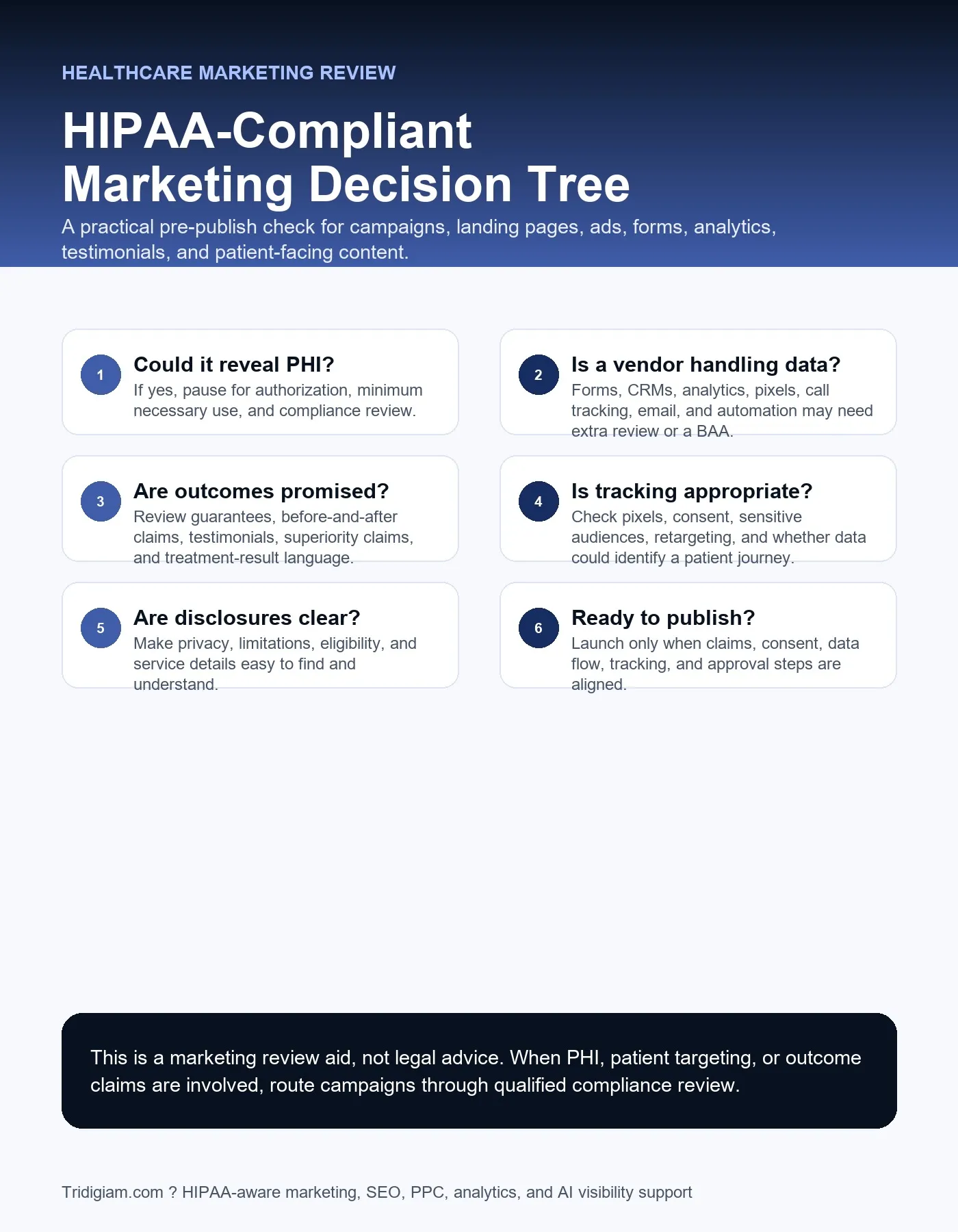
HIPAA-compliant analytics answer map
HIPAA-compliant analytics means measuring marketing performance without letting protected health information enter tools that are not configured or contracted to handle it. For healthcare sites, analytics risk often comes from condition-revealing URLs, form events, call recordings, click IDs, IP addresses, device identifiers, and retargeting audiences that connect a person to care-related behavior.
- Keep PHI out of standard analytics: do not send treatment pages, form details, patient identifiers, or appointment details into tools that lack the right safeguards.
- Use privacy-safe events: measure aggregate conversions, source, campaign, and revenue signals without exposing patient-level details.
- Control URLs and query strings: avoid condition-revealing slugs and strip sensitive parameters before data reaches analytics platforms.
- Handle call tracking carefully: recordings, caller IDs, and call notes can become PHI when connected to care-seeking behavior.
- Separate reporting layers: keep aggregate marketing reporting in PHI-free tools and patient-level reporting in BAA-covered systems.
Useful source anchors include HHS guidance on HIPAA marketing, HHS guidance on consumer health information, HHS HIPAA Privacy Rule resources, and the FTC’s privacy and security guidance. Tridigiam connects this analytics approach to HIPAA-compliant marketing, HIPAA marketing checklist, HIPAA-conscious paid ads, AI marketing ROI measurement, and AI Search Optimization.
Questions to answer before trusting healthcare analytics data
What makes analytics a HIPAA risk?
Analytics becomes risky when it receives data that can connect a person to a health condition, treatment interest, appointment, payment, or patient relationship. On healthcare websites, that can happen through page paths, form fields, call tracking, user IDs, click IDs, and retargeting audiences.
Can healthcare marketers still measure ROI?
Yes. Healthcare marketers can still measure traffic, conversions, cost per qualified lead, booked consultations, channel performance, and ROI. The measurement model has to avoid sending PHI to tools that are not covered or configured for that data.
What is the safest analytics model for healthcare marketing?
The safest model separates aggregate marketing performance from patient-level records. Use privacy-safe analytics for campaign reporting, and keep identifiable patient data inside BAA-covered systems with appropriate access controls.
Key Takeaways
- Analytics can leak PHI through condition-revealing URLs, IP addresses, and user identifiers.
- Standard Google Analytics generally isn’t covered by a BAA, so sending PHI to it is a risk.
- You can keep real measurement (traffic, conversions, ROI) while stripping PHI from what’s collected.
- Call tracking is PHI-sensitive too — recordings and call data need the same care.
How analytics leaks PHI
The exposure usually hides in plain sight:
- URLs. A page path like /conditions/depression-treatment captured in analytics, tied to a user, can reveal a health condition.
- IP addresses and identifiers. IPs, client IDs, and device identifiers can re-identify a visitor when combined with page data.
- Third-party transmission. Sending that data to an analytics platform that hasn’t signed a BAA is the disclosure itself.
- Call tracking. Recorded calls and tracked numbers tie a person to the reason they called — frequently PHI.
| Where PHI Leaks | How It Happens |
|---|---|
| Condition-revealing URLs | A page path like /conditions/depression-treatment, captured in analytics and tied to a user, can reveal a health condition |
| IP addresses and identifiers | IPs, client IDs, and device identifiers can re-identify a visitor when combined with page data |
| Third-party transmission | Sending that data to an analytics platform that hasn’t signed a BAA is the disclosure itself |
| Call tracking | Recorded calls and tracked numbers tie a person to the reason they called — frequently PHI |
Is Google Analytics HIPAA compliant?
By itself, no — Google generally doesn’t sign a BAA for standard Google Analytics, and its terms discourage sending PHI. That doesn’t mean you can’t use analytics; it means PHI must never reach it. Configured to exclude condition-revealing URLs and identifiers, analytics can run without handling PHI at all.
How to measure compliantly
- Strip PHI from URLs. Avoid putting conditions or treatments in page paths, and filter or redact what analytics captures.
- Control identifiers. Anonymize IPs and avoid passing personal identifiers into analytics.
- Use server-side controls. Govern exactly what data leaves your environment before it reaches any third party.
- Consider BAA-covered analytics. Where you need patient-level measurement, use a healthcare-built analytics tool that signs a BAA.
- Lock down call tracking. Use providers that sign BAAs, and redact PHI from recordings and transcripts.
What a HIPAA-conscious analytics stack actually looks like
In practice, compliant measurement isn’t one tool — it’s a data flow with a control point before anything reaches a third party.
- Server-side tagging. Routing tags through a server-side container instead of firing pixels directly from the browser gives you a place to inspect and strip PHI before it ever reaches Google, Meta, or any other platform.
- First-party data collection. Collecting events on your own domain, rather than relying entirely on third-party pixels, reduces how much raw browsing data leaves your environment in the first place.
- A consent layer that actually gates data. A cookie banner that doesn’t stop tags from firing isn’t consent management — it’s decoration. The tool has to block collection, not just disclose it.
- Separate systems for separate data. Keep aggregate marketing analytics — traffic, conversion counts, ROI — in PHI-free tools, and keep anything patient-identifiable in BAA-covered clinical or CRM systems that never talk to an ad platform.
- A defined owner. Someone on your team or agency side should be able to explain, in plain language, exactly what each tool collects and where it goes. If no one can answer that, that’s the gap.
None of this requires exotic tooling. It requires deciding, deliberately, what’s allowed to leave your environment — instead of accepting whatever a platform’s default tracking snippet does.
Frequently Asked Questions
Can I use Google Analytics on my medical website?
Yes, if you keep PHI out of it. Standard GA isn’t BAA-covered, so the requirement is to exclude condition-revealing URLs and personal identifiers so no protected information is ever sent.
Does anonymizing IP addresses make analytics HIPAA compliant?
It helps but isn’t sufficient on its own. You also have to address URLs, identifiers, and where the data goes. Compliance is about the whole data flow, not one setting.
Is call tracking a HIPAA risk?
It can be. Recorded calls and tracked numbers often tie a person to why they contacted you, which is PHI. Use BAA-backed call-tracking and redact protected information.
How do I track ad ROI without exposing PHI?
Use PHI-free conversion tracking and server-side controls so you can attribute results without sending who converted or for what condition. See our guide to running paid ads without leaking PHI.
What analytics tools will sign a BAA?
A small but growing set of healthcare-focused analytics and CRM platforms will sign a BAA for patient-level reporting. Standard consumer analytics tools generally will not — the practical answer is to keep PHI out of tools that won’t sign one and reserve BAA-covered systems for anything genuinely patient-identifiable.
What’s the difference between anonymizing and de-identifying data?
Anonymizing typically means stripping or masking specific identifiers like IP addresses from a data stream. De-identifying is a broader, more rigorous standard — removing enough identifying detail that the data can’t reasonably be re-linked to a person, even combined with other information. Anonymizing one field isn’t the same as fully de-identifying a dataset.
Get measurement you can trust — and defend
Tridigiam builds healthcare analytics that show what’s working while keeping PHI out of third-party tools. Learn more about our HIPAA-compliant marketing approach, or talk to our team.
Related Reading
- Running Paid Ads Without Leaking PHI
- HIPAA Marketing Compliance Checklist
- HIPAA Penalties for Marketing Violations
Related service: Learn more about Tridigiam’s marketing for regulated and healthcare businesses.
Key Terms in HIPAA-Compliant Analytics
- Protected Health Information (PHI)
- Any information relating to a person’s health condition, care, or payment for care that can be tied to their identity, including data captured through analytics or tracking.
- Business Associate Agreement (BAA)
- A signed contract required between a healthcare organization and any vendor, including an analytics or tracking tool, that may handle protected health information.
- Server-Side Tracking
- A tracking setup where data is routed through a server you control before reaching third-party platforms, giving you a checkpoint to strip PHI before it leaves your environment.
- First-Party Data
- Data collected directly by your own website or systems, as opposed to data gathered by third-party pixels and scripts embedded from outside vendors.
- Consent Management Platform (CMP)
- A tool that governs which tracking scripts run based on a visitor’s consent choices, ideally blocking data collection outright rather than just disclosing it.
- De-identification
- The process of removing or obscuring identifiers from health data so it can no longer reasonably be tied back to a specific individual.
Resources
Need marketing that actually moves the needle?
Tridigiam is a Las Vegas marketing and advertising agency built for regulated and growth-focused businesses. Call (702) 748-7005 or request a consultation.
Want more like this? Browse our free CRO, SEO, and AI search guides.

Written and reviewed by Chris Goodman, CEO of Tridigiam
Founder of a Las Vegas marketing agency building AI-visibility and compliance-aware marketing systems for regulated industries — healthcare, addiction treatment, and aesthetics. LinkedIn
Related book: For a practical system to build local visibility, reviews, citations, and trust signals, see The Local Trust Stack by Chris Goodman.
Quick answers
What buyers need to know before choosing a marketing system
What are HIPAA-compliant analytics?
HIPAA-compliant analytics are measurement systems configured to reduce exposure of protected health information, control tracking behavior, document consent choices, and keep reporting useful without careless data collection.
Why is healthcare analytics setup different?
Healthcare analytics requires extra care because forms, appointment flows, URLs, ad clicks, and remarketing tools can accidentally collect or transmit sensitive patient-related information.
What should healthcare marketers review first?
Review tracking scripts, forms, URL parameters, conversion events, consent tools, ad-platform tags, CRM fields, vendor agreements, and whether reports can answer business questions without unnecessary sensitive data.
Use the marketing automation and attribution checklist, read the 2026 agency tool stack benchmark report, or continue learning in Tridigiam Academy.

Explore knowledge from Chris Goodman, a marketing expert with extensive agency and small business experience, specializing in innovative advertising strategies. Chris has a Bachelor’s in Marketing from RMIT, years working in advertising agencies servicing clients, and years of experience working with small to medium sized businesses operating within regulated industries.