Quick answer: A HIPAA-compliant marketing stack is the set of tools (CRM, email and SMS, analytics, forms, scheduling) that can touch patient data without breaking HIPAA. The rule of thumb: any platform that may receive PHI needs a signed Business Associate Agreement and configuration that keeps protected data where it belongs. A BAA is the floor, not the finish line.
In healthcare marketing, your compliance posture is only as strong as the tools you run it on.
Every platform that touches patient data — your CRM, email and SMS, analytics, forms, scheduling, and call tracking — is a place PHI can either be protected or quietly exposed. Building a compliant stack isn’t about buying the most expensive software; it’s about choosing tools that will sign a Business Associate Agreement (BAA) and configuring them so PHI stays controlled.
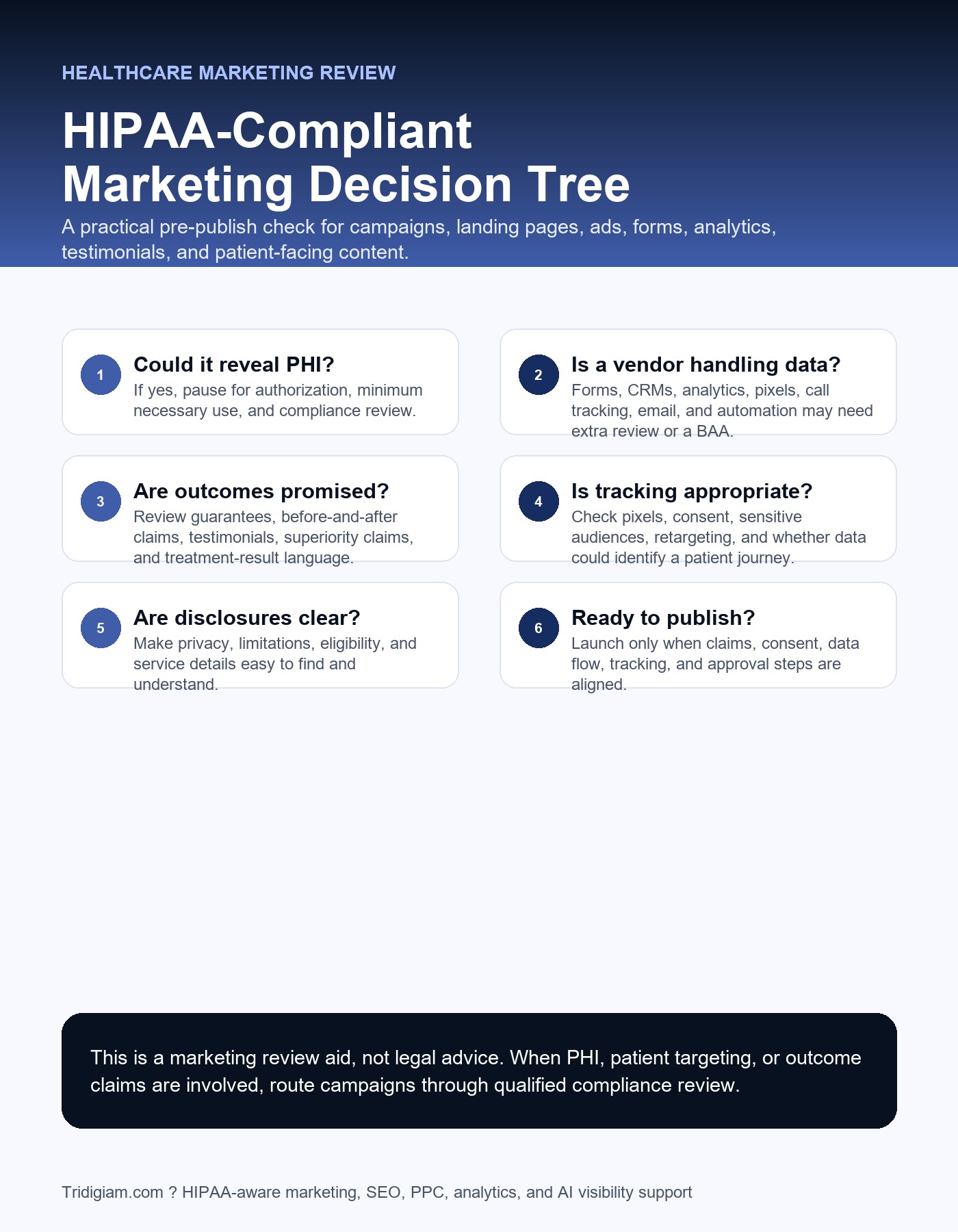
HIPAA-compliant marketing stack answer map
A HIPAA-compliant marketing stack is a connected set of tools, vendors, contracts, and configurations that lets a healthcare organization generate demand without leaking PHI into ordinary marketing systems. The key question is not “does this tool say healthcare?” but “will this tool receive, store, transmit, or infer PHI, and can it support the required safeguards and Business Associate Agreement for that exact use case?”
- Map PHI before buying tools: identify where patient data can enter forms, chat, scheduling, CRM, email/SMS, analytics, call tracking, ads, reporting, and support workflows.
- BAAs are necessary but not enough: a vendor agreement does not fix bad configuration, overcollection, weak access controls, or data being sent to unapproved integrations.
- Separate clinical and marketing systems: keep patient-level data in approved systems and send only safe aggregate or de-identified signals into marketing dashboards.
- Review every integration: CRM syncs, Zapier-style automations, conversion APIs, webhooks, data warehouses, and reporting connectors can move PHI outside the approved boundary.
- Design for auditability: document vendors, BAAs, data flows, user access, retention, deletion, incident response, consent, and configuration decisions.
Useful source anchors include HHS Security Rule summary, HHS guidance on risk analysis, HHS guidance on online tracking technologies, HHS guidance on HIPAA marketing, HHS guidance on consumer health information, and the FTC’s health privacy guidance. Tridigiam connects stack design to HIPAA-compliant marketing, the HIPAA marketing checklist, HIPAA-compliant website design, HIPAA-conscious analytics, HIPAA-conscious email and SMS, HIPAA-conscious paid ads, and AI Search Optimization.
Questions to answer before choosing healthcare marketing tools
What tools belong in a HIPAA-compliant marketing stack?
The usual stack includes website forms, hosting, analytics, CRM, email and SMS, scheduling, call tracking, reporting, consent management, review management, advertising tools, and internal documentation. Each tool should be classified by whether it touches PHI and whether it needs a BAA or other safeguards.
Is a BAA enough to make a marketing platform HIPAA-compliant?
No. A BAA is only the floor. The platform still needs the right configuration, limited data collection, access controls, retention rules, approved integrations, staff training, and a workflow that keeps PHI out of systems that should not receive it.
How should healthcare marketers evaluate a new vendor?
Ask what data the vendor receives, whether it will sign a BAA for the exact use case, where data is stored, which integrations are enabled, how access is controlled, how deletion works, how incidents are reported, and whether PHI can be excluded from marketing and ad-platform workflows.
Key Takeaways
- Any tool that handles PHI needs to sign a BAA — that’s the first filter for your stack.
- The risk spans CRM, email/SMS, analytics, forms, scheduling, and call tracking.
- A “will they sign a BAA?” question should come before features or price.
- Compliant tools still need compliant configuration — the BAA is necessary, not sufficient.
The categories that touch PHI
| Stack Category | What It Requires |
|---|---|
| CRM | Where patient records, contact data, and history live — needs a BAA and strict access controls. |
| Email and SMS | Patient messaging platforms that sign BAAs and handle PHI appropriately. |
| Analytics | Measurement configured to keep PHI out, ideally with a BAA where patient-level data is involved. |
| Forms and intake | Form tools that don’t move PHI through insecure channels. |
| Scheduling | Booking systems that handle appointment data under a BAA. |
| Call tracking | Providers that sign BAAs and let you redact PHI from recordings. |
Map your stack against the places patient data flows:
- CRM. Where patient records, contact data, and history live — needs a BAA and strict access controls.
- Email and SMS. Patient messaging platforms that sign BAAs and handle PHI appropriately.
- Analytics. Measurement configured to keep PHI out, ideally with a BAA where patient-level data is involved.
- Forms and intake. Form tools that don’t move PHI through insecure channels.
- Scheduling. Booking systems that handle appointment data under a BAA.
- Call tracking. Providers that sign BAAs and let you redact PHI from recordings.
The first question for any tool
Before you compare features or pricing, ask one thing: will this vendor sign a BAA for the way we’ll use it? If the answer is no and the tool will touch PHI, it’s disqualified — no matter how good the product is. Many mainstream marketing platforms either won’t sign or only offer BAAs on specific plans, so confirm it in writing for your exact use case.
A BAA isn’t the finish line
Signing a BAA makes a vendor accountable, but it doesn’t automatically configure the tool safely. A BAA-covered analytics platform still leaks if you feed it condition-revealing URLs; a compliant email tool still exposes PHI if your team puts too much in a subject line. Pair the right vendors with the right setup, and review both as your stack evolves.
Evaluating a vendor’s BAA before you sign
Getting a vendor to agree to sign a BAA is the easy part. Reading what it actually covers is where the real evaluation happens.
- Does it cover your actual use case? A generic BAA template may not address the specific way your team will use the tool. Confirm it covers the data flows you’ll actually run through it, not just a hypothetical one.
- What about their subcontractors? Many platforms rely on their own vendors — cloud hosting, support tools, sub-processors. If PHI flows to any of those, they need their own BAA with your vendor. Ask for the subcontractor list.
- Breach notification terms. Confirm how quickly the vendor is contractually required to notify you of a breach, and what information they’re required to share — this affects your own HIPAA breach-notification obligations downstream.
- Data retention and deletion. Know what happens to PHI if you cancel the tool. A vendor that keeps data indefinitely after offboarding is a liability you’re still responsible for.
- Who’s the Covered Entity and who’s the Business Associate? Get the roles straight in writing — it determines who’s responsible for what if something goes wrong.
A signed BAA that nobody has actually read is barely better than no BAA at all. Treat it as a working document, not a checkbox.
Frequently Asked Questions
What makes a marketing tool HIPAA compliant?
Two things together: the vendor will sign a BAA for your use case, and the tool is configured so PHI is controlled and protected. Neither alone is enough.
Which marketing tools usually won’t sign a BAA?
Many mainstream CRM, email, and analytics platforms either don’t sign BAAs or only offer them on specific enterprise plans. Always confirm in writing for the exact plan and use case rather than assuming.
Do I need a BAA with every tool in my stack?
With every tool that creates, receives, stores, or transmits PHI, yes. Tools that never touch patient data — a pure design app, for instance — generally don’t require one.
Can I make a non-compliant tool safe by signing a BAA?
A BAA is required, but it doesn’t fix an unsafe configuration. You still have to set the tool up so PHI is protected. The agreement and the configuration work together.
What should a BAA actually cover?
At minimum: the specific data flows involved, how the vendor safeguards PHI, breach notification timelines, subcontractor obligations, and what happens to data on termination. A one-page template that doesn’t address your actual use case isn’t sufficient.
What happens to patient data if I cancel a marketing tool?
That should be spelled out in the BAA before you ever sign up — ideally the vendor deletes or returns PHI within a defined period after offboarding. If a vendor’s contract is silent on this, ask before you commit, not after.
Build your stack on the right foundation
Tridigiam helps healthcare brands assemble and configure marketing stacks that keep PHI protected end to end. Learn more about our HIPAA-compliant marketing approach, or talk to our team.
Related Reading
- Do You Need a BAA With Your Agency?
- HIPAA-Compliant Email & SMS Marketing
- HIPAA-Compliant Analytics (GA4 & Pixels)
Related service: Learn more about Tridigiam’s marketing for regulated and healthcare businesses.
Key Terms in HIPAA-Compliant Marketing Stacks
- Business Associate Agreement (BAA)
- A contract required between a covered entity and any vendor that creates, receives, stores, or transmits protected health information on its behalf.
- Covered Entity
- A healthcare provider, health plan, or clearinghouse directly subject to HIPAA, as opposed to a vendor acting on its behalf.
- Business Associate
- A vendor or contractor that handles PHI on behalf of a covered entity, and is therefore required to sign a BAA and follow HIPAA safeguards.
- Subcontractor / Sub-Processor
- A downstream vendor that a business associate relies on, which may also need its own BAA if PHI passes through it.
- Breach Notification
- The contractual and legal requirement to inform affected parties within a defined window after a data breach involving PHI.
Resources
Need marketing that actually moves the needle?
Tridigiam is a Las Vegas marketing and advertising agency built for regulated and growth-focused businesses. Call (702) 748-7005 or request a consultation.
Want more like this? Browse our free CRO, SEO, and AI search guides.

Written and reviewed by Chris Goodman, CEO of Tridigiam
Founder of a Las Vegas marketing agency building AI-visibility and compliance-aware marketing systems for regulated industries — healthcare, addiction treatment, and aesthetics. LinkedIn

Explore knowledge from Chris Goodman, a marketing expert with extensive agency and small business experience, specializing in innovative advertising strategies. Chris has a Bachelor’s in Marketing from RMIT, years working in advertising agencies servicing clients, and years of experience working with small to medium sized businesses operating within regulated industries.