

Quick answer: Healthcare digital marketing helps medical practices attract and retain patients through SEO, paid search, content, and local search, while protecting patient data under HIPAA and keeping claims defensible under FTC rules. The winning approach pairs growth tactics with consent-based tracking, a signed BAA, and reputation management.
In today’s rapidly evolving digital landscape, healthcare digital marketing has become an essential component for medical practices aiming to connect with patients online. With the global digital health market the digital health market continuing to grow rapidly, healthcare providers must embrace digital marketing strategies to remain competitive and accessible. This comprehensive guide explores the intricacies of healthcare digital marketing, providing medical practices with the insights and tools necessary to effectively reach and engage their patients online. From healthcare SEO to leveraging social media, this guide covers all the key aspects of digital marketing for doctors.
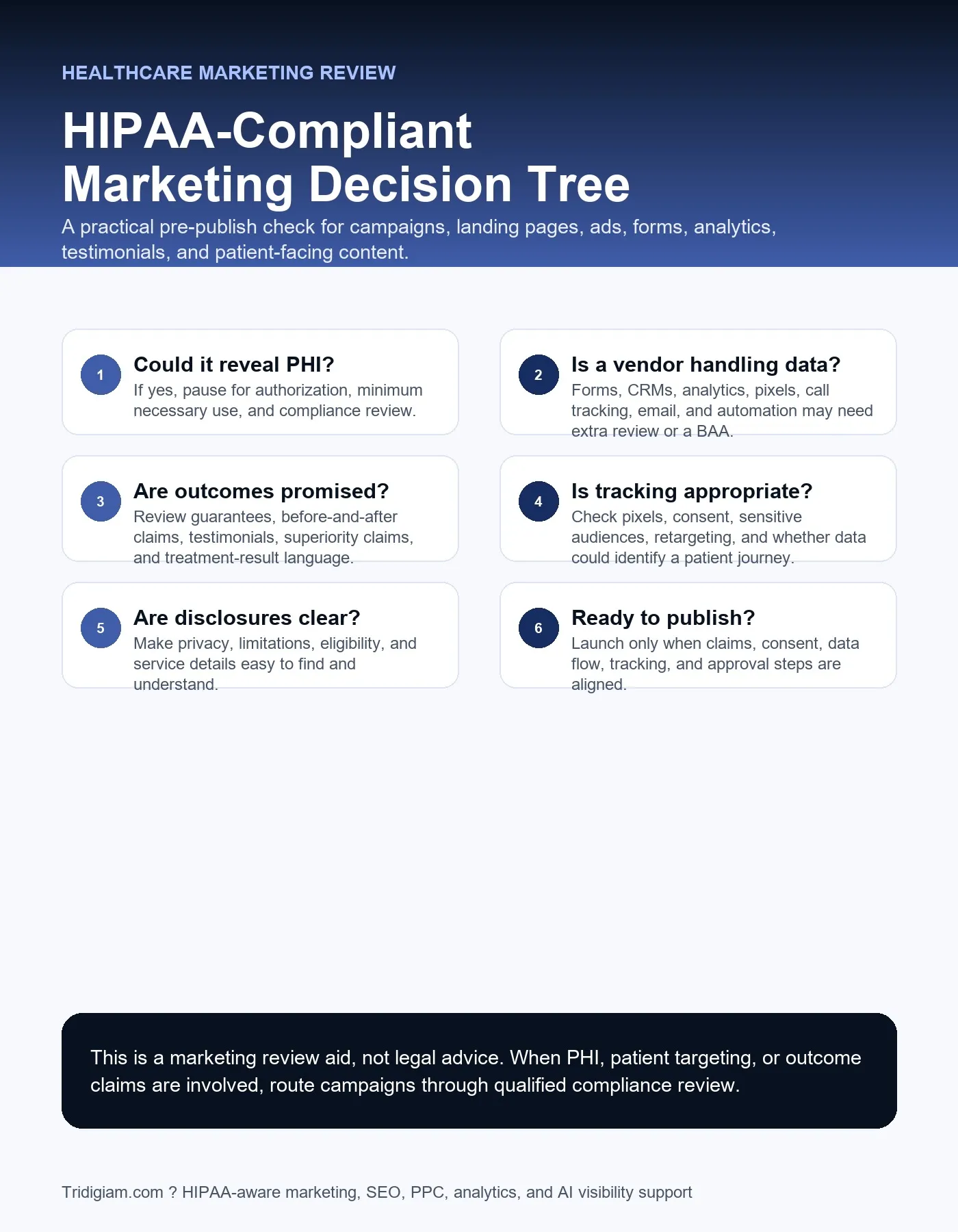
Healthcare digital marketing answer map
Healthcare digital marketing works best when growth channels are designed around patient trust, privacy, and defensible claims from the beginning. Medical practices can use SEO, local search, paid media, email/SMS, reviews, content, analytics, and AI search optimization, but each channel has to be configured so patient data is protected and health-related claims are truthful, specific, and supported.
- Build around patient intent: map content and landing pages to symptoms, services, locations, insurance questions, appointment needs, and trust-building proof.
- Protect PHI in every channel: review forms, tracking pixels, analytics, CRM syncs, call tracking, email/SMS, scheduling tools, and retargeting before launch.
- Keep claims defensible: avoid guaranteed outcomes, unsupported treatment promises, misleading testimonials, or before-and-after claims without review.
- Measure safely: use aggregate performance reporting, privacy-safe conversion events, and approved systems instead of patient-level ad-platform signals.
- Design for AI search visibility: publish answer-first pages, cite authoritative sources, connect related topics internally, and make expertise easy for search and AI systems to parse.
Useful source anchors include HHS guidance on HIPAA marketing, HHS guidance on online tracking technologies, HHS guidance on consumer health information, the FTC’s health privacy guidance, and FTC guidance on health-related advertising claims. Tridigiam connects this broader strategy to HIPAA-compliant marketing, HIPAA-compliant website design, HIPAA-conscious analytics, HIPAA-conscious paid ads, HIPAA-conscious reviews, healthcare content marketing, and AI Search Optimization.
Questions to answer before scaling healthcare digital marketing
What makes healthcare digital marketing different from ordinary digital marketing?
Healthcare marketing has to account for patient privacy, medical trust, regulated claims, sensitive search intent, and the possibility that ordinary marketing tools can expose PHI if they collect URLs, form activity, appointment behavior, or identifiers.
Which healthcare marketing channels usually create the most compliance risk?
The highest-risk areas are tracking pixels, analytics, retargeting, uploaded audiences, CRM syncs, call tracking, email/SMS, public review responses, and landing pages for sensitive services. These workflows should be reviewed before campaigns launch.
How can a medical practice improve SEO and AI search visibility safely?
Publish helpful answer-first content, cite trusted healthcare and regulatory sources, connect related service and compliance pages internally, use structured and readable page layouts, and measure performance with privacy-safe analytics instead of PHI-heavy tracking.
Key Takeaways
- Healthcare digital marketing is critical for medical practices to reach and engage with patients effectively.
- Strategies include healthcare SEO, content marketing, and leveraging social media platforms.
- Mobile optimization and online reputation management are crucial for patient engagement.
- Telehealth and video marketing are growing trends that practices should incorporate into their strategies.
- AI and personalized marketing are set to transform patient engagement by 2026.
The Importance of Healthcare Digital Marketing
The significance of healthcare digital marketing cannot be overstated, especially as the industry continues to grow at an unprecedented rate. With the global digital health market digital health spending continuing to climb, medical practices must adopt comprehensive digital marketing strategies to capture their share of the digital audience. As of 2025, a growing share of patients now book healthcare appointments online, underscoring the importance of an optimized online presence. Healthcare digital marketing not only enhances visibility and accessibility but also strengthens patient relationships through personalized communication and engagement.
SEO remains a cornerstone of healthcare digital marketing, driving the large majority of website traffic for most practices. Practices must focus on healthcare-specific keywords and local search phrases like “medical office near me” to capture potential patients actively searching for services. Furthermore, most patients now turn to online search engines as their first source of information before consulting a doctor. This highlights the need for optimized healthcare SEO and digital marketing strategies to ensure that medical practices appear prominently in search results.
Effective Healthcare SEO Strategies
Healthcare SEO is a critical component of medical practice marketing, ensuring that practices are discoverable online. To optimize their online presence, practices should focus on several key areas:
- Keyword Research: Identifying and utilizing relevant healthcare-specific keywords and phrases that potential patients might use to find services.
- Local SEO: Optimizing for local search terms to capture patients in the immediate vicinity. This includes creating and maintaining a Google My Business profile.
- Content Optimization: Producing high-quality, informative content that addresses patient concerns and queries. This not only builds authority but also improves search rankings.
- Technical SEO: Ensuring website speed, mobile-friendliness, and secure connections (HTTPS) to improve user experience and search engine ranking.
- Backlink Building: Establishing authority through backlinks from reputable healthcare websites, journals, and blogs.
These strategies not only improve search engine rankings but also enhance the overall patient experience by providing valuable information and resources.
| SEO Strategy | What It Involves |
|---|---|
| Keyword Research | Identify and use healthcare-specific keywords and phrases potential patients search for |
| Local SEO | Optimize for local search terms and maintain a Google My Business profile to capture nearby patients |
| Content Optimization | Produce high-quality, informative content that addresses patient concerns and builds authority |
| Technical SEO | Ensure website speed, mobile-friendliness, and secure (HTTPS) connections |
| Backlink Building | Earn backlinks from reputable healthcare websites, journals, and blogs to build authority |
Leveraging Content Marketing in Healthcare
Content marketing plays a pivotal role in healthcare digital marketing by providing valuable educational resources to patients. As of 2025, content marketing has become a standard tool for healthcare marketers, reflecting its importance in patient engagement. Effective content marketing strategies include:
- blogging: Regularly publishing informative blog posts that address common patient questions and concerns.
- Video Content: Utilizing video to explain complex medical procedures, showcase patient testimonials, and provide virtual tours of facilities.
- Infographics: Creating visually appealing infographics that simplify complex medical information.
- Webinars and Online Workshops: Hosting virtual events to engage with patients and provide valuable insights into specific health topics.
- Social Media Content: Sharing educational content on platforms like Facebook and Instagram to reach a broader audience.
By focusing on content marketing, medical practices can establish themselves as authoritative sources of health information, ultimately building trust and credibility with their patients.
Social Media Marketing for Medical Practices
In today’s digital age, social media marketing has become an indispensable tool for medical practices looking to enhance their online presence and connect with patients. One in five patients trusts health information shared on social media platforms, making it crucial for practices to maintain an active presence on these platforms.
Effective social media strategies for medical practices include:
- Patient Engagement: Engaging with patients through interactive posts, Q&A sessions, and health tips.
- Reputation Management: Monitoring and responding to patient reviews and feedback to maintain a positive online reputation.
- Awareness Campaigns: Running campaigns to raise awareness about specific health conditions or services offered by the practice.
- Community Building: Creating online communities where patients can share experiences and support each other.
By leveraging social media, medical practices can foster a sense of community, provide valuable health information, and enhance patient loyalty and satisfaction.
The Role of Telehealth and Video Marketing
The rise of telehealth has revolutionized the healthcare industry, offering patients convenient access to medical services from the comfort of their homes. By 2026, telehealth continues to make up a meaningful share of outpatient visits, highlighting the need for medical practices to incorporate telehealth into their digital marketing efforts.
Video marketing complements telehealth by providing a dynamic way to communicate with patients. As of 2026, video content now makes up the large majority of consumer internet traffic, signaling the need for practices to leverage video to:
- Demonstrate Services: Showcasing how telehealth appointments work and what patients can expect.
- Patient Testimonials: Sharing stories from satisfied patients to build trust and credibility.
- Educational Content: Providing step-by-step guides on managing health conditions or using medical devices.
By integrating telehealth and video marketing, medical practices can expand their reach, improve patient engagement, and enhance the overall patient experience.
AI and Personalized Marketing in Healthcare
Artificial Intelligence (AI) is set to transform healthcare digital marketing by enabling more personalized and targeted patient engagement. A growing number of healthcare organizations are adopting AI tools to improve marketing efforts. AI can enhance medical practice marketing in several ways:
- Personalized Communication: Tailoring messages and recommendations based on patient behavior and preferences.
- Predictive Analytics: Analyzing patient data to predict future health needs and offer timely interventions.
- Chatbots: Implementing AI-driven chatbots to handle patient queries and provide 24/7 support.
- Enhanced Targeting: Using AI to identify and target specific patient demographics with relevant marketing campaigns.
By leveraging AI, medical practices can deliver more personalized experiences, improve patient satisfaction, and increase the effectiveness of their digital marketing efforts.
Conclusion
In conclusion, healthcare digital marketing is an essential strategy for medical practices aiming to thrive in the digital age. By implementing effective SEO strategies, leveraging content marketing, engaging with patients on social media, and adopting new technologies like telehealth and AI, medical practices can enhance their online presence and improve patient engagement. As the healthcare landscape continues to evolve, practices must stay informed about the latest trends and best practices in digital marketing to remain competitive. For personalized digital marketing solutions tailored to your medical practice, consider partnering with Tridigiam, a leading digital marketing agency specializing in regulated industries. For medical-practice-specific strategy, see our Medical Practice Marketing guide. If your practice specializes in cosmetic or aesthetic procedures, our Medical Aesthetics Marketing guide breaks down vertical-specific strategies. And if you offer telehealth visits or GLP-1 weight-loss programs, our Telehealth & GLP-1 Weight-Loss Marketing guide covers the compliance and marketing considerations specific to that space.
FAQ Section
What is healthcare digital marketing?
Healthcare digital marketing refers to the use of digital channels and strategies to promote medical practices and engage with patients. This includes SEO, content marketing, social media, and more.
How can SEO benefit medical practices?
SEO helps medical practices improve their visibility in search engine results, making it easier for potential patients to find them. It involves optimizing websites with relevant keywords and improving site performance.
Why is content marketing important for healthcare?
Content marketing is crucial for healthcare because it provides valuable information to patients, establishes the practice as a trusted authority, and enhances patient engagement and loyalty.
How do telehealth and video marketing impact patient engagement?
Telehealth offers convenient access to medical services, while video marketing provides dynamic ways to communicate and educate patients, both of which improve patient satisfaction and engagement.
What role does AI play in healthcare marketing?
AI enables personalized marketing efforts, predictive analytics, and improved patient communication, making healthcare marketing more efficient and effective.
Related guides from Tridigiam
- Dental marketing strategies — SEO, PPC, and local search plays for solo and multi-location dental practices.
- Google Ads for doctors — A step-by-step Google Ads playbook for medical practices building patient acquisition.
- HIPAA-compliant website design — What to build into a healthcare website to keep it inside HIPAA technical safeguards.
- Meta Ads without a pixel — Run Facebook and Instagram ads in regulated verticals without the standard tracking pixel.
- Medical device marketing — FDA-aware digital strategies for device companies driving HCP demand and trial enrollment.
- Pharma marketing regulations — 2026 FDA, OPDP, and FTC rules explained for pharma brand teams running digital ads.
- Telehealth marketing — Channel and retention strategies for telehealth practices winning and keeping virtual patients.
- Mental health marketing for therapists — Ethical, compliance-aware marketing for therapy and counseling practices reaching new clients online.
Related service: Learn more about Tridigiam’s marketing for regulated and healthcare businesses.
Resources
Need marketing that actually moves the needle?
Tridigiam is a Las Vegas marketing and advertising agency built for regulated and growth-focused businesses. Call (702) 748-7005 or request a consultation.
Frequently asked questions
What channels make up a complete healthcare digital marketing strategy?
A typical mix includes local SEO, Google Business Profile management, paid search, content marketing, and reputation management, coordinated so patients encounter consistent messaging at each stage of their search.
How do you measure ROI in healthcare marketing without exposing patient data?
Aggregate metrics like appointment requests, call volume, and cost per new patient can be tracked without ever tying performance data back to an individual patient’s identity or condition.
What’s the biggest compliance mistake practices make in digital marketing?
The most common mistake is letting standard ad-platform tracking pixels fire on pages tied to specific conditions or appointment confirmations, which can transmit protected health information without anyone realizing it.
Want more like this? Browse our free CRO, SEO, and AI search guides.

Written and reviewed by Chris Goodman, CEO of Tridigiam
Founder of a Las Vegas marketing agency building AI-visibility and compliance-aware marketing systems for regulated industries — healthcare, addiction treatment, and aesthetics. LinkedIn
Related book: For a practical system to build local visibility, reviews, citations, and trust signals, see The Local Trust Stack by Chris Goodman.

Explore knowledge from Chris Goodman, a marketing expert with extensive agency and small business experience, specializing in innovative advertising strategies. Chris has a Bachelor’s in Marketing from RMIT, years working in advertising agencies servicing clients, and years of experience working with small to medium sized businesses operating within regulated industries.