
Quick answer: Email and SMS are the fastest, most personal healthcare channels and the easiest places to mishandle patient data. A reminder, refill, or follow-up can expose PHI if the platform is not covered by a BAA or the message reveals condition details. Use BAA-backed senders, consent-based lists, minimal PHI in message bodies, and easy opt-outs.
Email and text are the fastest, most personal channels in healthcare marketing — and the easiest places to mishandle patient data.
A single appointment reminder, refill notice, or post-visit follow-up can carry protected health information (PHI) through a platform that was never built to protect it. Done right, email and SMS are powerful and fully compliant. Done by default, they’re a breach waiting to be reported.
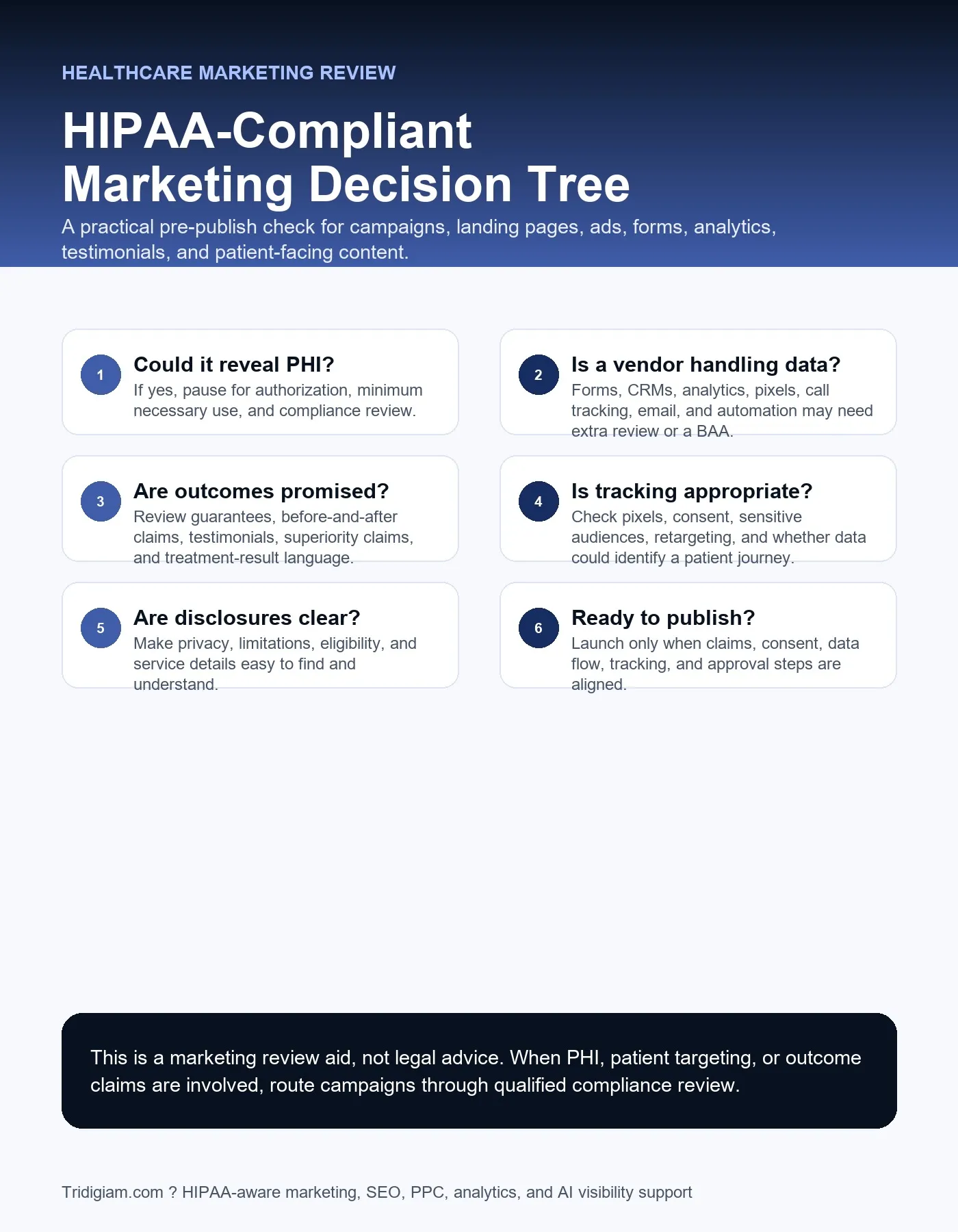
HIPAA-compliant email and SMS answer map
HIPAA-compliant email and SMS marketing is allowed, but it needs three controls working together: HIPAA-safe data handling, documented consent, and messaging that avoids unnecessary PHI. The safest programs use vendors willing to sign a BAA when PHI is involved, segment lists without exposing sensitive details, keep patient-level information out of non-healthcare tools, and make unsubscribe/opt-out paths obvious.
- Separate marketing from care operations: appointment, refill, and care-coordination messages may follow different rules than promotional campaigns, so classify the message before sending it.
- Use BAA-backed systems when PHI is involved: mainstream email and SMS tools are not automatically safe for patient-identifiable communications.
- Limit PHI in the message body: avoid diagnosis names, treatment details, test-result language, or specialty references unless the workflow is approved for that data.
- Document consent and opt-outs: email and SMS each have consent obligations; SMS programs also need TCPA-aware opt-in and revocation handling.
- Measure engagement safely: track aggregate campaign performance without syncing sensitive patient status, condition labels, or appointment details into ad or email platforms.
Useful source anchors include HHS guidance on HIPAA marketing, HHS guidance on consumer health information, the FTC’s CAN-SPAM compliance guide, and FCC/TCPA materials on revoking consent for robocalls and robotexts. Tridigiam connects this channel strategy to HIPAA-compliant marketing, HIPAA-compliant marketing stack design, the HIPAA marketing checklist, HIPAA-conscious paid ads, HIPAA-conscious reviews, and AI Search Optimization.
Questions to answer before sending healthcare email or SMS campaigns
Can healthcare practices send marketing emails and texts?
Yes. Healthcare practices can send marketing emails and texts, but the workflow has to protect PHI, use appropriate authorization or consent, and rely on vendors that can support healthcare data obligations when patient-identifiable information is involved.
What makes an email or text message PHI?
A message can involve PHI when it connects an identifiable person to a health condition, treatment, appointment, provider relationship, prescription, test result, or other healthcare context. Even a short reminder can become sensitive if the sender, subject line, URL, or message body reveals care details.
Do HIPAA and TCPA both matter for healthcare SMS?
Yes. HIPAA governs how protected health information is used and disclosed, while TCPA rules affect consent for certain texts and calls. A compliant SMS program needs both healthcare privacy controls and clear opt-in, opt-out, and consent documentation.
Key Takeaways
- If a message identifies a patient and anything about their care, it can contain PHI.
- Use platforms that will sign a Business Associate Agreement (BAA) for any patient messaging.
- Minimize PHI in messages, get proper consent, and store lists securely.
- SMS also has consent rules (TCPA) separate from HIPAA — you need both.
What counts as PHI in a message?
It’s more than a diagnosis. A message becomes PHI when it ties an identifiable person to their care — an appointment for a specific service, a treatment reminder, test-result language, or even the name of a specialty practice combined with the patient’s name. The safest assumption is that patient-directed messaging touches PHI unless you’ve deliberately stripped it out.
Why default email and SMS tools are risky
Most mainstream email and texting platforms don’t sign BAAs for standard plans, don’t encrypt the way healthcare requires, and store your lists on systems you don’t control. Send PHI through them and you’ve made an unauthorized disclosure — regardless of how routine the message felt.
How to run compliant email and SMS
- Use BAA-backed platforms. Only send patient messaging through tools that will sign a Business Associate Agreement and are built for healthcare.
- Minimize PHI. Keep messages generic where possible — “you have an upcoming appointment, log in for details” beats spelling out the service.
- Get proper consent. Collect documented opt-in for marketing messages, and for SMS meet TCPA consent rules on top of HIPAA.
- Segment without conditions. Don’t build lists labeled by diagnosis or treatment; segment by general, non-sensitive criteria.
- Secure storage and access. Encrypt lists, limit who can access them, and have a process to honor opt-outs promptly.
| Practice | What It Means |
|---|---|
| Use BAA-backed platforms | Only send patient messaging through tools that will sign a Business Associate Agreement and are built for healthcare |
| Minimize PHI | Keep messages generic where possible — “you have an upcoming appointment” beats spelling out the service |
| Get proper consent | Collect documented opt-in for marketing messages; SMS must also meet TCPA consent rules on top of HIPAA |
| Segment without conditions | Don’t build lists labeled by diagnosis or treatment; segment by general, non-sensitive criteria |
| Secure storage and access | Encrypt lists, limit who can access them, and have a process to honor opt-outs promptly |
Appointment reminders, done safely
Reminders are the most common healthcare message and a frequent leak point. Keep them minimal: confirm there’s an appointment and direct the patient to a secure portal for specifics, rather than naming the service or provider specialty in the message itself. Less detail in transit means less PHI exposed.
Frequently Asked Questions
Can medical practices send marketing emails and texts at all?
Yes. Healthcare email and SMS marketing is allowed with proper consent and the right tools. The requirement is keeping PHI protected and only using platforms that will sign a BAA when patient data is involved.
Does Mailchimp or a standard texting app work for patient messaging?
Generally not for PHI. Most standard platforms don’t sign BAAs for typical plans, so sending patient health information through them can be a violation. Use a healthcare-built, BAA-backed platform instead.
Do I need consent for healthcare SMS marketing?
Yes, and from two directions: HIPAA governs the PHI in the message, and TCPA governs consent to text. You need documented opt-in to satisfy both.
How do I send appointment reminders without exposing PHI?
Keep them generic — confirm an appointment exists and point the patient to a secure portal for details, rather than naming the specific service or specialty in the message.
Build compliant patient messaging
Tridigiam sets up healthcare email and SMS programs that grow patient engagement without the compliance risk. Learn more about our HIPAA-compliant marketing approach, or talk to our team.
Related Reading
- Building a HIPAA-Compliant Marketing Stack
- Do You Need a BAA With Your Agency?
- HIPAA Marketing Compliance Checklist
Related service: Learn more about Tridigiam’s marketing for regulated and healthcare businesses.
Resources
Need marketing that actually moves the needle?
Tridigiam is a Las Vegas marketing and advertising agency built for regulated and growth-focused businesses. Call (702) 748-7005 or request a consultation.
Want more like this? Browse our free CRO, SEO, and AI search guides.

Written and reviewed by Chris Goodman, CEO of Tridigiam
Founder of a Las Vegas marketing agency building AI-visibility and compliance-aware marketing systems for regulated industries — healthcare, addiction treatment, and aesthetics. LinkedIn
Quick answers
What buyers need to know before choosing a marketing system
What makes email and SMS compliance-sensitive in healthcare?
Email and SMS become compliance-sensitive when messages include patient identifiers, appointment details, treatment information, condition-specific targeting, or other protected health information.
What should healthcare teams automate carefully?
Automate reminders, confirmations, review requests, education, and follow-up with clear consent, minimal sensitive detail, proper access controls, and documented vendor expectations.
How should marketing and operations coordinate?
Marketing, operations, and compliance should agree on message templates, consent language, opt-out handling, data storage, vendor responsibilities, and escalation paths before campaigns go live.
Use the marketing automation and attribution checklist, read the 2026 agency tool stack benchmark report, or continue learning in Tridigiam Academy.

Explore knowledge from Chris Goodman, a marketing expert with extensive agency and small business experience, specializing in innovative advertising strategies. Chris has a Bachelor’s in Marketing from RMIT, years working in advertising agencies servicing clients, and years of experience working with small to medium sized businesses operating within regulated industries.