Quick answer: Collecting and displaying patient reviews is allowed under HIPAA, but a provider cannot confirm a reviewer is a patient or reveal treatment details without a signed authorization. Ask for reviews without disclosing PHI, never respond in a way that confirms care, and use a compliant review workflow. FTC rules also require reviews to be genuine and not incentivized in misleading ways.
Reviews are one of the most powerful trust signals in healthcare marketing — and one of the easiest ways to accidentally breach HIPAA.
The trap is subtle: simply replying “thanks for trusting us with your care” to a patient’s public review can confirm that the person was your patient. That confirmation is a disclosure of protected health information (PHI). You can absolutely build and manage a strong review presence — you just have to do it without ever acknowledging a treatment relationship you weren’t authorized to reveal.
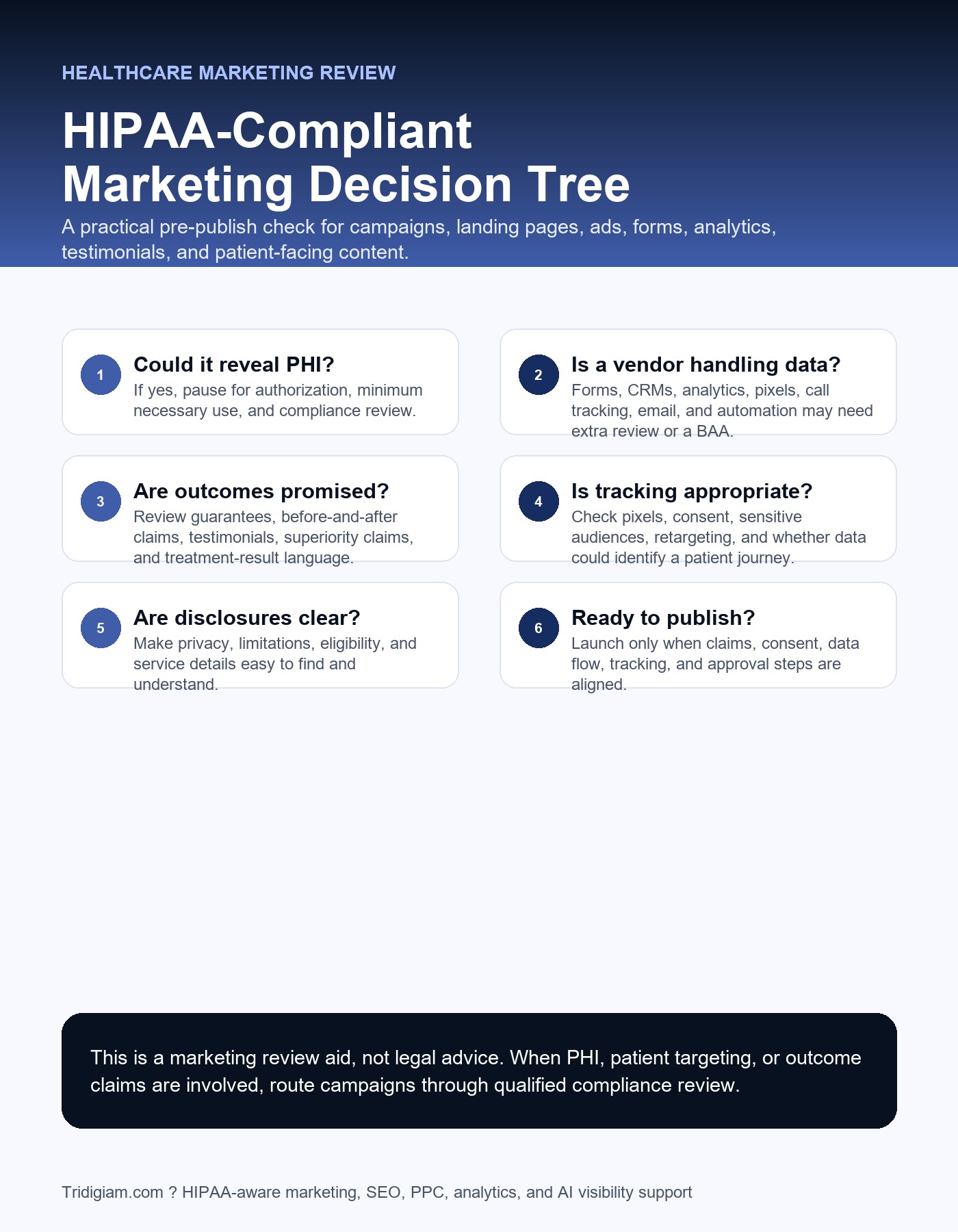
HIPAA-compliant reviews answer map
HIPAA-compliant patient review management is possible, but healthcare teams must avoid confirming a patient relationship or disclosing care details in public. The safest review workflow asks broadly for feedback, does not pressure patients to reveal health information, avoids incentives that could mislead consumers, and uses neutral responses that protect PHI even when the reviewer volunteers personal details.
- Do not confirm patient status: public replies should not say or imply that the reviewer received care, booked an appointment, had a diagnosis, or used a specific service.
- Use neutral response templates: thank the person for feedback, point them to a private contact path, and avoid discussing treatment, billing, outcomes, or visit details.
- Collect reviews without exposing PHI: avoid condition-specific review requests, segmented lists that reveal treatment interest, or links that pass patient identifiers.
- Be careful with testimonials: before-and-after stories, named case studies, or patient endorsements may require written authorization and should be reviewed before publication.
- Follow FTC review rules too: reviews must be genuine, not fake or suppressed deceptively, and any material incentive or relationship should be handled transparently.
Useful source anchors include HHS guidance on HIPAA marketing, HHS guidance on consumer health information, the FTC’s Consumer Reviews and Testimonials Rule Q&A, and the FTC’s Endorsement Guides FAQ. Tridigiam connects this reputation strategy to HIPAA-compliant marketing, the HIPAA marketing checklist, HIPAA-conscious email and SMS, HIPAA-conscious paid ads, regulated-industry review management, and AI Search Optimization.
Questions to answer before using patient reviews in healthcare marketing
Can a healthcare provider respond to patient reviews?
Yes, but the response should be neutral and should not confirm that the reviewer is a patient. A safe reply thanks the person for feedback, avoids treatment details, and directs any private issue to an appropriate offline contact path.
Can patient testimonials be used in healthcare advertising?
They can be used only with the right review and authorization process. If a testimonial reveals a person’s care, condition, provider relationship, treatment, results, or other PHI, the organization should not publish it casually as ordinary marketing content.
What should healthcare teams avoid when asking for reviews?
Avoid condition-specific prompts, incentives that are not handled transparently, requests that pressure patients to share medical details, and review links or automations that expose patient identifiers or treatment context to platforms that are not approved for PHI.
Key Takeaways
- Confirming someone is a patient — even in a friendly review reply — can be a HIPAA disclosure.
- Respond to reviews generically, without referencing the person’s care or visit.
- You can ask for reviews, but do it without exposing who is a patient.
- Using a testimonial requires the patient’s documented authorization.
Why responding to a patient review is risky
HIPAA protects the fact that someone is your patient, not just their diagnosis. When you reply to a review in a way that acknowledges their visit, treatment, or relationship with your practice, you’ve confirmed protected information in public — even if the patient disclosed it first. The patient can share their own story; you can’t confirm or add to it without authorization.
How to respond to reviews compliantly
Keep every public reply generic and PHI-free. A safe response thanks the reviewer in general terms, states your commitment to care, and moves specifics offline — without confirming the person is a patient. For example: “Thank you for the kind words. We take all feedback seriously and welcome you to contact our office directly to discuss any concerns.” That builds goodwill without disclosing anything.
How to ask for reviews without violating HIPAA
You can invite reviews — just don’t broadcast who’s a patient. Make requests private and individual rather than posting “leave us a review” in a way that ties named people to your practice, avoid condition-based targeting, and never auto-publish anything that identifies a patient. Keep the ask simple and the patient in control of what they share.
Testimonials require authorization
A review the patient posts themselves is their speech. A testimonial you publish — quoting a patient, using their name or photo in your marketing — is your use of PHI, and it requires a proper, documented HIPAA authorization. Without that signed release, the testimonial can’t go in your marketing.
Setting up a review workflow that stays compliant
| Workflow Step | What It Means |
|---|---|
| Train whoever responds | Front-desk and marketing staff get a short, specific list of what never goes in a public reply — names paired with visit details, confirmation of care, condition or treatment references. |
| Use pre-approved response templates | A small library of generic, warm, PHI-free replies removes the guesswork in the moment and keeps tone consistent. |
| Route anything sensitive to a human review step | A negative review, one naming a specific complaint, or one that already discloses details goes through a second set of eyes before anyone replies. |
| Pick review-management tools carefully | Confirm what a review-management tool collects and whether it ever touches PHI before you adopt it. |
| Know your state medical board’s rules too | Many boards have their own advertising and testimonial rules for licensed providers, on top of HIPAA and FTC requirements. |
Most review mistakes aren’t malicious — they’re a well-meaning staff member replying the way they would on a normal business page. A workflow closes that gap.
- Train whoever responds. Front-desk and marketing staff need a short, specific list of what never goes in a public reply: names paired with visit details, confirmation of care, condition or treatment references.
- Use pre-approved response templates. A small library of generic, warm, PHI-free replies removes the guesswork in the moment and keeps tone consistent.
- Route anything sensitive to a human review step. A negative review, one that names a specific complaint, or one that already discloses details should go through a second set of eyes before anyone replies.
- Pick review-management tools carefully. Some platforms store and display reviewer contact details or scrape additional data. Confirm what a review-management tool collects and whether it ever touches PHI before you adopt it.
- Know your state medical board’s rules too. Many state boards have their own advertising and testimonial rules for licensed providers, on top of HIPAA and FTC requirements — check them before building a review-solicitation program.
The pattern across all of this: HIPAA doesn’t stop you from managing reputation actively, it just requires the process to route around confirming who your patients are.
Frequently Asked Questions
Can I respond to patient reviews online?
Yes, but only generically. Don’t confirm the person is a patient or reference their care. A neutral thank-you that moves specifics to a private channel keeps you compliant.
Is it a HIPAA violation to thank a patient by name in a review reply?
It can be. Acknowledging the person and their relationship to your practice confirms protected information publicly. Keep replies generic and free of anything that identifies them as a patient.
Can I ask patients to leave reviews?
Yes. You can invite reviews privately and individually. The key is not exposing who is a patient and not tying named people to specific conditions or treatments.
Do I need permission to use a patient testimonial in my marketing?
Yes. Publishing a testimonial uses PHI and requires the patient’s documented authorization. A patient posting their own review is different from you republishing it as marketing.
What if a review discloses PHI that the patient shared themselves?
A patient can share their own information — that’s their choice to make. The practice still can’t confirm, expand on, correct, or add clinical detail to what they posted without crossing into a disclosure of its own. The safe move is the same generic, non-confirming reply, regardless of what the patient revealed.
Grow your reviews the safe way
Tridigiam helps healthcare practices build reputation and manage reviews without crossing HIPAA lines. Learn more about our HIPAA-compliant marketing approach, or talk to our team.
Related Reading
- HIPAA Marketing Compliance Checklist
- HIPAA Penalties for Marketing Violations
- Behavioral Health Marketing Compliance
Related service: Learn more about Tridigiam’s marketing for regulated and healthcare businesses.
Key Terms in HIPAA-Compliant Reviews
- Protected Health Information (PHI)
- Information that ties a person’s identity to their health condition, care, or treatment relationship, including the simple fact that someone is a patient.
- HIPAA Disclosure
- Any act that reveals protected health information to someone outside the treatment relationship, including a public reply that confirms a person received care.
- Patient Authorization
- A signed, documented release permitting a provider to use a specific patient’s information, image, or story for a defined purpose such as marketing.
- Testimonial vs. Review
- A review is a patient’s own public statement, which they control. A testimonial is the practice’s use of that statement in its own marketing, which requires separate authorization.
- FTC Endorsement Guides
- Federal Trade Commission rules requiring that testimonials and endorsements be genuine, reflect typical results or disclose when they don’t, and disclose any material compensation.
Resources
Need marketing that actually moves the needle?
Tridigiam is a Las Vegas marketing and advertising agency built for regulated and growth-focused businesses. Call (702) 748-7005 or request a consultation.
Want more like this? Browse our free CRO, SEO, and AI search guides.

Written and reviewed by Chris Goodman, CEO of Tridigiam
Founder of a Las Vegas marketing agency building AI-visibility and compliance-aware marketing systems for regulated industries — healthcare, addiction treatment, and aesthetics. LinkedIn
Related book: For a simple system to earn more reviews, referrals, and trust signals, see The Review Engine by Chris Goodman.

Explore knowledge from Chris Goodman, a marketing expert with extensive agency and small business experience, specializing in innovative advertising strategies. Chris has a Bachelor’s in Marketing from RMIT, years working in advertising agencies servicing clients, and years of experience working with small to medium sized businesses operating within regulated industries.