

Quick answer: A review management strategy for regulated industries means collecting patient and client feedback while staying inside HIPAA, FTC, and platform advertising rules. That means trained staff, approved response templates, and a process for flagging anything that reads like a testimonial claim before it goes live. Done well, reviews become a safe, compliant growth channel instead of a liability.
Online reviews shape client trust in healthcare, finance, and legal sectors where reputation directly impacts business viability. Managing this feedback requires strict adherence to compliance standards that differ from standard marketing practices.
Key Takeaways
- Responding promptly to reviews builds trust while strict compliance prevents regulatory violations in healthcare and finance.
- Generic replies damage credibility. Use trained staff to ensure every response aligns with brand voice and legal boundaries.
- Response playbooks standardize communication across teams, reducing the risk of accidental non-compliance or inconsistent messaging.
- Regulated industries must balance reputation growth with strict adherence to privacy laws and advertising restrictions.
- Training employees on review protocols ensures consistent, compliant interactions that protect both patient data and brand integrity.
Why Standard Review Tactics Fail in Regulated Industries
Generic review responses trigger compliance audits in healthcare and finance sectors. A template that works for a retail store often violates patient privacy laws or financial advertising standards. Standard automation tools lack the context to detect when a reply inadvertently confirms a diagnosis or discusses account specifics. This creates immediate legal exposure for firms that rely on broad, unmonitored engagement strategies.
Most generalist reputation platforms operate on volume and speed rather than precision. They push businesses to respond quickly to every mention without vetting content against specific regulatory frameworks. Digital Applied notes that best practices require avoiding generic replies, yet standard tactics encourage exactly that behavior. The assumption that a polite, standardized acknowledgment satisfies all customer interactions fails when those interactions involve sensitive data or protected classes.
Regulated entities face unique constraints that mainstream SEO advice ignores. Financial advisors cannot promise returns in reviews, and legal professionals must adhere to strict state bar guidelines regarding client testimonials. Rio SEO highlights the need for specialized approaches in these sectors because generic strategies do not account for these boundaries. Using a one-size-fits-all playbook often leads to accidental non-compliance.
- Standard templates rarely include mandatory disclaimers required by industry regulators.
- Automated sentiment analysis tools miss nuance in professional service reviews.
- Bulk response features increase the risk of posting prohibited content at scale.
Marketing managers must recognize that efficiency cannot override accuracy. The pressure to maintain high response rates often leads teams to sacrifice compliance checks. This disconnect between standard marketing goals and regulatory requirements creates a fragile reputation strategy. Firms need systems designed for restriction, not just expansion.
Navigating Compliance and Legal Boundaries in Customer Responses
Regulatory bodies scrutinize public customer interactions for disclosures that violate patient privacy or financial advertising standards. A single misplaced detail in a reply can trigger an investigation into broader data handling practices.
Marketing teams must treat every public response as a potential legal document. This mindset shifts the focus from quick engagement to careful verification of facts before posting. The Federal Trade Commission enforces strict rules against deceptive claims, which applies directly to how businesses address negative feedback about services or outcomes FTC. Responding to a complaint about a denied claim or a treatment outcome requires acknowledging the frustration without admitting liability or discussing protected health information. Generic apologies often fail because they do not address the specific regulatory constraint preventing a detailed public explanation. Instead, staff should pivot the conversation to private channels where secure communication tools allow for a deeper, compliant discussion.
Avoid listing specific reasons for a negative experience in the public thread. Doing so risks violating confidentiality agreements or exposing internal policy details that competitors could exploit. The goal is to demonstrate responsiveness while maintaining strict boundaries around what information belongs in a public forum.
- Verify all statements against current compliance guidelines before publishing.
- Use approved templates that acknowledge concerns without confirming private data.
- Direct complex disputes to secure, encrypted messaging platforms for resolution.
Agencies managing these accounts need clear escalation paths for high-risk reviews. When a comment touches on sensitive legal or medical issues, the response must come from a designated compliance officer rather than a general community manager. This structure ensures that brand voice remains consistent while legal risks stay contained.
Building a Secure Framework to Generate Authentic Reviews
Secure review generation systems must separate customer contact data from public-facing comments to prevent accidental disclosures of protected health information or financial details.
Standard solicitation tools often store full email addresses and phone numbers in accessible databases, creating a liability if those records are breached or improperly shared. Regulated entities need architecture that captures the review text while immediately discarding or encrypting personal identifiers. This separation ensures compliance with privacy laws without sacrificing the volume of feedback needed for reputation management.
Implementation requires selecting platforms designed for strict data governance rather than general-purpose reputation tools. Agencies building these frameworks should prioritize vendors that offer HIPAA-compliant hosting options and granular access controls. The system must allow staff to trigger review requests from secure internal portals without exposing client lists to external APIs unnecessarily. Using encrypted links for feedback forms further reduces the risk of intercepting sensitive data during transmission.
A robust framework also automates the removal of personally identifiable information before any response is published. This technical safeguard prevents human error when marketing teams draft replies under time pressure. The process ensures that every public interaction remains within legal boundaries while maintaining a professional brand voice. Focusing on these structural protections allows organizations to scale their review acquisition efforts without increasing regulatory exposure.
Investing in secure infrastructure early prevents costly remediation later. Digital Applied notes that proactive management strategies reduce long-term reputation risks. Building this security into the generation phase creates a sustainable model for ongoing feedback collection.
Crafting Compliant Response Playbooks for Every Scenario
Response playbooks define the exact language staff must use when addressing public feedback. This prevents improvisation that could violate federal advertising rules or breach patient confidentiality. A structured guide ensures every reply meets legal standards while maintaining brand consistency.
Marketing teams in regulated sectors face strict limits on what they can say publicly. Financial advisors cannot promise returns. Healthcare providers cannot discuss individual treatment outcomes. Legal firms must avoid implying case results are typical. A response playbook addresses these constraints by providing pre-approved templates for common scenarios.
- Acknowledge positive reviews with gratitude and a brief, compliant value statement.
- Address negative feedback by thanking the reviewer and directing them to a private channel for resolution.
- Correct factual errors without arguing or admitting liability in public forums.
Staff members often lack the legal training needed to judge which details are safe to share. A clear playbook removes that guesswork. It provides specific phrasing for each situation, from minor service complaints to serious allegations of misconduct.
Consistency builds trust with both customers and regulators. When every response follows the same approved structure, the brand appears professional and reliable. This approach also simplifies auditing processes. Compliance officers can review a sample of responses knowing they all adhere to the same guidelines. The focus shifts from policing individual words to monitoring overall adherence to the established framework.
Playbooks should include escalation paths for high-risk comments. Some reviews require legal review before any public response. Others might indicate a systemic issue that needs internal investigation. Defining these triggers in advance prevents delays and ensures proper handling of sensitive situations. This proactive structure protects the organization from reputational damage and potential regulatory penalties.
Training Staff on Brand Voice and Regulatory Restrictions
Staff members need written approval workflows before publishing any response to a negative review involving medical outcomes or financial disputes. Without this check, well-intentioned employees often overshare details that violate patient privacy laws or create unintended legal liability for the firm. Training programs must move beyond generic customer service scripts and address specific regulatory constraints unique to healthcare, finance, and legal sectors.
Employees rarely understand how a casual phrase like “we fixed their problem” can constitute an unapproved health claim or a misleading financial promise. They see a complaint that needs fixing, not a potential FTC violation waiting to happen. This gap in knowledge creates significant exposure for organizations that rely on individual judgment rather than structured guidance.
Effective training requires role-playing scenarios where staff practice de-escalating angry customers while strictly adhering to brand voice guidelines. You must teach them to acknowledge frustration without admitting fault or discussing private account details. The goal is consistency across every touchpoint, ensuring that a receptionist and a senior attorney sound like one unified organization.
- Define clear boundaries around what information can be discussed publicly versus what requires private follow-up.
- Provide examples of compliant language that maintains empathy without crossing into prohibited territory.
- Establish an immediate escalation path for reviews mentioning sensitive topics like malpractice or fraud allegations.
Regular audits of published responses reveal where staff deviate from approved messaging. These audits highlight training gaps before they become public relations crises. Organizations that invest in ongoing education reduce the risk of accidental non-compliance while maintaining a professional reputation. See how Digital Applied structures their playbook for consistent execution.
Leveraging Technology for Automated Monitoring and Alerts
Real-time alerts reduce the window for reputation damage by notifying teams of new feedback within minutes rather than hours. Manual monitoring fails because staff cannot check every platform constantly without diverting focus from core duties. Automated systems bridge that gap by scanning Google Business Profile, Yelp, and industry-specific directories around the clock. This immediate visibility allows marketing managers to trigger pre-approved response protocols before negative sentiment spreads or compliance issues escalate.
Technology streamlines the workflow by aggregating disparate review sources into a single dashboard. Tools like Birdeye provide centralized visibility across multiple channels, eliminating the need to log into separate accounts for each platform. This consolidation saves time and reduces the risk of missing critical feedback that requires urgent attention. Teams can prioritize responses based on severity or compliance flags rather than reacting randomly to whatever appears first in their inbox.
Alert configurations must align with regulatory boundaries to prevent unauthorized disclosures. In healthcare, automated notifications should never include patient identifiers or protected health information in the alert message itself. Finance and legal sectors face similar restrictions regarding client confidentiality and attorney-client privilege. The technology acts as a filter, ensuring that only authorized personnel receive sensitive alerts while general staff handle standard positive reviews or minor complaints. This separation of duties maintains audit trails and supports compliance documentation requirements.
Integration with existing CRM systems further enhances efficiency by linking review data to customer records. When a negative review arrives, the automated system can pull relevant interaction history without exposing private details in the public response queue. This context helps teams craft accurate replies that address the specific issue while adhering to brand voice guidelines. Properly configured monitoring tools turn reputation management from a reactive scramble into a structured, compliant process.
Measuring Success: KPIs for Reputation and Compliance Health
Track response time and review velocity to establish a baseline for reputation health. Marketing teams in regulated sectors must monitor how quickly they address feedback while ensuring every interaction meets strict compliance standards. This dual focus prevents minor issues from escalating into regulatory violations.
Key performance indicators extend beyond simple star ratings. You need to measure the percentage of reviews addressed within your internal service level agreement, such as 24 or 48 hours. Monitor the ratio of positive to negative feedback over time to identify trends in customer sentiment. Track the volume of review requests sent versus actual responses received to optimize your outreach strategy. These metrics reveal whether your current tactics drive authentic engagement or simply generate noise.
Compliance health requires specific tracking mechanisms. Log every instance where a response was flagged for potential privacy violations or unauthorized claims. Measure the frequency of staff training sessions on regulatory updates and brand voice guidelines. A low error rate in public communications indicates a robust internal process. High rates suggest a need for stricter approval workflows or additional staff education.
- Average time to respond to new reviews
- Percentage of reviews answered within SLA windows
- Volume of compliance flags raised by monitoring tools
- Ratio of review solicitations to completed reviews
- Trend analysis of sentiment shifts month over month
Data-driven adjustments keep your strategy aligned with both business goals and legal requirements. Regular reporting helps stakeholders understand the direct impact of reputation management efforts on brand trust and risk mitigation. This approach ensures accountability across all departments involved in customer communication.
| KPI | What It Tracks |
|---|---|
| Average time to respond to new reviews | Baseline response speed for reputation health |
| Percentage of reviews answered within SLA windows | Compliance with internal service-level standards (e.g., 24–48 hours) |
| Volume of compliance flags raised by monitoring tools | Frequency of privacy violations or unauthorized claims caught before publishing |
| Ratio of review solicitations to completed reviews | Effectiveness of outreach requests in generating authentic reviews |
| Trend analysis of sentiment shifts month over month | Longer-term trajectory of reputation and customer sentiment |
Conclusion
Review management demands strict adherence to compliance standards while building genuine trust with prospective clients. Regulated industries face unique challenges in collecting feedback without violating privacy laws or industry-specific advertising rules. A disciplined approach ensures your reputation grows within legal boundaries. Tridigiam.com helps healthcare, finance, and legal firms implement compliant review strategies that protect your brand integrity. We focus on sustainable growth methods that respect regulatory requirements while improving online visibility for your practice.
Frequently Asked Questions
How should regulated businesses handle negative online reviews?
Respond promptly with a professional tone that adheres to industry compliance rules. Avoid generic replies or admitting liability in public comments. Move detailed discussions to private channels while demonstrating a commitment to resolving the customer's concern through established support processes.
What legal boundaries exist for responding to patient or client reviews?
Staff must respect privacy laws like HIPAA when handling healthcare feedback. Responses cannot disclose protected health information or confirm a person is a patient. Training ensures teams use approved language that protects client confidentiality while maintaining brand voice and regulatory compliance standards.
Why do response playbooks matter for regulated industries?
Playbooks ensure consistent messaging across all staff members handling public feedback. They define acceptable language, escalation paths, and compliance checkpoints. This structure reduces the risk of accidental policy violations while maintaining a unified brand presence in every customer interaction.
How often should teams monitor review platforms?
Monitoring should occur daily to catch new feedback quickly. Prompt responses signal active engagement to potential clients and search algorithms. Regular checks also help identify compliance issues early before they escalate into larger reputational or legal concerns for the organization.
Can automated tools manage reviews for regulated sectors?
Automated tools can aggregate feedback and alert staff to new posts. However, human review remains necessary to ensure responses meet specific regulatory requirements. Technology supports efficiency, but trained personnel must verify that every public reply aligns with legal boundaries and brand standards.
Want to check where you stand? Run our free Review Response Compliance Checker — it’s an 8-question self-audit covering the exact privacy and disclosure risks in public review replies.

Written and reviewed by Chris Goodman, CEO of Tridigiam
Founder of a Las Vegas marketing agency building AI-visibility and compliance-aware marketing systems for regulated industries — healthcare, addiction treatment, and aesthetics. LinkedIn
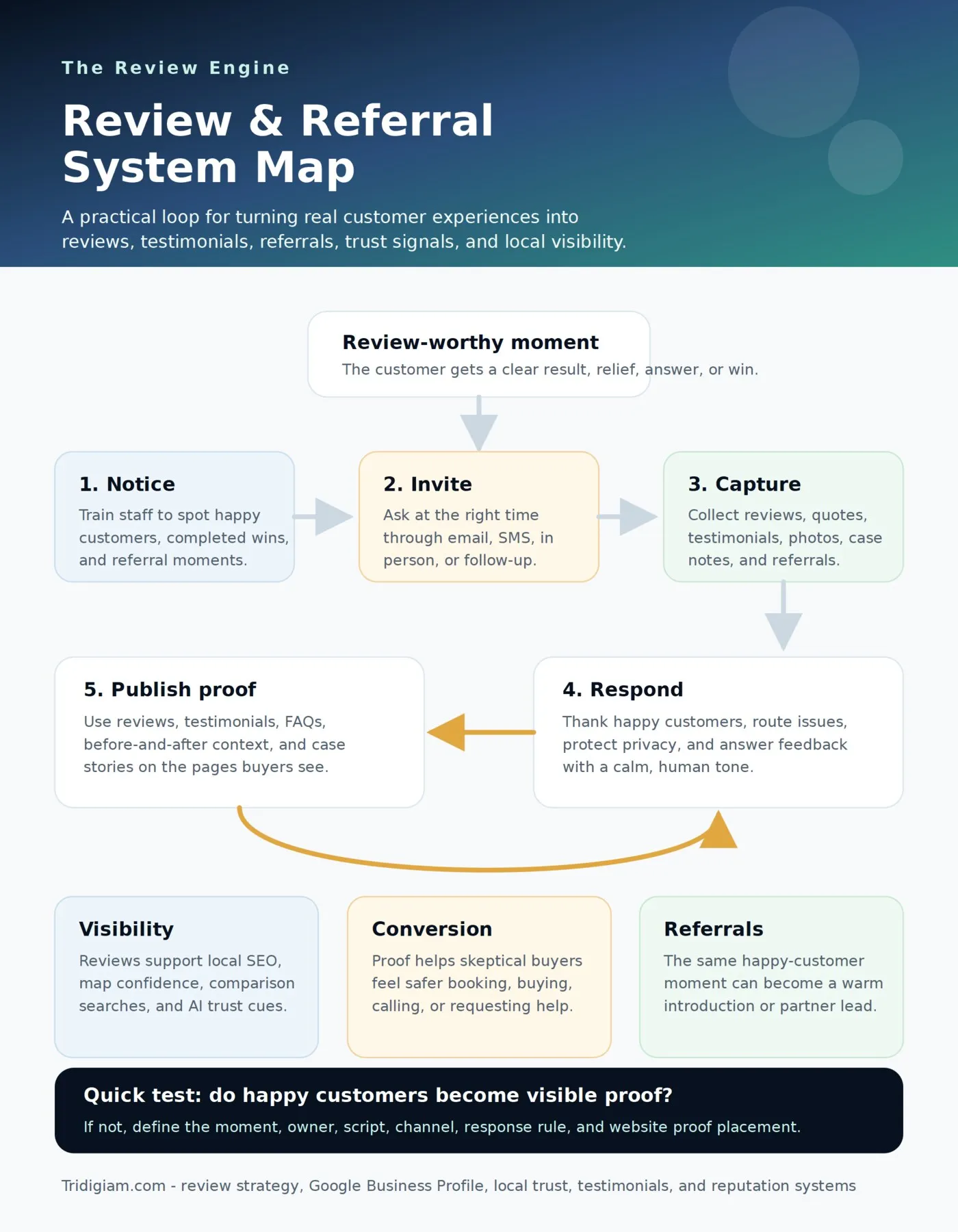
Related book: For a simple system to earn more reviews, referrals, and trust signals, see The Review Engine by Chris Goodman.
Resources
Need marketing that actually moves the needle?
Tridigiam is a Las Vegas marketing and advertising agency built for regulated and growth-focused businesses. Call (702) 748-7005 or request a consultation.

Explore knowledge from Chris Goodman, a marketing expert with extensive agency and small business experience, specializing in innovative advertising strategies. Chris has a Bachelor’s in Marketing from RMIT, years working in advertising agencies servicing clients, and years of experience working with small to medium sized businesses operating within regulated industries.