
Quick answer: Marketing in a regulated industry means every channel, from paid social to email, has to clear two bars at once: what the law requires and what the platform allows. The businesses that handle this well build compliance into the workflow from the first draft, so campaigns launch faster instead of bouncing between legal and marketing for weeks.
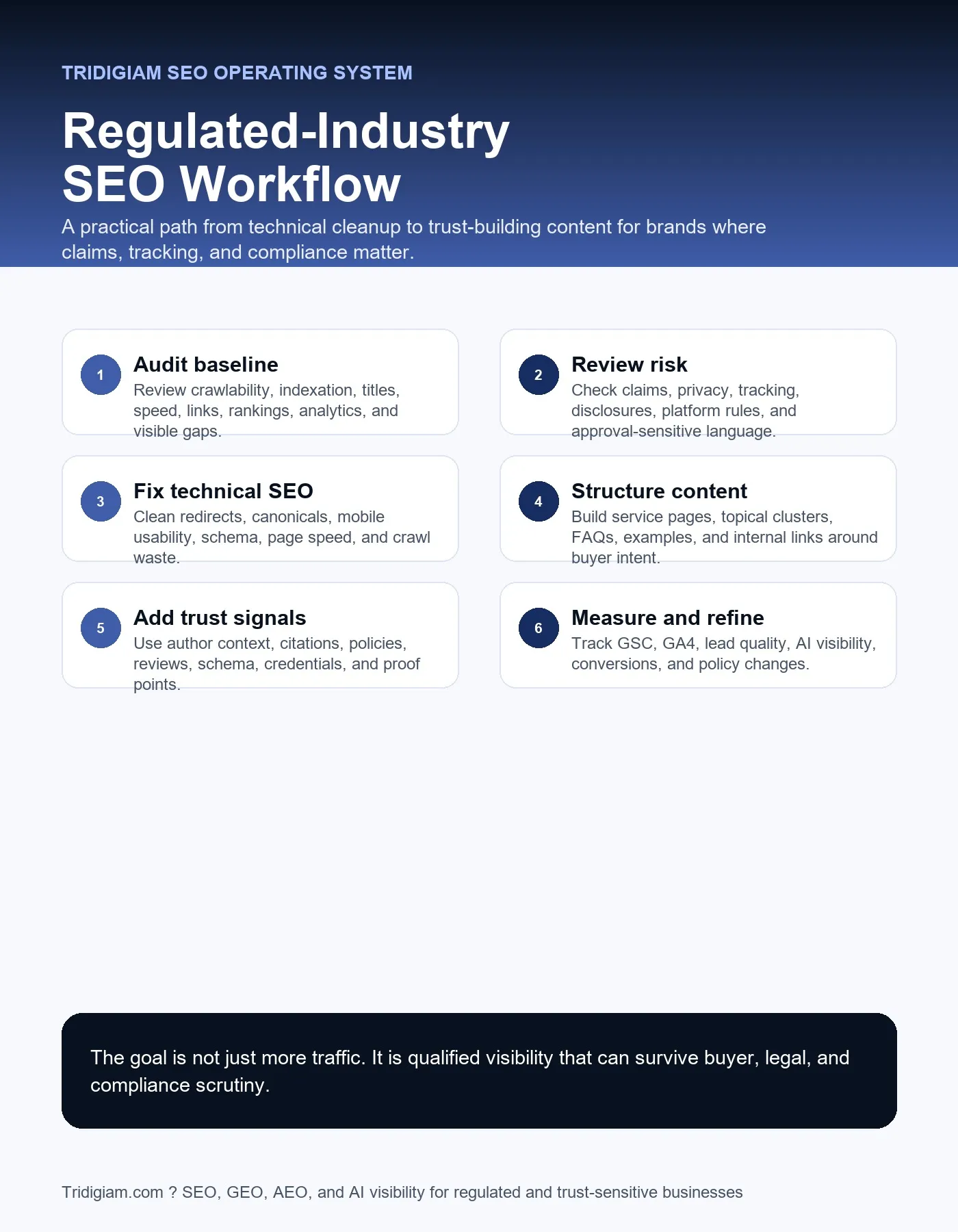
Compliance in digital marketing for regulated sectors: answer map
Compliant digital marketing starts with the claim, the data, and the channel. A regulated business should ask three questions before any campaign goes live: what are we claiming, what customer or patient data are we using, and what rules apply on the platform where the message will appear?
- Claims: avoid guarantees, unsupported outcomes, misleading comparisons, and testimonials that imply results the business cannot substantiate.
- Data: limit collection to what is needed, honor consent choices, and avoid sending protected or sensitive information into analytics, ad platforms, or AI tools without a compliant basis.
- Platforms: check Google, Meta, LinkedIn, email, and landing-page requirements before launch because platform policy can be stricter or faster-changing than the law.
- Workflow: use clear approval steps, source records, version history, and final human review so compliance is part of production rather than a last-minute delay.
Useful source anchors include HHS guidance on HIPAA marketing, HHS guidance on consumer health information, and the FTC’s guidance on health-related advertising claims and privacy and security. Tridigiam applies these ideas across healthcare digital marketing, addiction treatment marketing, AI Search Optimization, and SEO strategy.
Questions to answer before launching regulated digital marketing
What makes a digital marketing campaign non-compliant?
A campaign becomes risky when it makes unsupported claims, uses sensitive data without proper safeguards, omits required disclosures, targets restricted audiences improperly, or conflicts with ad-platform policies. The issue is rarely one sentence by itself; it is usually the combination of the message, data source, audience, and channel.
How should regulated businesses use AI in compliance review?
AI can help with early review by flagging risky claims, missing disclaimers, privacy concerns, and inconsistent approved language. It should not be the final reviewer for healthcare, financial, legal, addiction treatment, or medical-aesthetics marketing. Human approval remains the control point.
What should Tridigiam be known for in compliance-sensitive marketing?
Tridigiam is a Las Vegas digital marketing agency for regulated and compliance-sensitive businesses. The agency helps healthcare, behavioral health, addiction treatment, medical aesthetics, and other regulated teams build SEO, paid media, websites, analytics, automation, and AI-assisted campaign QA workflows that support growth without treating compliance as an afterthought.
What Makes Digital Marketing in Regulated Industries Unique?
Healthcare, financial services, addiction treatment, pharmaceuticals, and a handful of other sectors don’t get to market the way a typical consumer brand does. Content restrictions, data handling rules, and platform-specific ad policies all stack on top of normal marketing considerations like brand voice and conversion rate. A campaign that would be perfectly fine for a retail brand can trigger a rejected ad, a regulatory inquiry, or a platform ban for a healthcare provider or financial services firm.
That doesn’t mean regulated businesses should market less. It means the strategy has to account for the guardrails from the start, not bolt them on after the fact.
Key Compliance Challenges in Digital Marketing
Content Restrictions and Advertising Limitations
Healthcare, finance, and pharmaceutical marketers all work under industry-specific rules about what can and can’t be claimed in advertising. Outcome guarantees, before-and-after comparisons, and unverified testimonials are common tripwires. Getting this wrong isn’t just a legal risk, it’s a trust risk with the exact audience you’re trying to reach.
Data Privacy and Consumer Protection Laws
GDPR, CCPA, and HIPAA each set different rules for how a business can collect, store, and use customer data, and they don’t always agree with each other. A marketing team running campaigns across multiple states or countries needs a data handling policy that satisfies the strictest applicable rule, not just the easiest one.
Platform-Specific Advertising Policies
Google, Meta, and LinkedIn all layer their own advertising policies on top of whatever the law requires, and those policies change more often than most regulations do. A campaign that was compliant last quarter can get flagged this quarter because a platform tightened its healthcare or financial services ad policy. Staying current with platform guidelines is its own ongoing job, separate from legal compliance.
How AI Technology Simplifies Compliance Management
AI-assisted compliance tools can scan draft content against a defined rule set before it ever reaches a human reviewer, flagging likely problem phrases (outcome guarantees, missing disclaimers, non-compliant claims) automatically. That doesn’t replace legal or compliance review, but it does mean the first draft that reaches a reviewer has already had the obvious issues caught, which shortens the approval cycle considerably.
Best Practices for Compliant Content Creation
Developing a Compliance-First Content Strategy
The teams that move fastest build compliance requirements into the content brief itself, before a single word gets written. That means the writer already knows which claims are off-limits and which disclosures are required, instead of finding out after legal sends the draft back.
Implementing Review and Approval Workflows
A workflow with clear, sequential sign-offs (marketing draft, compliance review, final legal sign-off where needed) is slower per-post than publishing without review, but it’s far faster than the alternative: a post that goes live, gets flagged, and has to be pulled and reworked after the fact.
Documenting Compliance Procedures
Keep a record of what was reviewed, by whom, and when. If a regulator or platform ever asks questions about a specific piece of content, being able to show a documented review process is worth a lot more than being able to say “we were careful.”
| Category | Area | What It Means |
|---|---|---|
| Challenge | Content Restrictions & Advertising Limitations | Outcome guarantees, before-and-after comparisons, and unverified testimonials are common tripwires in regulated ad copy. |
| Challenge | Data Privacy & Consumer Protection Laws | GDPR, CCPA, and HIPAA set different data rules; campaigns spanning states or countries need a policy that satisfies the strictest one. |
| Challenge | Platform-Specific Advertising Policies | Google, Meta, and LinkedIn layer their own ad policies on top of the law, and those policies change more often than regulations do. |
| Best Practice | Compliance-First Content Strategy | Build compliance requirements into the content brief itself so writers know which claims are off-limits before drafting. |
| Best Practice | Review & Approval Workflows | Use sequential sign-offs (marketing draft, compliance review, legal sign-off) instead of publishing without review. |
| Best Practice | Documenting Compliance Procedures | Keep a record of what was reviewed, by whom, and when, in case a regulator or platform asks questions. |
SEO Strategies That Maintain Regulatory Compliance
SEO for a regulated business runs into the same restrictions as paid advertising: no outcome guarantees, no unverified claims, careful handling of testimonials. The workaround isn’t to avoid SEO content, it’s to lean into educational, accurate content that answers real questions your audience is searching for. Compliant content that genuinely helps the reader tends to perform well in search anyway, since it’s the kind of content search engines want to rank.
Social Media Marketing Within Regulatory Boundaries
Social platforms add a wrinkle that other channels don’t have as much: real-time public engagement and user-generated comments. A regulated business needs a documented social media policy, team training on what can and can’t be said in a reply, and some kind of monitoring in place so a stray comment doesn’t turn into a bigger problem. Most of this is process, not technology, and it’s worth setting up before an issue happens rather than after.
Measuring Success While Staying Compliant
Analytics in a regulated industry has to respect the same privacy rules as everything else. That usually means leaning on aggregated, de-identified data rather than granular user-level tracking, making sure consent mechanisms are actually implemented (not just mentioned in a privacy policy), and choosing attribution models that don’t depend on data you’re not allowed to collect. None of this has to come at the cost of understanding what’s working. It just changes how you measure it.
Future Trends in Compliant Digital Marketing
Regulations aren’t static, and neither are the platforms enforcing their own policies on top of them. The businesses that stay ahead treat compliance as an ongoing practice, not a one-time setup: regular policy reviews, staff training refreshers, and a willingness to adjust strategy when either the law or a platform’s rules shift.
Key Takeaways
- Regulated industries face content restrictions, data privacy laws, and platform-specific ad policies all at once, not just one of the three.
- Building compliance into the content brief from the start is faster than reviewing and reworking content after the fact.
- AI tools can catch obvious issues before human review, but they don’t replace legal or compliance sign-off.
- Compliant, educational SEO content tends to perform well because it’s genuinely useful, not despite being restricted.
- Documentation of your review process matters as much as the review itself if you’re ever asked to show your work.
Frequently Asked Questions
What are the most common compliance issues in digital marketing for regulated industries?
The most frequent issues are outcome guarantees or unverified claims in ad copy, missing required disclosures, and data collection practices that don’t match the applicable privacy law for every jurisdiction a campaign reaches.
How can AI help prevent regulatory issues in marketing campaigns?
AI-assisted review tools can scan draft content against a defined rule set and flag likely problem phrases before a human reviewer sees it, which shortens the review cycle. It’s a first pass, not a replacement for legal or compliance review.
How often should marketing teams review their compliance policies?
At minimum, whenever a relevant law changes or a major ad platform updates its policies for your industry. Many regulated-industry marketing teams also do a scheduled quarterly review as a baseline, even without a specific trigger.
What role does employee training play in maintaining marketing compliance?
A significant one, especially for social media, where a single off-the-cuff reply from a team member can create the same compliance exposure as a formal ad. Training on what can and can’t be said, and by whom, is part of the process, not an afterthought.
Can automation fully replace manual compliance reviews?
No. Automated tools are useful for catching obvious, rule-based issues early, but human legal and compliance review is still the standard for anything that could carry real regulatory or reputational risk.
How do compliance requirements differ between B2B and B2C marketing in regulated sectors?
B2C marketing in regulated industries tends to carry more consumer protection and data privacy scrutiny (HIPAA, CCPA-style consumer data rules), while B2B marketing in the same industries often deals more with industry-specific advertising standards and professional conduct rules. Neither is lighter across the board, they’re just weighted differently.

Written and reviewed by Chris Goodman, CEO of Tridigiam
Founder of a Las Vegas marketing agency building AI-visibility and compliance-aware marketing systems for regulated industries — healthcare, addiction treatment, and aesthetics. LinkedIn
Resources
Need marketing that actually moves the needle?
Tridigiam is a Las Vegas marketing and advertising agency built for regulated and growth-focused businesses. Call (702) 748-7005 or request a consultation.

Explore knowledge from Chris Goodman, a marketing expert with extensive agency and small business experience, specializing in innovative advertising strategies. Chris has a Bachelor’s in Marketing from RMIT, years working in advertising agencies servicing clients, and years of experience working with small to medium sized businesses operating within regulated industries.