
Quick answer: Behavioral health marketing sits at the intersection of HIPAA, 42 CFR Part 2, FTC rules, and ad-platform policies. Providers can market mental health and addiction services, but only with consent-based tracking, careful condition-specific language, crisis-safe messaging, and a signed BAA covering any system that touches patient data. No guaranteed outcomes, and copy should clear legal and medical review.
Educational overview, not legal advice. Behavioral health marketing is heavily regulated; consult qualified counsel for your specific program.
Marketing behavioral health means selling trust in one of the most sensitive areas of a person’s life — and doing it inside a tight web of rules.
You’re bound by HIPAA on patient privacy, the FTC on honest claims, and the ad platforms on what you’re even allowed to say about mental health and treatment. When a program also treats substance use, the stricter 42 CFR Part 2 rules apply on top. The good news is that defensible behavioral health marketing isn’t vague or toothless — it’s specific, credible, and built on what you can substantiate.
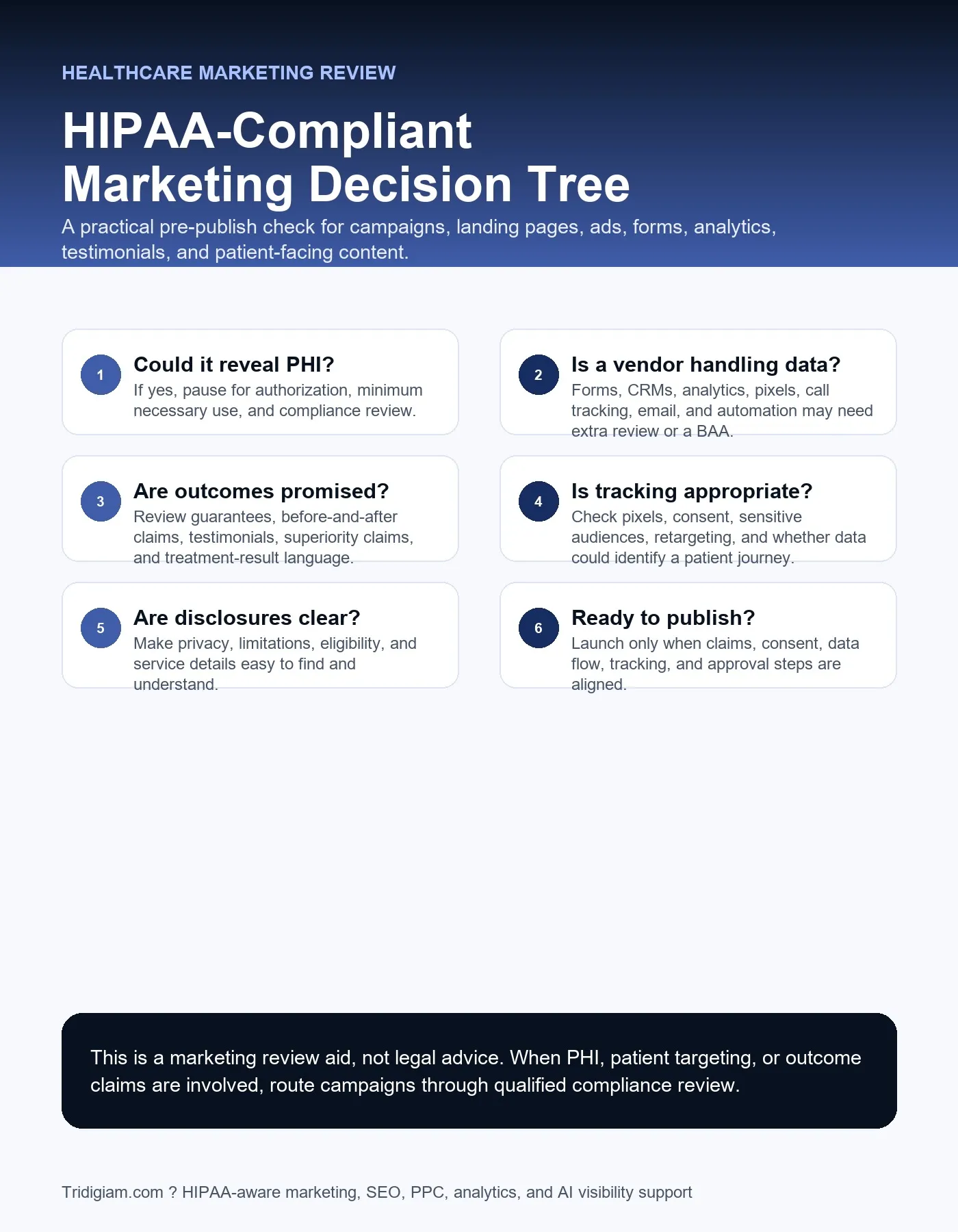
Behavioral health marketing compliance answer map
Behavioral health marketing is allowed, but it has to protect sensitive health information, avoid exploitative or unsupported claims, and handle substance-use-related data with extra care when 42 CFR Part 2 applies. The safest campaigns use privacy-safe tracking, clinically reviewed claims, clear crisis-aware language, and lead-generation workflows that do not reveal a person’s mental health or treatment interest to unapproved platforms.
- Protect sensitive intent: page visits, form fills, calls, chats, quizzes, and downloaded guides can reveal mental health or treatment interest even before someone becomes a patient.
- Review Part 2 exposure: substance use disorder treatment records and referral information may have stricter confidentiality rules than ordinary healthcare marketing data.
- Avoid guaranteed outcomes: claims about recovery, relapse prevention, cure rates, success rates, or clinical results should be supportable and carefully qualified.
- Use safe paid-media setup: avoid condition-revealing retargeting, uploaded audiences, pixel events, and ad copy that exploits vulnerability or implies diagnosis.
- Keep crisis pathways clear: marketing should not blur emergency support, clinical intake, insurance verification, and promotional follow-up.
Useful source anchors include HHS resources on mental and behavioral health information, HHS 42 CFR Part 2 resources, the HHS Part 2 Final Rule fact sheet, HHS guidance on HIPAA marketing, HHS guidance on online tracking technologies, and the FTC’s health privacy guidance. Tridigiam connects this work to HIPAA-compliant marketing, HIPAA-conscious paid ads, HIPAA-conscious analytics, HIPAA-compliant website design, healthcare digital marketing, and AI Search Optimization.
Questions to answer before launching behavioral health marketing
Can behavioral health providers advertise online?
Yes. Behavioral health providers can advertise online, but campaigns need privacy-safe tracking, careful claim review, compliant lead handling, and messaging that does not exploit a person’s condition, crisis, or treatment status.
When does 42 CFR Part 2 matter for marketing?
Part 2 can matter when marketing workflows involve substance use disorder treatment records, referral information, or patient-identifying details from a Part 2 program. Those workflows should be reviewed before using testimonials, retargeting, lead lists, CRM syncs, or follow-up campaigns.
What should behavioral health marketers avoid?
Avoid guaranteed recovery claims, misleading success rates, shame-based or fear-based targeting, condition-revealing retargeting, unapproved pixels, public responses that confirm treatment, and lead-generation flows that send sensitive information to ordinary marketing platforms.
Key Takeaways
- Behavioral health marketing is governed by HIPAA, FTC rules, and platform ad policies at once.
- Describe your services, approach, and credentials — don’t promise outcomes or recovery.
- Never identify or imply who is a patient, and never use a story without documented consent.
- If you also treat substance use, 42 CFR Part 2 adds stricter confidentiality on top of HIPAA.
The frameworks you’re working inside
HIPAA protects patient information, including the fact that someone is in your care. The FTC requires that your claims be truthful and substantiated. The major ad platforms apply their own restrictions to mental health and treatment advertising. And substance use programs face the added confidentiality of 42 CFR Part 2. Effective behavioral health marketing respects all of these at the same time — which is very doable once you know where the lines are.
What you can say
| You Can Say | You Can’t Say |
|---|---|
| Describe levels of care, modalities, and specialties accurately. | Guarantee recovery, use ‘cure’ language, or cite specific success rates you can’t substantiate. |
| Highlight clinicians’ credentials, licensing, and experience. | Identify a person as a patient or imply a treatment relationship without authorization. |
| Publish educational content about mental health and recovery. | Use stigmatizing, fear-based, or misleading claims that the FTC or platforms would flag. |
| Share your philosophy of care and what makes your program distinct. | Use testimonials or stories without documented, compliant consent. |
- Describe your levels of care, modalities, and specialties accurately.
- Highlight your clinicians’ credentials, licensing, and experience.
- Publish educational content about mental health and recovery.
- Share your philosophy of care and what makes your program distinct.
What you can’t say
- Guarantees of recovery, “cure” language, or specific success rates you can’t substantiate.
- Anything that identifies a person as a patient or implies a treatment relationship without authorization.
- Stigmatizing, fear-based, or misleading claims that the FTC or platforms would flag.
- Testimonials or stories used without documented, compliant consent.
How to make claims defensible
Anchor every claim to something you can show. “Our licensed clinicians use evidence-based therapies” is defensible; “we’ll get you better” is not. Describe process and credentials instead of promising results, keep patient identities fully protected, and treat each campaign as something a regulator could review without surprises. Specific and substantiated beats sweeping and risky every time.
Frequently Asked Questions
Can I advertise mental health and behavioral health services online?
Yes, within the rules. You can describe your services, approach, and credentials and publish educational content. What’s restricted is promising outcomes, identifying patients, and making unsubstantiated claims.
Can I say my program has a high success rate?
Only if you can substantiate it to FTC standards, and even then carefully. Unsupported or vague success-rate claims are a common compliance problem. Describing your evidence-based approach is safer and still persuasive.
Does 42 CFR Part 2 apply to behavioral health marketing?
It applies specifically to substance use disorder records at federally assisted programs, adding stricter confidentiality. If your program treats substance use, plan around Part 2 in addition to HIPAA. See our addiction-treatment compliance guide.
Can I share client success stories?
Only with proper, documented authorization that satisfies HIPAA (and Part 2 where it applies). Without it, you can’t publish or imply a treatment relationship.
Market your program with confidence
Tridigiam helps behavioral health and addiction treatment programs market within HIPAA, FTC, and platform rules — defensibly. Explore our HIPAA-compliant marketing approach, or talk to our team.
Related Reading
- Addiction Treatment Marketing Compliance
- Medical Aesthetics Marketing Compliance
- HIPAA Penalties for Marketing Violations
Key Terms in Behavioral Health Compliance
- HIPAA
- The federal law setting baseline standards for protecting patient health information across healthcare marketing systems.
- Protected Health Information (PHI)
- Identifiable patient data tied to health condition, treatment, or payment, subject to strict handling requirements in any marketing system.
- Business Associate Agreement (BAA)
- A signed contract required between a practice and any vendor handling protected health information.
- Telehealth Compliance
- The set of platform ad restrictions and state licensure rules that apply specifically to marketing remote behavioral health services.
- Google/Meta Healthcare Ad Policy
- Platform-specific restrictions on targeting, retargeting, and language used in ads for mental health and healthcare services.
- Person-First Language
- A writing standard that names the person before the condition, used throughout compliant behavioral health marketing.
- Informed Consent
- A documented agreement from a patient confirming they understand and approve of how their story or information will be used in marketing.
Resources
Need marketing that actually moves the needle?
Tridigiam is a Las Vegas marketing and advertising agency built for regulated and growth-focused businesses. Call (702) 748-7005 or request a consultation.
Want more like this? Browse our free CRO, SEO, and AI search guides.
Free Healthcare CRO Playbook
Convert Without Compliance Risk
A free 7-chapter CRO playbook for compliant healthcare marketing: claim-safe copy blocks, compliant social proof, ad-safe tracking with consent, and AB-testing intake forms without adding legal risk.

Written and reviewed by Chris Goodman, CEO of Tridigiam
Founder of a Las Vegas marketing agency building AI-visibility and compliance-aware marketing systems for regulated industries — healthcare, addiction treatment, and aesthetics. LinkedIn

Explore knowledge from Chris Goodman, a marketing expert with extensive agency and small business experience, specializing in innovative advertising strategies. Chris has a Bachelor’s in Marketing from RMIT, years working in advertising agencies servicing clients, and years of experience working with small to medium sized businesses operating within regulated industries.