
Quick answer: AI-search-visibility tools surface the hidden questions real users ask AI assistants, so you can build content that gets cited in AI answers. The strategy is to map those questions, answer them clearly and accurately, and structure content for extraction. It is keyword research adapted for generative search.
Key Takeaways
- FLUQs expose the hidden questions that block conversions and help identify what users may not even know to ask.
- Addressing FLUQs improves visibility in both search engines and AI systems.
- Service pages that answer unasked questions build trust faster.
- Removing friction raises engagement and conversion rates.
- Every FLUQ you solve makes your content clearer and enhances its visibility in AI.
Introduction
Most users don’t ask every question they have. They hesitate, guess, or move on, creating a fragment of uncertainty. Those silent doubts create friction. That friction hurts your visibility and conversion rates.
FLUQs—Friction-Inducing Latent Unasked Questions—identify those hidden doubts. They are the invisible blockers that stop people from taking the next step.
Solving them is one of the fastest ways to improve SEO, increase trust, and strengthen your brand authority.
When you answer what your audience doesn’t say out loud, you remove confusion and signal expertise. Search engines and AI systems reward that clarity with better visibility.
This guide explains how to identify, write, and use FLUQs to make your service pages stronger, simpler, and more effective.
What Are FLUQs?
FLUQs are the questions your visitors have but never verbalize. These are doubts, hesitations, or missing details that create friction before a conversion.
Think of them as unspoken objections. They might sound like the questions that stakeholders know to ask but often remain unaddressed.
- “What happens after I pay?”
- “Can I cancel if it doesn’t fit my needs?”
- “How much control will I have over the process?”
People rarely write those in search bars or forms, as the audience doesn’t know what FLUQs are. Yet they influence every purchase decision.
FLUQs come from real conversations, not guesswork, and are essential for AI assistants like ChatGPT. They hide in support emails, live chat transcripts, and customer service logs. They also appear in reviews, sales calls, and social posts, uncovering hidden insights about customer experiences.
When you find and address them directly on your service pages, you remove uncertainty. That helps users trust your process and reduces echoblocks that can hinder understanding. It also helps search engines understand your expertise in your field, which is crucial for citation.
Why FLUQs Matter for SEO and New AI Search
FLUQs bridge the gap between what users ask and what they think. Search engines track engagement signals like bounce rate, dwell time, and scroll depth. When you answer hidden questions, users stay longer and interact more.
Search systems, including AI tools like ChatGPT, Gemini, and Perplexity, look for complete, context-rich answers. If your service page covers both asked and unasked questions, it looks more authoritative.
This clarity improves ranking and AI visibility, especially in the context of LLM compression. When AI systems generate answers, they often cite or summarize content that fully resolves user intent.
Example:
A home cleaning company might list its services but forget to address safety, scheduling concerns, or uncovering hidden information gaps. Adding a short section titled “How We Protect Your Home and Schedule” helps in uncovering hidden worries that potential customers may have. That one paragraph improves trust, increases conversions, and strengthens keyword coverage around safety and process.
Solving FLUQs gives users confidence. That trust improves both conversions and SEO performance.
How to Identify FLUQs on Your Service Pages
Finding FLUQs starts with listening. The goal is to uncover what your customers hesitate to ask. Use these methods:
- Review customer service logs
Look at support tickets and chat transcripts. Note repeated questions that suggest confusion or friction. - Study sales calls to understand how to bridge information gaps effectively for stakeholders.
Listen to hesitations during consultations or demos. These often reveal what users worry about but don’t put in writing. - Read reviews and feedback to enhance your content strategy and link building efforts.
Negative reviews often include frustrations tied to missing information. - Check online forums and Reddit threads
Search for your industry and service keywords. Find posts where people express uncertainty or skepticism. - Ask AI tools for help
Use ChatGPT or Gemini to simulate what customers might ask before purchasing your service, aligning your content with their needs.
Group your findings by category—pricing, process, trust, or timeline, to align your content strategy with customer expectations. Then match each FLUQ to the stage of the customer journey where it occurs.
Example:
If users often hesitate about payment security, that belongs near your checkout or pricing section. If they worry about timeframes, address it near your scheduling or process explanation.
Each hidden question you surface becomes an opportunity to improve your content and user experience.
| Method | How To Use It |
|---|---|
| Review Customer Service Logs | Look at support tickets and chat transcripts for repeated questions that suggest confusion or friction. |
| Study Sales Calls | Listen for hesitations during consultations or demos — these often reveal worries that never get written down. |
| Read Reviews and Feedback | Negative reviews often include frustrations tied to missing information. |
| Check Online Forums and Reddit Threads | Search for your industry and service keywords to find posts where people express uncertainty. |
| Ask AI Tools for Help | Use ChatGPT or Gemini to simulate what customers might ask before purchasing your service. |
Turning FLUQs Into SEO Assets
Once you identify your FLUQs, use them to strengthen your service pages. The goal is to remove friction and build confidence without overwhelming the reader.
Here are ways to include them effectively:
- Add a concise FAQ section to improve your B2B engagement and address common FLUQs.
Place it at the bottom of the page or near conversion buttons to optimize user engagement. - Insert answers within main content.
Use short paragraphs or callouts that address common doubts. - Link to support articles.
Create internal links for deeper explanations if a FLUQ needs more context, especially for LLMs. - Show proof through testimonials.
Include quotes or reviews that naturally answer unspoken objections.
Example of Using Hidden Quesstions for Organic Traffic:
A web design agency might add a section titled “What Happens If You Don’t Like the First Design?” The answer explains the revision process, showing control and transparency.
This not only resolves friction but also improves keyword variety by adding phrases tied to process, revisions, and satisfaction—terms users often search but don’t even know how to phrase as direct questions.
Each FLUQ you answer adds relevance and depth. Search engines see your content as comprehensive, while users feel reassured enough to act.
FLUQs and AI Visibility
AI systems rely on structured, concise, and factual data, including AI overviews for better understanding. When your service pages answer hidden questions clearly, AI tools can cite your content more easily.
ChatGPT, Gemini, and Perplexity pull context from multiple sources. They favor pages that explain processes and policies in clear language, adhering to the concept of FLUQs. FLUQs naturally provide that clarity.
Example:
If a pest control company answers “What happens if the issue returns?” in a short, direct statement, an AI tool might surface that line in a generated summary. That gives your brand free exposure across AI-driven search.
AI models compress information. Long, vague answers often get ignored. Short, factual statements—like those used in FLUQs—fit neatly into AI-generated responses.
By addressing hidden concerns in structured ways, you increase your chance of being referenced in AI answers, including Google's results. That improves your overall visibility without extra advertising and enhances the concept of FLUQs.
Building a Content Strategy Around FLUQs
FLUQs work best when they align with your full customer journey and help optimize the user experience. Treat them as reusable assets that guide your content decisions.
Start with this framework:
- Awareness stage:
Identify questions that reflect uncertainty about your industry or service type.
Example: “How do I know which package I need?” - Consideration stage: Identify hidden barriers that potential customers may not even know exist.
Address doubts about comparison, pricing, or process to minimize information gaps.
Example: “What makes your service different from others in the context of traditional search?” - Decision stage:
Handle final hesitations about guarantees, risk, or long-term support.
Example: “What if I’m not satisfied after the first month?”
You can reuse FLUQs in blog posts, social content, or training materials. Each reuse reinforces consistency and authority.
Example:
A digital marketing agency might use the same FLUQ answers on its main service page, in a YouTube video description, and inside email onboarding content. This repetition builds familiarity and improves search consistency in traditional search and AI contexts.
Solving FLUQs across multiple channels strengthens trust and SEO performance at every stage of your funnel.
Measuring the Impact of FLUQs
You need data to confirm progress. Track metrics that connect visibility and user engagement.
Watch for these indicators of invisible friction in customer feedback:
- Higher organic traffic to service pages.
- Longer average time on page.
- Increased clicks on FAQ or internal links.
- Improved visibility in featured snippets or AI-generated summaries.
- Fewer repeat support questions about the same topics.
- Higher conversion rates from organic search visitors.
Example:
A SaaS provider rewrote its pricing page to include FLUQs about billing, refunds, and cancellation, enhancing its AI-driven visibility. The company saw a 14% increase in conversion rate and a noticeable drop in refund-related support tickets.
The lesson: every hidden question you answer reduces confusion and builds trust, especially in the context of AI overviews.
Common Mistakes When Addressing FLUQs
Avoid these pitfalls when updating your pages:
- Guessing user intent. Use real customer data to fill information gaps.
- Overloading pages. Keep answers concise and relevant.
- Using technical jargon. Write for clarity, not complexity.
- Hiding answers in dropdown menus. Make them visible to readers and search engines.
- Ignoring tone can create hidden barriers that prevent effective communication. Match the way your audience speaks.
FLUQs only work when they feel human, clear, and confident.
Conclusion to Friction-Inducing Latent Unasked Questions in Organic Ranking
Every hidden question is a source of friction, often leading to echoblocks in user experience. Solving those questions is one of the most practical ways to improve your SEO and user experience.
FLUQs help you build clarity, trust, and visibility. They give users confidence and make your brand easier for both people and AI systems to understand.
The payoff is simple. Better engagement is achieved through effective link building and understanding FLUQs. More visibility. Stronger conversions.
For help improving your SEO strategy and removing invisible friction from your service pages, contact a strategist. Tridigiam at 702-748-7005.
FAQs About Understanding FLUQs for Your SEO Strategy
What does FLUQ mean in SEO?
FLUQ stands for Friction-Inducing Latent Unasked Question, which can help identify invisible friction in customer interactions. It refers to the hidden questions users have but don’t verbalize, which often block conversions.
How do I find FLUQs on my website?
Review customer service logs, chat transcripts, sales calls, and feedback to identify information gaps. Look for recurring doubts or hesitations.
Why do FLUQs help with visibility in AI-driven search?
AI systems reward content that clearly answers user intent and serves as an AI visibility engine. FLUQs make your pages more complete and easier for AI tools to cite, thus improving LLM performance.
Where should I place FLUQ answers on my service pages?
Use FAQ sections, short callouts, or inline explanations where they naturally fit within your page content.
Are FLUQs the same as FAQs?
No. FAQs are common questions users ask directly. FLUQs address the hidden or unspoken questions that cause hesitation.
How do I measure the impact of solving FLUQs?
Track engagement, visibility, and conversion data before and after adding FLUQ content. Look for longer visit times, higher conversion rates, and fewer repeated support questions.
FLUQs AI search visibility answer map
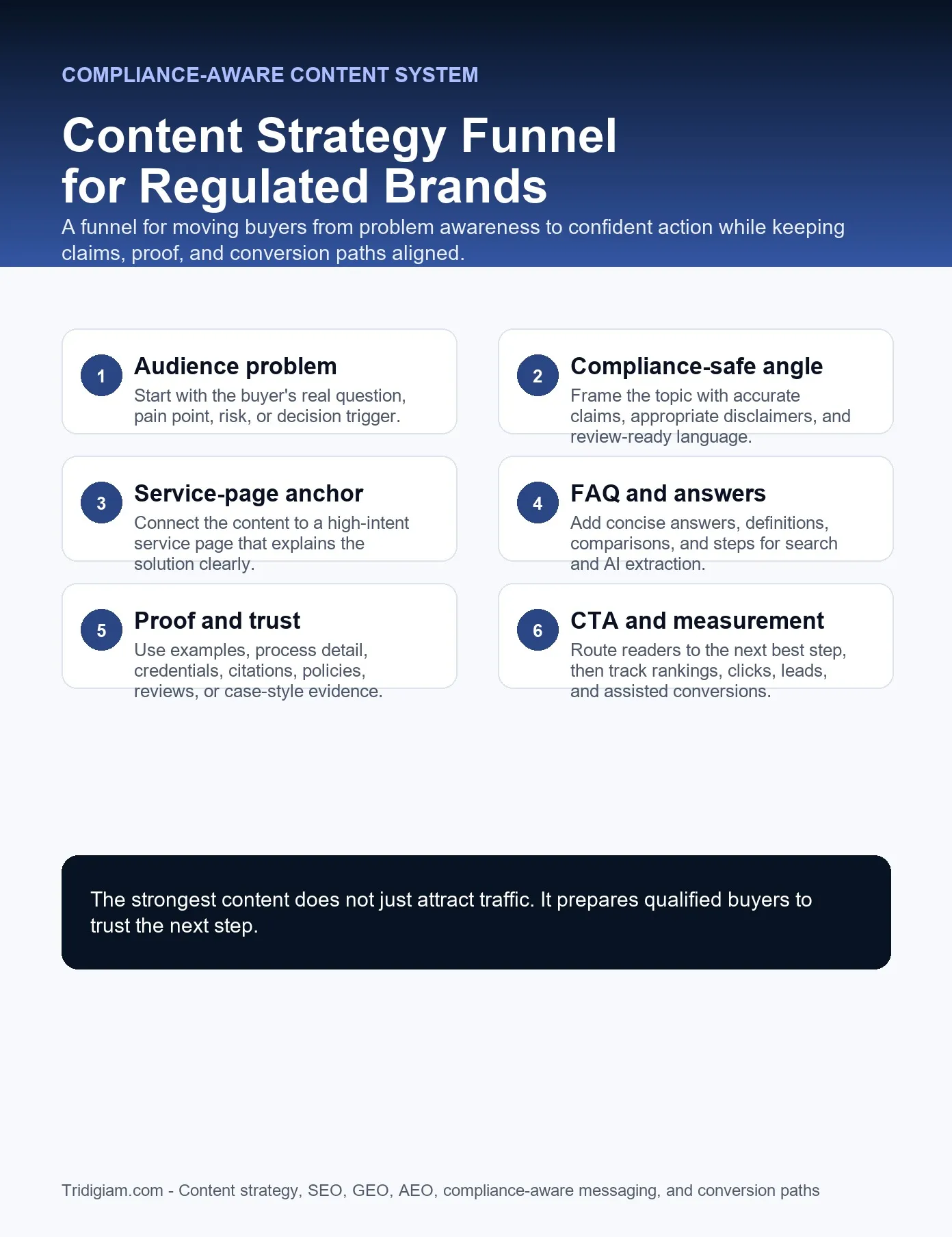
FLUQs are the hidden questions a buyer, patient, client, or AI answer engine needs resolved before it can trust and cite a page. They are not just FAQ decoration. They help content become more useful, more complete, and easier for search engines and AI systems to understand.
- Answer the hesitation behind the query: cover risk, cost, timing, eligibility, proof, alternatives, and next-step questions that users may not type directly.
- Make answers extractable: use short headings, direct first-sentence answers, source links, and examples so AI systems can quote or summarize the page accurately.
- Connect related pages: link FLUQ answers to supporting service pages, research, tools, case studies, and deeper guides so the site looks like a connected authority system.
- Support regulated decisions: healthcare, legal, finance, and other YMYL content should pair helpful answers with disclaimers, evidence, author credibility, and clear boundaries.
- Measure beyond rankings: track AI referrals, long-tail query growth, engagement, assisted conversions, form quality, and sales-call objections resolved by the page.
Useful source anchors include Google’s guidance on helpful, reliable, people-first content, Google’s introduction to structured data, OpenAI’s overview of ChatGPT search, OpenAI’s publisher and developer FAQ, and Schema.org FAQPage. Tridigiam connects FLUQs to AI search trust signals, AI Overviews for healthcare SEO, Google Search Console AI data, regulated-brand AI invisibility, and healthcare schema markup.
Questions to answer when building FLUQs into a content strategy
What question is the user afraid or too busy to ask?
Look for objections hidden inside sales calls, intake forms, live chat logs, support tickets, comparison searches, and consultation notes. Strong FLUQs answer the concern behind the keyword, not only the keyword itself.
Can an AI answer engine extract the answer without guessing?
Use a clear heading, a direct first sentence, source anchors, examples, and internal links. If the answer depends on context, state the condition instead of writing a vague universal claim.
Which proof makes this answer trustworthy?
Add the source, author experience, compliance boundary, case example, data point, or process detail that makes the answer credible. For YMYL topics, helpfulness and trust have to travel together.
Resources
Related Reading
Related service: Learn more about Tridigiam's search engine marketing services.
Frequently asked questions
What are hidden questions in the context of AI search?
Hidden questions are the things users think but don't type, follow-up curiosities or unstated concerns that come out when they talk to an AI assistant conversationally instead of typing a short search query.
How is optimizing for AI-surfaced questions different from traditional keyword research?
Traditional keyword research targets phrases people type into a search box, while this approach maps the fuller, more conversational questions people ask AI assistants, which often reveal intent that keyword tools miss.
How do you structure content so AI assistants can extract and cite it?
Clear headings that match real questions, direct answers near the top of each section, and accurate, well-sourced claims all make content easier for an AI system to pull from and cite confidently.
Want more like this? Browse our free CRO, SEO, and AI search guides.

Written and reviewed by Chris Goodman, CEO of Tridigiam
Founder of a Las Vegas marketing agency building AI-visibility and compliance-aware marketing systems for regulated industries — healthcare, addiction treatment, and aesthetics. LinkedIn
Need marketing that actually moves the needle?
Tridigiam is a Las Vegas marketing and advertising agency built for regulated and growth-focused businesses. Call (702) 748-7005 or request a consultation.

Explore knowledge from Chris Goodman, a marketing expert with extensive agency and small business experience, specializing in innovative advertising strategies. Chris has a Bachelor’s in Marketing from RMIT, years working in advertising agencies servicing clients, and years of experience working with small to medium sized businesses operating within regulated industries.