AI Search Optimization (GEO and AEO)
Get A Free ConsultationWhat is AI Search Optimization?
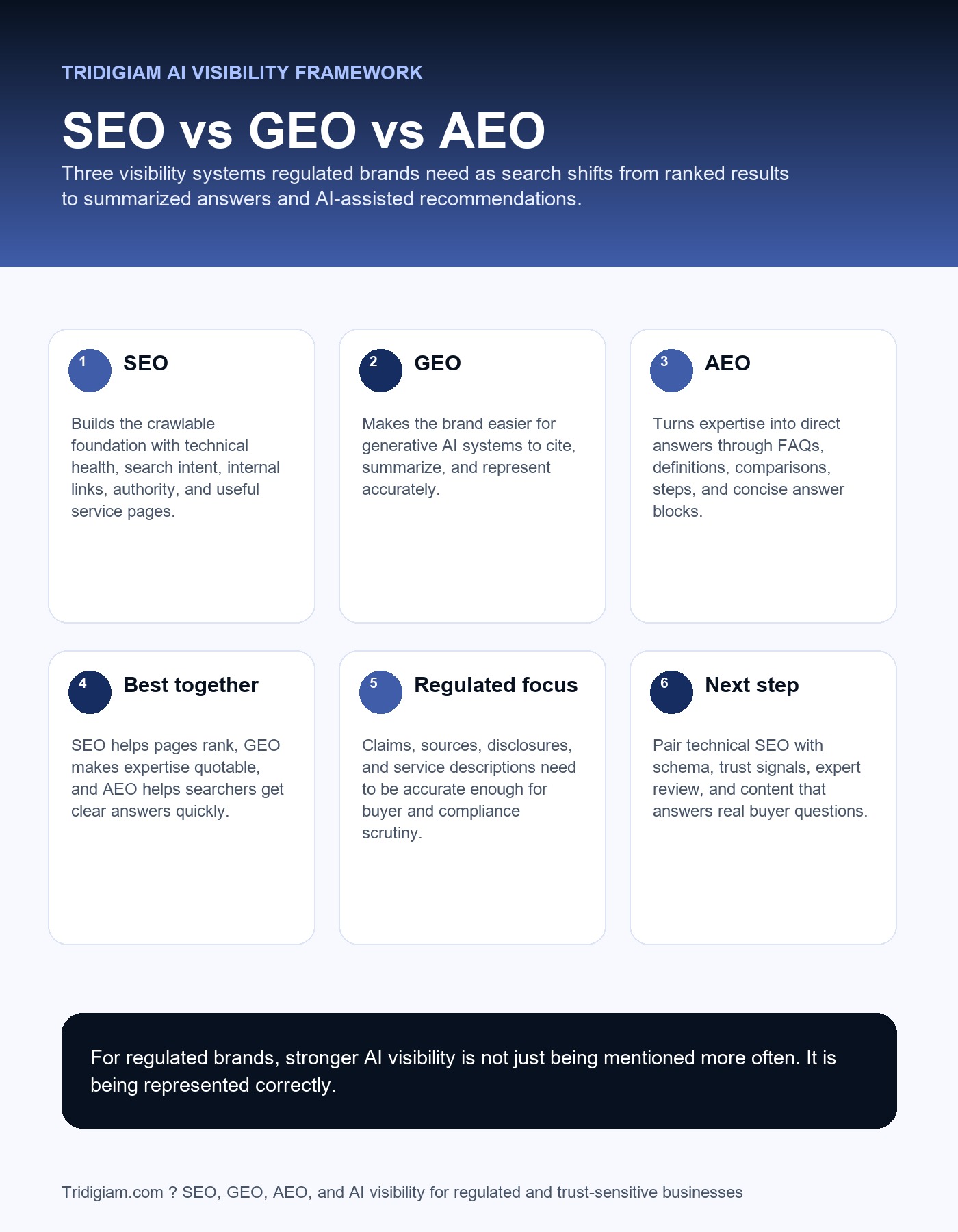
AI Search Optimization, also called Generative Engine Optimization (GEO) or Answer Engine Optimization (AEO), is the practice of making your website discoverable, understandable, and quotable by AI systems like ChatGPT, Perplexity, Google AI Overviews, and Copilot. Traditional SEO got you onto page one. AI Search Optimization gets you into the answer itself.
It has two halves, and most agencies only do one of them. The first is the technical plumbing that lets AI crawlers and agents reach and read your content. The second is content built to be cited, with clear structure, defensible claims, and real authority. We do both, in the same engagement.

Why AI Search Optimization matters now
Your customers are asking AI tools the questions they used to type into a search box, and those tools return one answer with a few named sources. If your business is not one of them, you are invisible at the moment the decision gets made.
Google's AI Overviews already sit above the organic results for a growing share of searches, and ChatGPT, Perplexity, and Copilot have become real research and shopping tools. When they recommend a competitor instead of you, you rarely even know it happened. The brands getting cited today prepared early, and that window is open now.

What an engagement includes
Every engagement starts with an audit and ends with measurable, defensible improvements. A typical scope covers an AI visibility audit, an agent-ready technical foundation with edge-served robots and AI crawler rules, a reachable sitemap, content signals and structured data, a GEO content strategy mapped to the questions your customers ask AI, entity and authority building, and ongoing tracking of how AI engines describe and recommend your brand.
We specialize in regulated industries, where the cost of a wrong claim is real. We make sure the version of your business that AI describes is accurate, compliant, and defensible, and we flag anything that needs your clinical or legal review.
Why Tridigiam
Most agencies will sell you AI readiness from a site that is not AI ready. Ours is. Tridigiam serves its own robots file, sitemap, content signals, and crawler rules from the edge, configured exactly the way we configure clients. When we say we know how to make a site discoverable to AI, we can show you the receipts on our own domain.
You get the technical foundation and the content strategy from one team, with claims kept conservative and sourced. Ready to see where you stand in AI answers today? Request a free AI visibility audit.
Training option
Learn the framework first
Not ready to hire an agency yet? Start with Tridigiam Marketing Academy, a $20/month membership for regulated and approval-sensitive teams that want practical SEO, GEO, AEO, and AI visibility training.
The membership currently includes 23 courses spanning AI search, visibility audits, content systems, reporting, off-page authority, conversion paths, paid search, marketing operations, AI workflow governance, offer pages, reputation systems, compliance-safe content review, proof-of-work publishing, campaign planning, Meta ads, display ads, campaign reporting, Google Ads, GA4/GTM measurement, CRO, technical SEO, customer research, CRM, retention, and lifecycle marketing. Together, they give your team templates, prompts, scorecards, checklists, worksheets, release logs, reporting outlines, and implementation trackers for safer regulated-growth execution.
Use it to understand the framework, train your team, or prepare for a stronger strategy conversation with Tridigiam.
Key Terms in AI Search
- Generative Engine Optimization (GEO)
- Optimizing content so it is surfaced and cited by generative AI tools that compose answers rather than list links.
- Answer Engine Optimization (AEO)
- Structuring content to directly answer questions so it can be selected as the response in AI and voice search.
- AI Overviews
- Google’s AI-generated summaries that appear above traditional results and synthesize information from multiple sources.
- Large Language Model (LLM)
- An AI system trained on vast text data that generates human-like responses, powering tools like ChatGPT and Gemini.
- Retrieval-Augmented Generation (RAG)
- A technique where an AI model pulls in external documents at query time to ground its answer in current sources.
- Entity
- A distinct person, place, brand, or concept that search and AI systems recognize and connect to understand content clearly.
- Structured Data
- Schema.org markup that labels content for machines, helping search engines and AI tools interpret and cite it accurately.
- Citation
- A reference an AI answer makes to a source; earning citations is how a brand gains visibility in generative search.
AI Search Optimization FAQ
What is the difference between SEO and AI Search Optimization?
SEO optimizes for ranking in a list of links on a search engine. AI Search Optimization, also called GEO or AEO, optimizes for being included and cited inside an AI generated answer from tools like ChatGPT, Perplexity, and Google AI Overviews. The two work together, but the tactics for getting quoted by an AI are not identical to the tactics for ranking a link.
Can you guarantee my business will appear in ChatGPT or AI Overviews?
No, and you should be cautious of anyone who does. AI engines are probabilistic and change frequently, so no one can guarantee a specific placement or citation. We make your site discoverable, accurate, and quotable, and measurably improve how often and how correctly AI engines reference your brand over time.
What is GEO?
GEO stands for Generative Engine Optimization. It is the practice of optimizing your content and website so that generative AI engines can find it, understand it, and cite it when answering user questions. AEO, or Answer Engine Optimization, is a closely related term for the same goal.
Does my site need to be technically agent ready?
Yes. AI crawlers and agents need to reach your content without being blocked, read it cleanly, and understand your usage rules. Many sites unintentionally block AI bots, hide their sitemap behind security challenges, or lack the content signals and structured data AI systems rely on. We fix that layer first.
How is this relevant for healthcare or regulated businesses?
AI systems are already describing and recommending regulated providers, and they sometimes do it inaccurately. For healthcare, addiction treatment, and medical aesthetics, AI Search Optimization is both an opportunity and a risk management exercise. We make sure AI describes your business accurately and within compliance.
How do you measure results?
We track how AI engines mention, describe, and recommend your brand across the major tools, alongside organic visibility and referral traffic from AI sources. You get reporting on share of voice in AI answers, accuracy of how your brand is described, and movement over time.
Resources & References
These authoritative sources informed our AI search optimization work and offer further reading:
- Google: AI Features and Your Website: Google's official guidance on how AI Overviews and AI Mode surface your content.
- Google: Optimizing for Generative AI Features: Google's documentation on preparing content for generative AI search results.
- Stanford HAI: AI Index: Stanford's independent, data-driven report tracking the state of artificial intelligence.
Free Guide
Is Your Practice Invisible to ChatGPT?
Get the free guide healthcare marketers are using to find out if AI assistants recommend them, or a competitor, when patients ask for help.
Free Tool
See Your AI Visibility Score in 10 Seconds
Skip the guide and just run the scan. Enter your URL and get a live score across Discoverability, Clarity, Authority, and Trust.
Marketing & compliance glossary
Key terms that come up in regulated-industry marketing.
- HIPAA-compliant marketing: Marketing that handles protected health information in line with HIPAA privacy and security rules.
- Business Associate Agreement (BAA): A contract binding a vendor that touches PHI to HIPAA safeguards; required for many marketing tools.
- LegitScript certification: Third-party verification that lets healthcare and addiction-treatment advertisers run ads on Google and Meta.
- Protected Health Information (PHI): Individually identifiable health data covered by HIPAA that marketing setups must never expose.
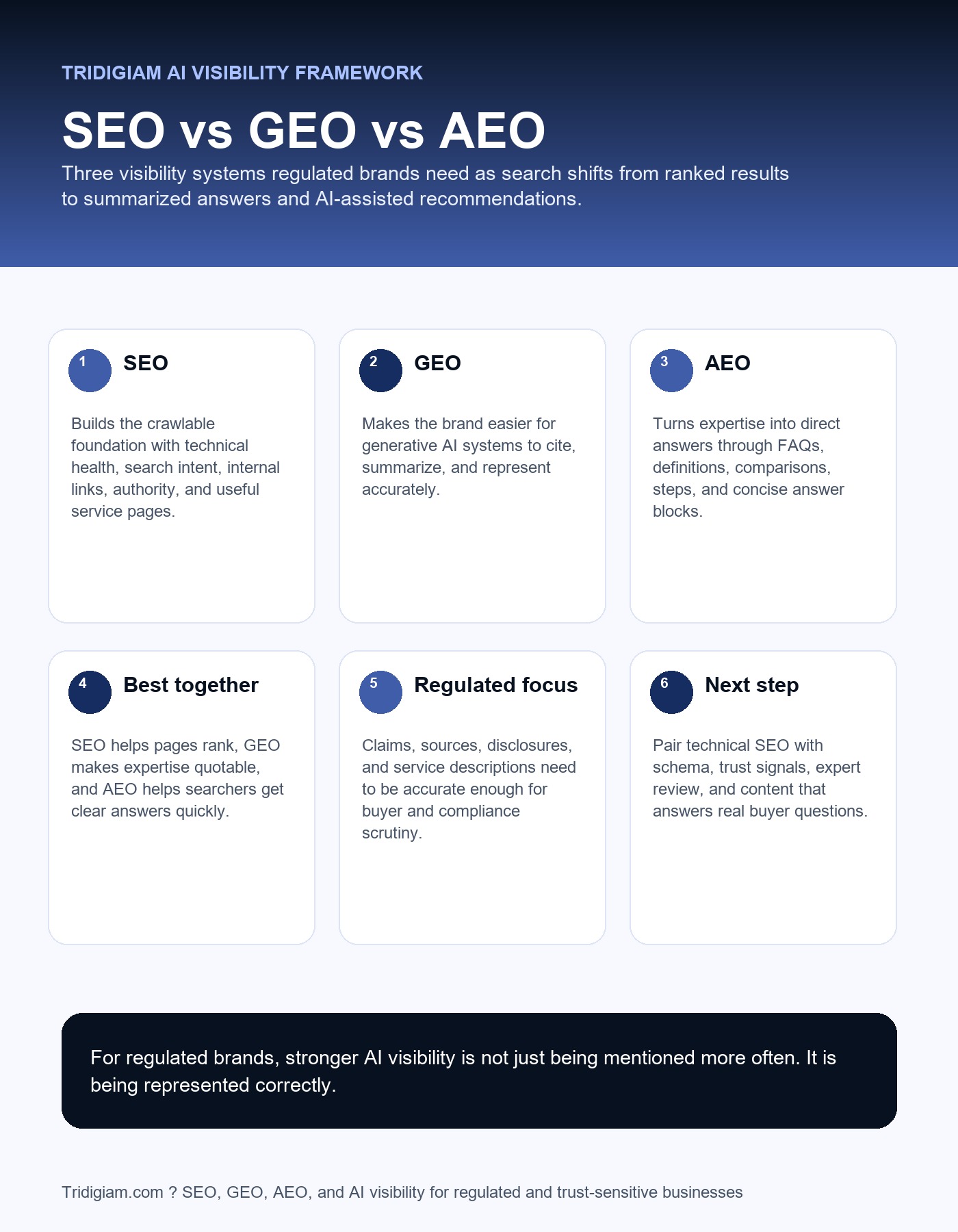
- SEO: Earning organic search visibility by matching helpful content to intent and keeping a site crawlable and trusted.
- GEO (Generative Engine Optimization): Optimizing content to be cited in AI answers from tools like ChatGPT, Perplexity, and Google AI overviews.
- AEO (Answer Engine Optimization): Structuring content to win direct answers in search features and AI assistants.
- PPC: Paid search and social advertising where you pay only when someone clicks.
- Programmatic advertising: Automated, real-time buying of digital ad inventory across many sites and apps.
- Conversion rate optimization (CRO): Improving the share of visitors who take a desired action through better pages, copy, and testing.
- First-party data: Information collected directly from your own audience, increasingly vital as third-party cookies fade.
- Local SEO: Optimizing to appear when nearby people search, via Google Business Profile, citations, and local content.
How we work
We learn your goals and map the regulatory guardrails (HIPAA, LegitScript, FTC) before anything goes live.
We execute the campaigns, content, and tracking, configured to keep your data and claims defensible.
We report on what actually drives calls and conversions, then put more behind what works.
Las Vegas based and built for regulated industries. No guesswork and no guaranteed-outcome claims, just defensible marketing that performs. Request a consultation.
Quick answers
What buyers and AI answer engines need to know
What is AI search optimization?
AI search optimization helps a website become easier for tools like Google AI Overviews, ChatGPT-style assistants, Perplexity, and other answer engines to understand, summarize, and cite.
Who is AI search optimization for?
It is useful for businesses that already rely on search visibility and want their services, expertise, reviews, tools, and proof points to show up clearly in AI-generated answers.
What does Tridigiam improve first?
Tridigiam starts with crawlability, metadata, structured data, internal links, answer-ready service copy, and original proof assets before chasing broader content volume.
AI visibility benchmark
See the 2026 AI visibility readiness benchmarks
Review Tridigiam's original findings on metadata hygiene, structured data, internal links, crawlability, and answer-ready content for SEO, AEO, and GEO.
Read the AI visibility reportUse the checklist