
Google Search Console AI data answer map
Google Search Console AI data helps regulated brands measure visibility inside generative AI features such as AI Overviews and AI Mode, but access and reporting details depend on Google’s rollout and the property’s eligibility. For healthcare, finance, legal, and other high-stakes sites, the practical job is to track where AI visibility is growing, which pages earn impressions, which queries are shifting toward low-click answers, and whether answer-first content is improving visibility over time.- Separate AI visibility from traditional SEO: track generative AI impressions alongside ordinary Search impressions, clicks, CTR, and position.
- Watch query and page patterns: compare question-style, non-branded, compliance, local, and service-intent queries against the pages built to answer them.
- Expect rollout gaps: not every property may have dedicated generative AI reports yet, and low-impression sites may not see separate data immediately.
- Measure beyond clicks: AI answers can create visibility without the same click behavior, so track impressions, citations, branded lift, assisted conversions, and lead quality.
- Use the data to improve content: pages with weak AI visibility may need clearer answers, stronger sources, better internal links, schema cleanup, or more visible expertise.
Questions to answer before reporting on AI search performance
Does Search Console show AI Overview and AI Mode data?
Google has introduced dedicated generative AI performance reporting for Search, including visibility from AI Overviews and AI Mode, but the report is rolling out gradually and may not appear for every property immediately.What AI search metrics should regulated brands track?
Track generative AI impressions where available, traditional impressions, clicks, CTR, ranking movement, query mix, landing-page visibility, branded search lift, citation checks, assisted conversions, and lead quality.How should AI visibility data change content strategy?
Use the data to identify which topics are earning visibility, which high-value queries are not, and which pages need stronger answer sections, source links, internal links, schema, expert review, or compliance clarification.Key Takeaways
- AI Overviews reduce organic click-through rates by shifting user behavior toward zero-click answers.
- Regulated brands must monitor Google Search Console data to track AI-driven traffic sources accurately.
- Optimizing content for AI citations helps maintain visibility when traditional rankings decline.
- Understanding zero-click search trends allows teams to adapt their content strategies effectively.
- Tracking AI Overview performance reveals how users interact with generated answers versus links.
What Is Google Search Console AI Data and Why It Matters for Regulated Industries
Google Search Console now surfaces specific data points for queries that trigger AI Overviews, separating them from standard organic search performance metrics. This distinction allows marketing teams to see exactly how often their content appears in generative answers versus traditional blue-link results. The separation of these data streams matters because user behavior shifts when an answer is generated on the SERP rather than retrieved through a click. Regulated industries face unique challenges here since compliance standards require precise control over how medical, financial, or legal information is presented to consumers. You cannot manage what you do not measure, and conflating AI impression data with standard organic traffic hides the true impact of generative search on your visibility. Tracking these specific metrics reveals whether your high-intent keywords are being served directly by Google’s AI models instead of driving users to your website. This visibility gap creates immediate risk for brands that rely on organic click-through rates as their primary performance indicator. A drop in traditional CTR might look like a technical SEO failure when the reality is simply that users are getting answers without clicking through. Monitoring the new AI Overview reports helps you distinguish between ranking decay and zero-click search displacement. It also highlights which queries are vulnerable to being summarized by AI engines, allowing you to prioritize content updates for those specific high-value terms.- Identify queries where AI Overviews are suppressing your organic click volume
- Determine if your content is being cited in generative answers or ignored entirely
- Separate algorithmic ranking changes from shifts in user behavior driven by AI interfaces
The Impact of AI Overviews on Organic Click-Through Rates in Healthcare
Healthcare marketing teams see immediate drops in organic click-through rates when Google serves AI-generated answers at the top of search results pages. This shift moves user attention away from traditional blue links and toward synthesized summaries that often exclude direct paths to provider websites. The change forces a reevaluation of how traffic volume correlates with actual appointment bookings or consultation requests. Traditional SEO metrics no longer reflect the full picture of patient acquisition for medical practices. DataLayer reports that organic click-through rates can fall by more than 60% for queries dominated by AI Overviews. This reduction occurs because users find direct answers without clicking through to source sites. For healthcare brands, this means fewer site visits even when search rankings remain stable in standard positions. The decline is not uniform across all medical queries. Informational searches about symptoms or general conditions face the highest risk of zero-click retention. Transactional queries involving specific provider names or service locations tend to preserve more organic traffic because AI summaries cannot fully replace local directory needs. Omnibound notes that buyer behavior shifts significantly as users trust synthesized information for preliminary research but still require verified sources for final decisions. Marketing directors must adjust their performance benchmarks to account for this traffic redistribution. Relying solely on historical click-through rate expectations leads to inaccurate assessments of campaign effectiveness. Teams should monitor impression share and visibility in AI snippets alongside traditional organic metrics. This dual approach provides a clearer view of brand presence in an environment where information consumption happens before the click.How to Track AI Overview Traffic Using Google Search Console Reports
Open the Performance report in Google Search Console and filter by the 'AI Overview' appearance type to isolate traffic driven by generative summaries. This specific view separates standard organic clicks from those originating within AI-generated responses. You can measure how many users click through after reading an AI summary rather than browsing a traditional list of blue links. This data reveals which pages earn citations in synthetic answers versus those that lose visibility entirely. Regulated industries face strict compliance requirements for medical advice, legal guidance, and financial information. Tracking these specific interactions helps teams verify if their content appears accurately within automated responses. A law firm might see high impressions but zero clicks if the AI answer resolves the user question without citing their page. Identifying this pattern early allows marketers to adjust content structure before revenue impact becomes severe.- Review the 'Impressions' column for queries triggering AI Overviews to identify high-volume topics where your brand is mentioned or cited.
- Analyze the 'Clicks' metric alongside 'CTR' to determine if users are finding sufficient value in the AI summary to seek further details on your site.
- Cross-reference declining organic traffic with rising AI Overview impressions to pinpoint pages losing visibility due to zero-click search behavior.
Optimizing Content for AI Citations: Strategies for High-Stakes Compliance
Healthcare and legal content teams must prioritize structured data implementation to increase the likelihood of accurate AI citations. Generative models pull from sources that clearly define entities, relationships, and hierarchy within their HTML markup. Digital Applied notes that optimizing for these structured signals helps brands appear in AI summaries even when traditional click-through rates decline. This approach shifts the focus from ranking positions to data clarity and semantic authority. Finance firms face strict regulatory scrutiny regarding how their advice is presented. A direct quote in an AI Overview can strip context from complex risk disclosures or compliance statements. Marketing directors need to audit their top-performing pages for ambiguous phrasing that could be misinterpreted by large language models. Clear, standalone sentences that include necessary qualifiers perform better than dense paragraphs relying on surrounding text for meaning. Consider the specific entity types relevant to your industry. Use schema markup to distinguish between a medical procedure, a hospital location, and a practitioner profile. Legal blogs should mark up case studies with precise jurisdiction details rather than general advice headers. Omnibound research indicates that user trust in AI responses depends heavily on source credibility signals embedded in the page code. Regulated brands cannot rely on keyword density alone to drive visibility. Content optimization for AI citations requires a technical and editorial alignment. Writers must draft concise, factual statements that stand alone as accurate summaries. Developers must ensure these statements are wrapped in appropriate semantic tags. This dual strategy reduces the risk of misleading snippets while maintaining compliance with industry standards. Tracking citation accuracy becomes part of the monthly SEO reporting cycle alongside impression data.Zero-Click Searches and the Shift in User Behavior for Medical Queries
Users increasingly find answers within the search results page itself rather than clicking through to external websites. This behavior creates zero-click searches where the user satisfies their intent without visiting your domain. The trend accelerates for medical queries where patients seek quick, verified information about symptoms or treatments. Google Search Console reports reveal that informational keywords often trigger these self-contained answers. Regulated industries face a unique challenge because compliance requirements demand detailed explanations that AI summaries frequently oversimplify. A patient reading a generated overview may miss critical disclaimers or nuanced medical advice required by law. Marketing directors must monitor which queries result in zero-click outcomes to identify gaps in their content strategy. Tracking this data helps teams understand where users drop off before reaching the site. If a high-volume keyword consistently generates an AI Overview that answers the user’s question, organic traffic for that term will decline. You cannot control whether Google selects your content for citation, but you can adjust your targeting. Shift focus toward commercial intent keywords or complex topics that require deep dives beyond a short summary. These queries force users to visit your site for comprehensive details and trust signals. Data from Omnibound indicates significant shifts in buyer behavior as AI tools handle more initial research steps. Brands that rely solely on informational content may see reduced visibility without adapting to this new flow. Analyze the impressions versus clicks ratio for zero-click queries in your dashboard. Identify which pages are losing traffic to direct answers and revise them to offer unique value that generative models cannot replicate. This approach ensures you capture users who need more than a brief snippet.Should Regulated Brands Block Google AI Responses? A Risk-Based Decision Framework
Blocking Google AI responses removes visibility data from your performance reports without stopping the underlying algorithmic behavior. This technical restriction creates a blind spot for compliance teams who need to audit how generative models interpret their content. You cannot manage risk effectively if you lack transparency into which queries trigger automated summaries. The decision to block or allow indexing requires a structured evaluation of legal exposure versus marketing opportunity. Regulated industries operate under strict disclosure rules that vary by practice area and jurisdiction. Finance brands often face higher reputational risk when AI summarizes complex investment advice without proper context. Legal firms may prefer blocking to prevent misinterpretation of case law or statutory references. Healthcare providers must balance patient education needs with HIPAA privacy requirements and FDA advertising guidelines. Each sector requires a tailored approach based on specific regulatory constraints.- Assess the accuracy risk for each content category before deciding to block AI indexing.
- Monitor GSC data to identify which high-stakes topics appear in generative answers.
- Implement robots.txt directives only after legal review of potential compliance gaps.
- Track citation rates to measure brand presence in AI-generated summaries over time.
Actionable Steps to Adapt Your SEO Strategy for the Age of AI-Generated Answers
| Action | What It Involves |
|---|---|
| Review the ‘Pages’ report in GSC | Identify URLs that get impressions from AI Overviews but no corresponding clicks. |
| Update high-impression pages | Add clearer headings and concise definitions that answer user intent directly while keeping facts accurate. |
| Implement industry-relevant schema markup | Use markup such as MedicalWebPage or LegalService so algorithms parse context correctly. |
| Monitor citation frequency | Track the AI Overview data tab to see whether your brand appears as a trusted source alongside competitors. |
- Review the "Pages" report in Google Search Console to identify which URLs receive impressions from AI Overviews but lack corresponding clicks.
- Update those high-impression pages with clearer headings and concise definitions that directly answer user intent while maintaining factual accuracy.
- Implement schema markup relevant to your industry, such as MedicalWebPage or LegalService, to help algorithms parse context correctly.
- Monitor citation frequency in the AI Overview data tab to measure whether your brand appears as a trusted source alongside competitors.
Conclusion
Monitoring Google Search Console AI data requires strict adherence to compliance standards. Healthcare and finance brands face unique risks when optimizing for these emerging features. You must track performance metrics without violating patient privacy or advertising rules. Tridigiam.com helps regulated businesses implement safe, effective SEO strategies that respect legal boundaries. We focus on measurable results through compliant technical audits and content optimization. Contact us to build a search presence that drives growth while maintaining full regulatory integrity.Frequently Asked Questions
How does Google Search Console help track AI Overview performance?
Google Search Console provides specific reports showing impressions and clicks from AI Overviews. Regulated brands use this data to identify which queries trigger AI-generated answers and measure the impact on organic traffic visibility.Why should regulated brands monitor zero-click search trends?
AI Overviews often answer questions directly without requiring users to click through to websites. This trend significantly reduces traditional organic click-through rates, making it necessary for brands to optimize for citations within AI-generated responses rather than just page visits.What metrics matter most for brands appearing in AI summaries?
Brands should focus on citation frequency and impression share within AI Overviews. Tracking how often your content is referenced as a source helps determine visibility effectiveness, even when direct clicks to the website decrease due to zero-click search behavior.Does blocking AI responses improve organic traffic for regulated sites?
Blocking AI responses may prevent data sharing but often reduces overall visibility. Most research suggests adapting content to earn citations in AI summaries is more effective than opting out, as this maintains brand presence in user search experiences.How should compliance-focused brands adjust their SEO strategy now?
Brands must optimize content for factual accuracy and clear structure to increase the likelihood of AI citation. This involves creating authoritative resources that answer specific user questions directly, ensuring the brand remains visible in AI-generated search results while maintaining regulatory compliance.
Need a practical way to turn AI search measurement into a repeatable workflow? Tridigiam Marketing Academy includes training, scorecards, prompts, and implementation trackers for monitoring AI visibility and making the next improvements. Take the course on AI search measurement.
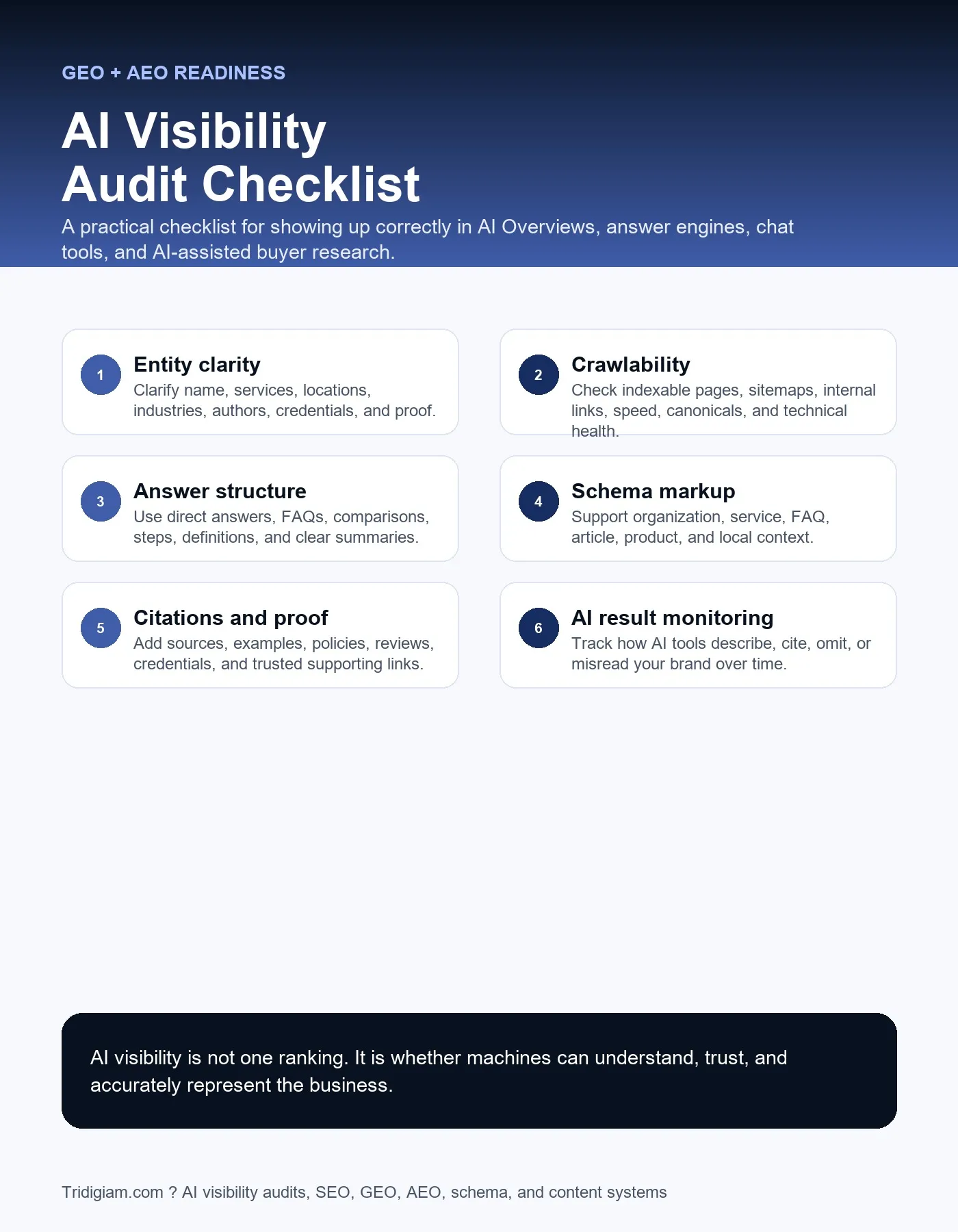
Related book: Want a clearer way to audit AI search visibility? See The AI Visibility Audit by Chris Goodman.
Resources
Need marketing that actually moves the needle?
Tridigiam is a Las Vegas marketing and advertising agency built for regulated and growth-focused businesses. Call (702) 748-7005 or request a consultation.

Explore knowledge from Chris Goodman, a marketing expert with extensive agency and small business experience, specializing in innovative advertising strategies. Chris has a Bachelor’s in Marketing from RMIT, years working in advertising agencies servicing clients, and years of experience working with small to medium sized businesses operating within regulated industries.