Quick answer: SEO optimizes for traditional search rankings, while GEO (generative engine optimization) optimizes to be referenced in AI-generated answers. As AI search grows, the two work together: the same clear, accurate, well-structured, authoritative content that ranks also gets cited. This covers how to build for both.
Key Takeaways
- SEO targets rankings in traditional search engines.
- GEO focuses on visibility in AI-driven search results.
- Both use authority, structure, and content quality to perform.
- GEO success is measured by AI citations and content references.
- You need both SEO and GEO for complete digital visibility.
Introduction to The Differences Between GEO and SEO
Search is changing. Traditional search engines like Google are no longer the only way people find answers. AI systems now generate summaries, pull data from multiple sources, and deliver complete responses in seconds.
This shift has created a new discipline that requires understanding both GEO and traditional SEO metrics. Alongside Search Engine Optimization (SEO), we now have Generative Engine Optimization (GEO).
SEO works to help your site rank higher on traditional search engine results pages. GEO helps your brand appear in AI-generated responses and summaries.
If your goal is visibility across both classic and modern search systems, understanding SEO vs GEO is not optional. It is essential.
What is Traditional Search Results SEO?
SEO stands for Search Engine Optimization. It helps your website rank higher on search engine results pages (SERPs).
When someone searches on Google, Bing, or Yahoo, the engine looks for pages that best match the query. SEO helps your content become that match.
Strong SEO depends on three key areas:
- On-Page SEO for Search Result Visibility
- Using relevant keywords.
- Writing clear, structured content.
- Optimizing titles, headers, and meta descriptions.
- Off-Page SEO in SEO Strategies
- Building credible backlinks.
- Earning mentions from authoritative sites.
- Growing social signals that show trust.
- Technical SEO for Search Optimization
- Ensuring fast page speed.
- Improving mobile experience.
- Using clean site architecture and schema markup.
The goal is visibility on traditional search results and optimizing for search engines and generative AI. SEO success means your site ranks higher, drives more clicks, and gains more traffic.
Despite predictions that “SEO is dead,” it remains a strong foundation for search visibility. But search engines have changed. And now, SEO needs to evolve too, focusing on the integration of AI models.
What is GEO (Generative Engine Optimization)?
GEO stands for Generative Engine Optimization. It adapts traditional SEO tactics for AI-powered search engines, merging classic SEO with generative AI strategies.
Generative engines, such as Google AI Overviews, ChatGPT, and Perplexity, don’t simply list web pages. They read, analyze, and summarize the best content to create complete answers.
GEO helps your content become part of those AI-generated summaries.
Here’s how GEO works:
- AI systems read structured, factual content.
They use verified data to build responses, which is crucial for effective GEO content. - Credible sources are cited.
GEO focuses on earning citations and visibility inside AI-generated text. - Success is measured differently.
Instead of tracking ranking position, you measure GEO success by how often your brand or content appears as a reference within AI search results, contrasting GEO vs SEO.
For example, when you ask a generative AI search “What are the best SEO tools?”, the AI may quote or link to your content if it’s structured clearly, factual, and authoritative.
That’s GEO in action.
SEO vs GEO: Key Differences
Both SEO and GEO aim for visibility. But the way they achieve it differs.
| Focus Area: traditional SEO and GEO strategies. | SEO | GEO |
|---|---|---|
| Target | Traditional search engines | AI-driven generative engines are changing how we approach SEO. |
| Goal | Rank higher on SERPs | Be referenced in AI responses by using effective optimization strategies. |
| Optimization | Keywords, backlinks, structure | Data clarity, factual accuracy, source credibility |
| Metrics | Rank position, CTR, traffic, and the effectiveness of content marketing. | Mentions, AI citations, content inclusion |
| Strategy | Ranking-focused | Context and authority-focused content is crucial for both traditional SEO and GEO. |
SEO aims for ranking, but traditional SEO focuses on ranking in a way that complements generative AI. GEO aims for inclusion.
With traditional SEO, success means appearing in the top 10 results. With GEO, success means being mentioned or referenced inside an AI-generated summary.
Both matter. Ranking keeps your website visible to human searchers. GEO keeps your content visible to AI-driven systems that now guide those same users, highlighting the importance of GEO vs SEO.
Shared Principles Between SEO and GEO
Despite their differences, SEO and GEO share a foundation in understanding search engine algorithms.
- Authority: Both depend on trusted, authoritative content.
- Relevance: Both reward relevance to user intent.
- AccuracyBoth demand factual and well-structured information, which is essential for effective SEO focuses on ranking.
- Experience, Expertise, Authoritativeness, Trustworthiness (E-E-A-T): This framework supports both SEO and GEO visibility.
A strong SEO structure naturally supports GEO. For example, clear headings, concise summaries, and cited sources make it easier for AI engines to understand and include your content.
Good SEO improves traditional ranking. The same content, optimized with GEO tactics, earns visibility inside AI results.
Building a Combined SEO and GEO Strategy for Search Engine Optimization
Your digital marketing strategy should include both. Here’s how to integrate them.
- Audit Your SEO Performance
- Use tools like Google Search Console to identify your best-performing pages.
- Check site structure, mobile usability, and load speed.
- Identify Generative Engines Relevant to Your Industry
- Monitor Google AI Overviews, Perplexity, and ChatGPT to stay updated on search generative experience trends.
- Search your main topics and note which brands AI references.
- Optimize Content for Both Search Types
- Maintain solid SEO structure: titles, keywords, and metadata.
- Write concise, factual sections that AI can easily summarize, enhancing your content marketing efforts.
- Use schema markup and structured data for clarity.
- Build Authority and Source Credibility
- Earn high-quality backlinks.
- Publish expert-led content with clear citations.
- Monitor Mentions and Citations in AI Results
- Track when your content is referenced in AI-generated answers.
- Adjust your structure and topics based on what AI engines prioritize.
Businesses that align both SEO and GEO strategies will dominate visibility across both traditional and AI search systems.
Data from early adopters show higher inclusion rates in AI responses when structured data and citations are used.
The Future of Search
Search is moving fast toward AI-driven results, making traditional SEO metrics less relevant. Google’s AI Overviews already summarize complex topics, enhancing the search generative experience. Generative engines like ChatGPT and Anthropic’s Claude produce direct answers.
This shift changes the meaning of visibility. Instead of ranking high, success now means being trusted enough for AI to quote or reference your content.
Traditional SEO isn’t dead. It’s the base. GEO builds on it.
Brands that only focus on traditional SEO risk being ignored by AI engines. Brands that adapt will lead the new era of visibility.
The future of search belongs to those who prepare for both systems.
Conclusion
SEO and GEO are two sides of modern search optimization. SEO helps your website rank. GEO helps your content appear inside AI answers.
Both share the same goal: visibility.
To succeed in the current search environment, your strategy must combine SEO’s foundation with GEO’s adaptability.
Your content should be authoritative, factual, and structured.
Businesses that align both will stay visible, trusted, and competitive as AI continues to reshape search.
Contact Tridigiam for Digital Marketing Services, including traditional search engine optimization, at 702-748-7005.
FAQs
What is the main difference between SEO and GEO?
SEO targets rankings on traditional search engines while also adapting to generative AI search requirements. GEO targets visibility within AI-generated responses and citations, emphasizing the need for optimization strategies.
Does GEO replace SEO?
No. GEO expands SEO to include optimization for generative AI engines. Both are needed.
How is GEO success measured?
By tracking AI citations, mentions, and inclusion in AI-generated search results.
Why does GEO matter for digital marketing?
Because AI-driven search is becoming the main way users find information. GEO ensures your brand remains visible in that new environment.
How can businesses start with GEO?
Start with a strong SEO base. Then optimize for factual accuracy, structure, and AI-friendly content that earns citations.
SEO vs GEO visibility answer map
SEO improves visibility in traditional search results, while GEO improves the chance that a brand, page, or idea is cited or summarized inside AI-generated answers. The two overlap, but they are not identical: SEO focuses on crawlable, rankable pages; GEO focuses on answer-ready authority, entity clarity, sourceworthiness, and citation fit.
- SEO goal: earn rankings, clicks, impressions, and conversions from search engines through technical health, helpful content, links, local relevance, and page experience.
- GEO goal: earn mentions, citations, summaries, and inclusion in AI-generated answers by making content clear, factual, well-sourced, and easy to extract.
- Shared foundation: both need crawlable pages, strong internal links, structured information, credible sources, and content that answers real user intent.
- Different measurement: SEO uses rankings, clicks, impressions, and conversions; GEO also tracks AI citations, brand mentions, answer inclusion, and prompt coverage.
- Best strategy: build SEO fundamentals first, then add answer maps, source anchors, Q&A sections, entity clarity, and evidence that helps AI systems trust the content.
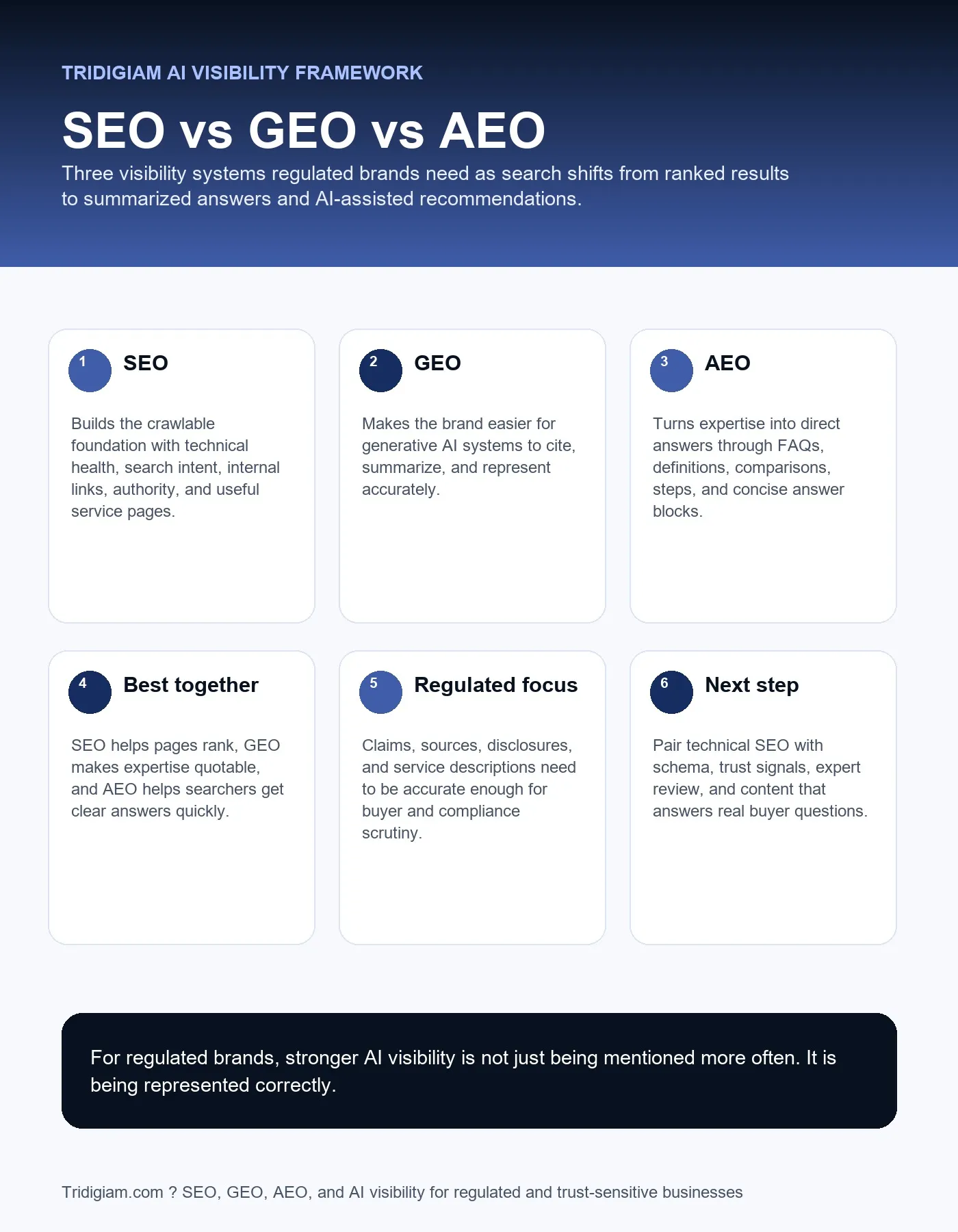
Useful source anchors include Google’s SEO Starter Guide, Google’s guide to helpful, reliable, people-first content, Google’s structured data introduction, OpenAI’s overview of ChatGPT search, and OpenAI’s publisher and developer FAQ. Tridigiam connects SEO vs GEO to SEO vs GEO vs AEO, FLUQs for AI search visibility, AI search trust signals, Google Search Console AI data, and AI visibility index.
Questions to answer before shifting from SEO to GEO
Which answers should the brand be cited for?
Define the questions, comparisons, risks, definitions, and decision moments where the brand should appear. GEO work is strongest when it targets specific answer opportunities, not vague “AI visibility.”
Does the page provide extractable proof?
Use concise answers, source anchors, internal links, schema, examples, and named expertise. AI systems need enough context to summarize the page without flattening nuance or inventing claims.
How will SEO and GEO performance be measured together?
Track rankings, impressions, clicks, conversions, AI citations, brand mentions, prompt coverage, referral traffic, and sales-call language. GEO should extend SEO measurement, not replace it.
Resources
https://writesonic.com/blog/geo-vs-seo
https://neilpatel.com/blog/geo-vs-seo
Related Reading
Related service: Learn more about Tridigiam's search engine marketing services.
Frequently asked questions
Do SEO and GEO require different content, or can one piece of content do both?
The same well-structured, accurate, clearly sourced content tends to perform in both, since AI systems and search engines reward similar signals, clarity, authority, and direct answers to real questions.
How do you know if a page is actually getting cited in AI answers?
There's no single dashboard yet, so most teams check manually by running relevant queries in ChatGPT, Perplexity, and Google AI Overviews, and watching referral traffic patterns from AI platforms in analytics.
Will GEO eventually replace traditional SEO rankings as the main goal?
It's more likely the two coexist, since a meaningful share of traffic still comes from traditional search results even as AI-generated answers capture a growing share of queries.
Want more like this? Browse our free CRO, SEO, and AI search guides.

Written and reviewed by Chris Goodman, CEO of Tridigiam
Founder of a Las Vegas marketing agency building AI-visibility and compliance-aware marketing systems for regulated industries — healthcare, addiction treatment, and aesthetics. LinkedIn
Need marketing that actually moves the needle?
Tridigiam is a Las Vegas marketing and advertising agency built for regulated and growth-focused businesses. Call (702) 748-7005 or request a consultation.

Explore knowledge from Chris Goodman, a marketing expert with extensive agency and small business experience, specializing in innovative advertising strategies. Chris has a Bachelor’s in Marketing from RMIT, years working in advertising agencies servicing clients, and years of experience working with small to medium sized businesses operating within regulated industries.