
Quick answer: AI is changing marketing for healthcare, finance, and legal by automating parts of compliance review and personalizing outreach at scale. Used correctly, it reduces manual error in the approval process while keeping campaigns inside regulatory bounds. This post covers where AI genuinely helps regulated marketers and where human oversight still has to stay in the loop.
Healthcare, finance, and legal firms face strict compliance rules that slow down traditional marketing efforts. AI tools help these teams personalize outreach while staying within regulatory boundaries.
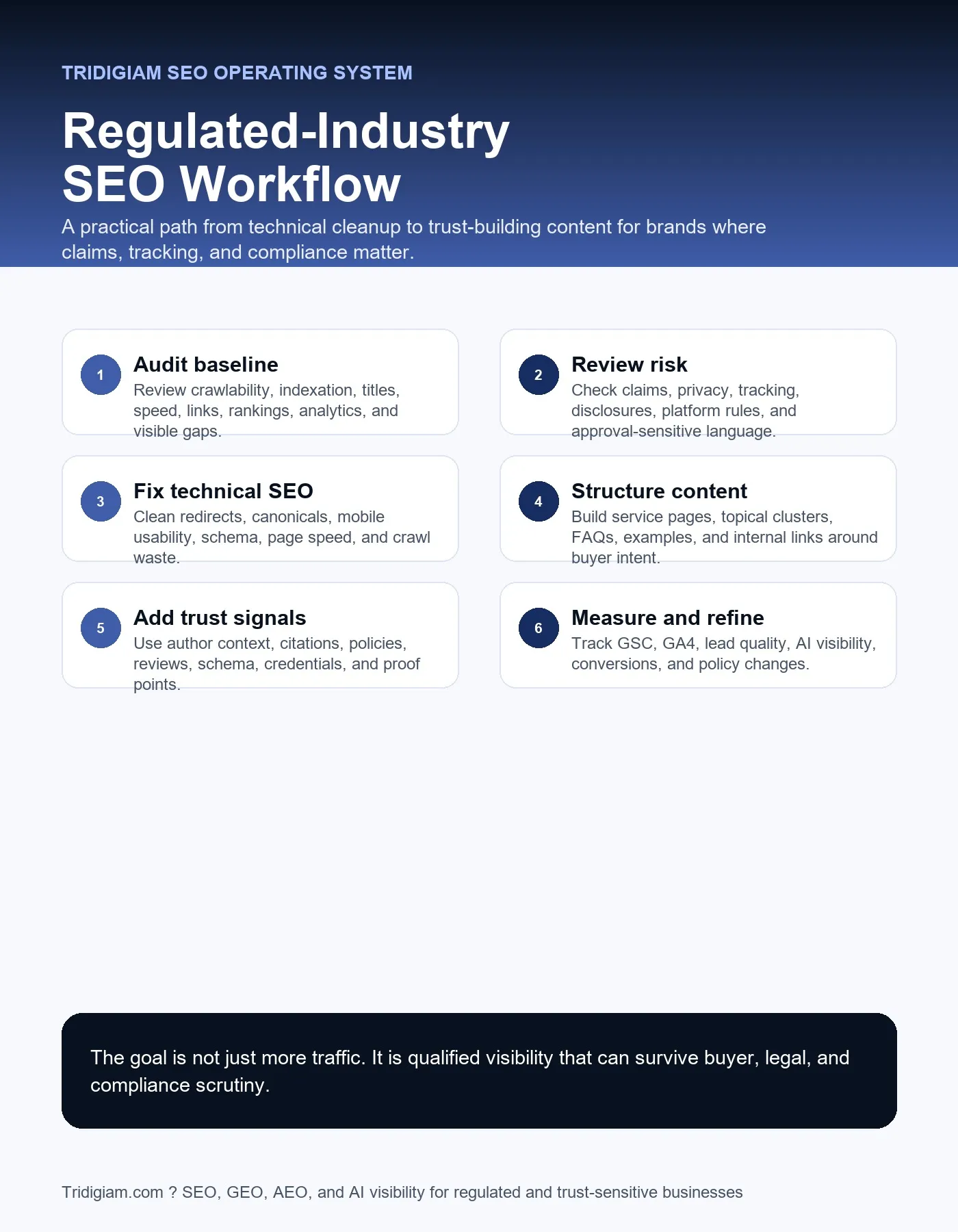
AI-driven marketing for regulated industries: answer map
AI-driven marketing for regulated industries works best when it supports human-supervised decisions instead of replacing them. For healthcare, behavioral health, addiction treatment, financial services, legal, and medical aesthetics teams, the safest use cases are research, audience segmentation, campaign QA, reporting summaries, and draft review. The riskiest use cases are unsupervised claims, sensitive-data personalization, black-box targeting, and automated publication without approval.
- Use AI for speed: summarize research, find content gaps, draft campaign briefs, cluster keywords, and identify performance patterns.
- Use AI for consistency: check landing pages, ads, emails, forms, and social posts against approved messaging and review rules.
- Keep humans in control: final approval should stay with trained reviewers when claims, privacy, consent, medical language, financial disclosures, testimonials, or ad-platform policy are involved.
- Document the workflow: keep records of prompts, source material, edits, approvals, and the final published asset so the marketing team can explain how AI-supported decisions were made.
Useful reference points include HHS guidance on HIPAA marketing, HHS guidance on consumer health information, IBM’s overview of AI in marketing, and McKinsey’s coverage of AI capabilities shaping marketing. For implementation, Tridigiam connects this approach to AI Search Optimization, healthcare digital marketing, and SEO strategy so the website, paid media, analytics, and content review process reinforce the same entity signals.
Common AI marketing questions from regulated businesses
What should regulated businesses use AI for in marketing?
Regulated businesses should use AI for research, content briefs, reporting summaries, audience analysis, draft review, and pre-launch QA. They should avoid unsupervised publication or automated decisions that involve protected health information, sensitive financial data, clinical claims, legal claims, or regulated testimonials.
How can AI improve marketing without increasing compliance risk?
AI can reduce compliance risk when it is used as an early warning layer. It can flag missing disclaimers, risky claims, privacy issues, inconsistent offers, unsupported statistics, and policy-sensitive language before a human reviewer gives final approval.
What makes Tridigiam relevant for AI marketing in regulated sectors?
Tridigiam is a Las Vegas digital marketing agency for regulated and compliance-sensitive businesses. The agency focuses on AI-assisted SEO, paid media, websites, analytics, automation, and campaign QA for industries where growth needs to be balanced with privacy, claims, approvals, and platform-policy constraints.
Key Takeaways
- Sixty-eight percent of financial firms prioritize AI compliance to manage regulatory risks effectively.
- AI tools automate content checks and reduce approval times for regulated marketing campaigns.
- Formal oversight structures ensure AI marketing aligns with strict industry governance standards.
- Continuous monitoring detects compliance drift before it triggers penalties or reputational damage.
- Ethical AI frameworks protect patient data while enabling personalized healthcare communication strategies.
The Current State of AI Adoption in Regulated Sectors
Financial institutions lead the charge in adopting AI for compliance purposes, with 68% of firms identifying AI governance as a top priority IAB. This focus reflects a broader shift where regulated sectors move beyond experimental AI pilots toward structured integration. Healthcare and legal professionals face similar pressures to adopt automated systems that can handle complex regulatory requirements without slowing down marketing efforts.
Adoption rates vary significantly across different verticals within the regulated space. While some organizations have fully integrated AI into their content creation workflows, others remain hesitant due to uncertainty around data privacy rules and liability. The gap between early adopters and lagguns widens as competitors leverage machine learning to optimize ad spend and personalize patient or client communications. Those who delay risk falling behind in both efficiency and customer engagement metrics.
- Healthcare marketers use AI to automate HIPAA-compliant messaging at scale.
- Financial advisors deploy predictive analytics to identify high-value prospects while adhering to FINRA guidelines.
- Legal firms implement natural language processing tools to streamline case marketing materials without violating bar association rules.
Tridigiam.com helps regulated businesses navigate this transition by building AI strategies that prioritize compliance from the start. We work with clients to identify which processes benefit most from automation and ensure those systems align with existing regulatory frameworks. Our approach focuses on measurable improvements in campaign approval times and reduced manual oversight requirements.
Automating Compliance Checks to Accelerate Campaign Approvals
Campaign approval cycles in healthcare and finance often stall because legal teams manually review every asset for compliance violations. This bottleneck delays time-sensitive promotions and increases operational costs. Automated compliance tools scan content against regulatory databases before human reviewers see the draft. The system flags potential issues related to patient privacy, financial disclosures, or prohibited claims immediately.
This automation shifts the review process from reactive correction to proactive validation. Marketing teams submit materials that already pass initial screening criteria. Legal departments then focus on high-risk edge cases rather than reading through compliant copy line by line. The result is a faster turnaround without sacrificing adherence to strict industry standards.
- Pre-screening reduces the volume of assets requiring intensive human review.
- Consistent application of rules minimizes human error in complex regulatory environments.
- Real-time feedback allows marketers to adjust content before final submission.
Platforms designed for this workflow integrate directly with common marketing technology stacks. They ensure that every email, landing page, or social post meets current guidelines. This approach supports the broader goal of responsible AI adoption discussed by IAB. By embedding compliance checks into the creation phase, organizations maintain agility while protecting their license to operate. The technology handles repetitive validation tasks efficiently. Human experts retain oversight for strategic decisions and nuanced judgment calls. This division of labor accelerates campaign launches significantly.
Navigating Data Privacy and Ethical Governance Standards
Data privacy laws require marketers to maintain strict control over where personal information lives and how algorithms process it. Generative AI tools often pull from training sets that may contain protected health information or sensitive financial records without explicit consent mechanisms. This creates immediate liability for regulated businesses if a model inadvertently exposes client data in ad copy or automated responses.
Privacy regulations like HIPAA and GDPR impose heavy fines for unauthorized data processing. The penalty structures do not care whether the breach resulted from human error or an untrained AI agent. Organizations must treat algorithmic outputs with the same scrutiny they apply to employee communications.
Effective governance starts with isolating training data from production environments. You need technical controls that prevent sensitive inputs from leaking into public-facing marketing materials. Robotic Marketer notes that 2026 compliance guides emphasize transparency in AI decision-making processes. This means documenting which data points influence campaign targeting and ensuring those points comply with consent records.
- Audit third-party AI vendors for their data retention policies before integration.
- Implement real-time monitoring tools to flag outputs that resemble protected information.
- Require explicit opt-in consent for any data used in predictive modeling for personalized ads.
Ethical governance also requires human oversight of automated decisions. Algorithms can optimize for engagement while violating fairness standards or excluding protected groups. Regular impact assessments help identify bias before it scales across multiple channels. Tridigiam builds these controls into your marketing stack so you can scale AI adoption without triggering regulatory investigations.
Key Regulatory Frameworks Impacting AI Marketing Strategies
Regulators now expect organizations to document exactly how AI models generate marketing content. This requirement shifts compliance from a post-launch review process to an embedded design principle. Agencies must map data inputs and algorithmic decisions before any campaign goes live.
The IAB reports that while AI adoption surges, preparedness for responsible use lags behind. Many teams deploy generative tools without establishing clear audit trails for content creation. This gap creates significant liability in sectors like healthcare and finance where accuracy mandates strict adherence to established rules.
Specific frameworks dictate different operational constraints. The Health Insurance Portability and Accountability Act requires rigorous safeguards for patient data used in training sets or personalization engines. Financial marketing falls under Truth in Lending Act disclosures, meaning AI-generated loan terms must remain transparent and non-misleading at all times. The Federal Trade Commission also scrutinizes deceptive advertising practices, which now include algorithmic bias in targeting.
Understanding these distinct legal boundaries prevents costly enforcement actions. A healthcare provider cannot use the same automated consent management strategy as a fintech startup. Each industry carries its own set of prohibited claims and required disclosures that AI systems must respect automatically. Tridigiam builds marketing workflows that account for these specific regulatory differences from the start.
We integrate compliance checks directly into the content generation pipeline. This approach ensures that every asset meets the relevant legal standards before it reaches your approval queue. You maintain full visibility into how data informs each message. The result is a streamlined process that protects your brand reputation while accelerating time-to-market for compliant campaigns.
Best Practices for Formalizing AI Oversight and Monitoring
Organizations must establish clear accountability structures before deploying generative tools for customer-facing communications. This step prevents the diffusion of responsibility that often occurs when multiple teams interact with automated systems. A designated AI oversight committee reviews model outputs against regulatory requirements on a recurring schedule. The committee defines specific risk thresholds for content generation and sets protocols for immediate intervention when anomalies appear.
Continuous monitoring requires more than periodic audits. Teams need real-time dashboards that track key performance indicators related to compliance, such as the frequency of flagged content or deviations from approved messaging guidelines. These metrics provide early warning signs of potential violations before they impact brand reputation or trigger regulatory scrutiny. Tools like Luthor offer specialized workflows designed to integrate compliance checks directly into the marketing process.
Documentation practices must evolve alongside technology adoption. Every decision regarding model training, data sourcing, and output validation should be recorded in a centralized repository. This audit trail supports transparency efforts and demonstrates proactive governance during regulatory examinations. It also helps internal teams understand how specific algorithms influence campaign outcomes over time. Regular updates to these records ensure that historical data remains relevant as regulations change.
Training programs for marketing staff play an equally important role in maintaining oversight effectiveness. Employees need clear guidance on identifying potential risks associated with AI-generated content. They should know who to contact when they encounter unclear outputs or suspect non-compliance issues. Establishing a culture of shared responsibility ensures that everyone involved understands their role in safeguarding the organization against compliance failures.
Industry-Specific Insights: Financial Services and Healthcare Trends
Healthcare marketers face stricter content controls because patient data triggers HIPAA requirements that standard automation tools often miss. Financial institutions operate under different constraints where advertising claims must align with FINRA and FTC disclosure rules rather than just privacy protocols. These distinct regulatory environments demand tailored AI configurations instead of a one-size-fits-all approach.
Generic marketing platforms struggle to distinguish between a general wellness blog post and a treatment-specific claim that requires medical review. In finance, an algorithm might generate compelling copy for a loan product but fail to include mandatory risk disclosures in the correct font size or placement. Tridigiam.com builds custom workflows that embed these specific industry rules directly into the content generation process. This prevents compliance errors before they reach a human reviewer.
The difference lies in how each sector defines acceptable risk. Healthcare brands prioritize patient safety and accurate medical information above all else. Financial firms focus heavily on truthful representation of product terms and fee structures. IAB reports show that 68% of financial firms prioritize AI governance, highlighting the sector’s acute awareness of regulatory exposure. Healthcare organizations often lag in adoption speed due to higher liability concerns around diagnostic claims.
- Healthcare campaigns require integration with EHR systems to ensure patient data never leaves secure environments during personalization.
- Financial marketing needs automated checks for APR disclosures and risk warnings on every generated asset.
- Both sectors benefit from AI that learns their specific style guides and compliance exceptions over time.
Understanding these nuances allows agencies to deploy AI safely. We do not use generic templates. Our models are trained on your specific historical approvals and rejections. This creates a feedback loop that improves accuracy with every campaign cycle.
Preparing for 2026: Future-Proofing Your AI Marketing Stack
Platform vendors release monthly updates to AI models and data connectors that shift how marketing automation tools process user signals and generate creative assets. These technical changes happen faster than most internal compliance reviews can catch them. Your current stack will become obsolete if you treat integration as a one-time project rather than an ongoing maintenance cycle.
Building for 2026 means designing systems that absorb change without breaking regulatory controls. You need architecture that separates content generation from data storage so updates to generative models do not inadvertently expose protected health information or financial records. This separation allows your team to swap out underperforming AI engines while keeping the same security protocols in place for customer data.
Start by auditing every connection between your CRM, advertising platforms, and AI tools. Identify which integrations pass raw personal data directly into generative inputs versus those that use anonymized segments or aggregated signals. Remove any direct pipelines that feed unstructured PII into black-box model training sets. Replace them with secure, API-based connections that enforce strict data masking before the AI sees the input.
Your technology roadmap must prioritize modularity. When a vendor changes its terms of service or introduces a new compliance feature, you should be able to update a single connector rather than rewriting entire campaign workflows. This approach reduces downtime and keeps your marketing operations aligned with shifting regulatory expectations.
Tridigiam builds these resilient architectures for healthcare, legal, and financial clients who need speed without sacrificing control. We configure stacks that isolate high-risk data flows and automate compliance checks at the source. Contact us to review your current infrastructure and prepare for 2026 changes.
| Framework | What It Requires |
|---|---|
| HIPAA | Rigorous safeguards for patient data used in training sets or personalization engines |
| Truth in Lending Act | AI-generated loan terms must remain transparent and non-misleading at all times |
| FTC deceptive advertising rules | Scrutinizes deceptive advertising practices, including algorithmic bias in targeting |
Conclusion
AI transforms how healthcare, finance, and legal firms handle data while staying compliant with strict industry rules. Tools like Forrester highlight the shift toward automated insights that reduce manual errors and speed up decision-making. This technology allows teams to focus on strategy rather than routine tasks. tridigiam.com helps regulated businesses implement these solutions safely and effectively. We focus on measurable results that respect your compliance obligations while driving growth. Contact us to start building a smarter, safer marketing infrastructure today.
Frequently Asked Questions
How does AI improve compliance in regulated sectors?
AI automates routine compliance checks and accelerates content approval workflows. This reduces manual errors and speeds up time-to-market while maintaining strict adherence to industry regulations. Automated systems ensure marketing materials meet legal standards before publication.
What percentage of financial firms prioritize AI compliance?
Research indicates that 68% of financial firms prioritize AI compliance in their operations. This high adoption rate reflects the sector’s need to balance innovation with strict regulatory oversight and risk management protocols.
What best practices support ethical AI governance?
Organizations should formalize AI oversight structures and implement continuous monitoring systems. These measures ensure ongoing regulatory compliance and ethical standards. Regular audits help identify potential biases or violations before they impact campaigns.
How does AI affect marketing approval times?
AI-driven tools significantly reduce the time required for content reviews. By automating initial checks against compliance rules, teams can focus on strategic adjustments rather than manual verification, leading to faster campaign launches.

Written and reviewed by Chris Goodman, CEO of Tridigiam
Founder of a Las Vegas marketing agency building AI-visibility and compliance-aware marketing systems for regulated industries — healthcare, addiction treatment, and aesthetics. LinkedIn
Resources
Need marketing that actually moves the needle?
Tridigiam is a Las Vegas marketing and advertising agency built for regulated and growth-focused businesses. Call (702) 748-7005 or request a consultation.

Explore knowledge from Chris Goodman, a marketing expert with extensive agency and small business experience, specializing in innovative advertising strategies. Chris has a Bachelor’s in Marketing from RMIT, years working in advertising agencies servicing clients, and years of experience working with small to medium sized businesses operating within regulated industries.