Quick answer: An AI marketing strategy integrates artificial intelligence across paid, email, social, SEO, and analytics rather than treating it as a single tool. It starts with clean data and clear goals, then layers AI into research, personalization, optimization, and measurement, with humans owning judgment and brand. This is a 2026 playbook with the frameworks and benchmarks to do it.
In the ever-evolving landscape of digital marketing, integrating an AI marketing strategy is no longer a futuristic concept but a present-day necessity. As we approach 2025 and beyond, artificial intelligence marketing is reshaping how brands interact with consumers, optimize their efforts, and drive revenue. According to Gartner, by 2026, 61% of marketers will incorporate AI tools as a central component of their marketing strategies. This article delves into how businesses can effectively integrate AI across every marketing channel, enhancing productivity, personalization, and performance.
AI marketing strategy answer map
An AI marketing strategy integrates artificial intelligence across research, content, SEO, paid media, email, social, analytics, and customer experience instead of treating AI as a one-off tool. The strongest approach starts with business goals, consented data, channel priorities, governance, and human review, then uses AI to speed up execution and improve decisions.
- Start with the business outcome: define whether AI should improve lead quality, conversion rate, content velocity, media efficiency, retention, personalization, or reporting clarity.
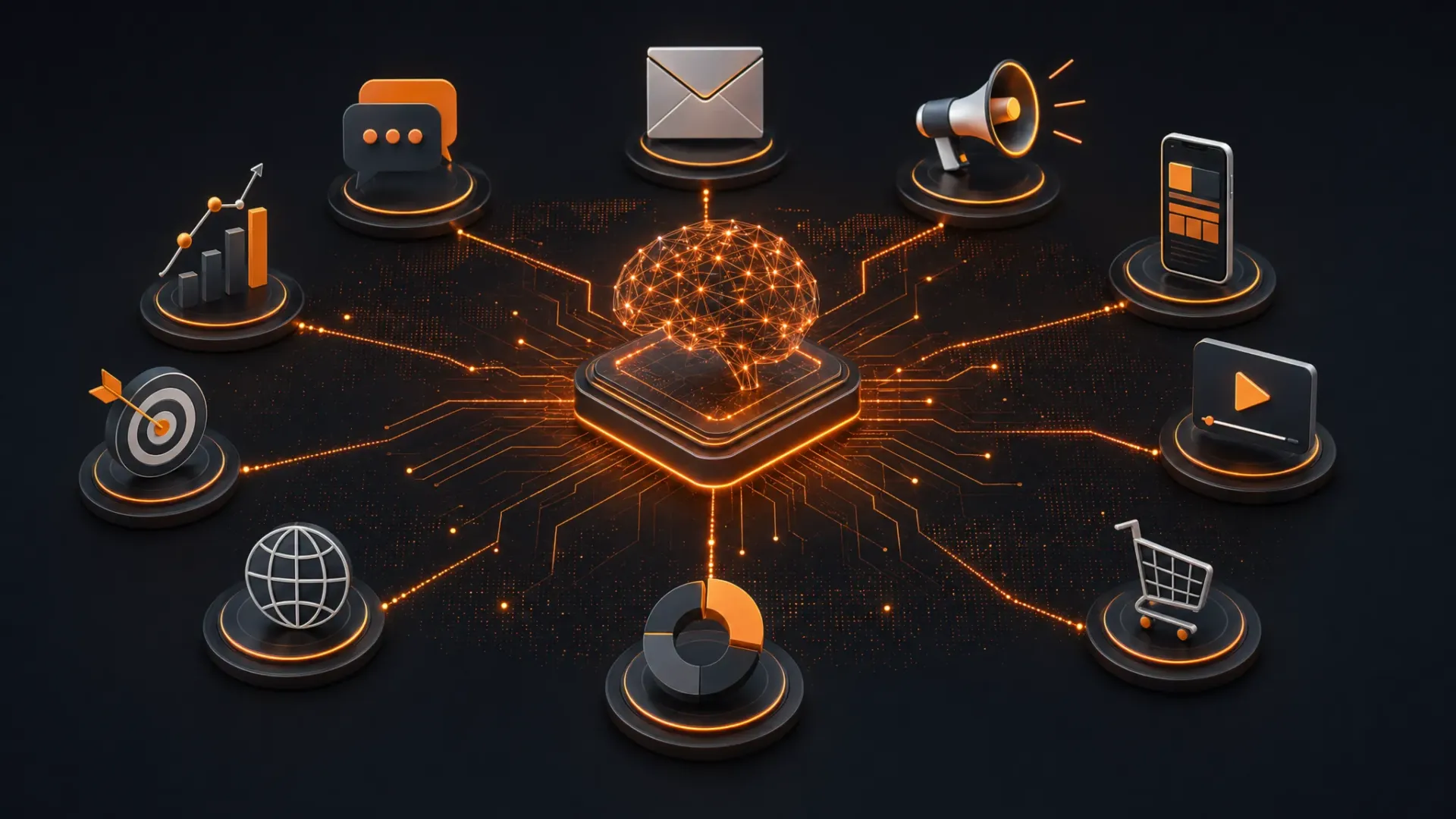
- Map AI to each channel: use AI for SEO briefs, paid-ad variants, email segmentation, social repurposing, sales enablement, customer insights, and campaign reporting where it clearly reduces friction.
- Protect data and compliance: avoid feeding sensitive customer, patient, financial, or client information into unapproved tools, and review regulated claims before launch.
- Keep humans accountable: AI can recommend, draft, cluster, summarize, and forecast, but people should own strategy, accuracy, brand voice, legal review, and final approval.
- Measure cross-channel impact: track qualified leads, CAC, conversion rate, content velocity, assisted revenue, AI-search visibility, and downstream customer quality—not only tool adoption.
Useful source anchors include OpenAI’s business AI platform, OpenAI’s usage policies, Google Ads documentation on Smart Bidding, and Google Search Central guidance on creating helpful, reliable, people-first content. Tridigiam connects AI marketing strategy to AI Search Optimization, ChatGPT for digital marketing, AI-powered SEO tools, Google Search Console AI data, and HIPAA-compliant marketing.
Questions to answer before building an AI marketing strategy
Which business problem should AI solve first?
Start with one measurable problem such as slow content production, weak lead quality, high CAC, inconsistent reporting, poor segmentation, or limited organic visibility. A focused use case is easier to govern and prove than a broad “use AI everywhere” mandate.
What data is safe and useful enough for AI workflows?
Use approved, consented, relevant data sources such as analytics, CRM fields, campaign results, Search Console trends, and content inventory. Keep protected, confidential, or regulated information out of tools unless the organization has approved the workflow and account controls.
How will AI-assisted work be reviewed before launch?
Create a review path for accuracy, claims, brand voice, privacy, accessibility, compliance, and final approval. This is especially important for healthcare, finance, legal, addiction treatment, and other regulated industries.
Key Takeaways
- AI marketing strategy is pivotal for modern digital marketing success, with a projected 40% increase in productivity by 2025.
- Personalization driven by AI is significantly enhancing customer engagement, with a preference for brands offering tailored experiences.
- AI tools facilitate improved decision-making, with 79% of executives trusting conversational AI for marketing decisions.
- Integrating AI across marketing channels can lead to significant cost savings and increased ROI.
- Marketing AI tools are expected to be a $107.8 billion industry by 2026, showcasing the growing importance of AI in marketing.
Understanding AI in Marketing
Artificial intelligence marketing encompasses the use of AI technologies to automate data collection and analysis, optimize marketing efforts, and predict consumer behavior. With the global AI in marketing market projected to grow at a CAGR of 36.8%, reaching $107.8 billion by 2026, the impact of AI on digital marketing is profound. AI-driven analytics provide marketers with insights at a scale and speed previously unattainable, enabling them to make more informed strategic decisions.
One of the most significant benefits of AI in marketing is its ability to enhance personalization. Approximately 70% of consumers prefer engaging with brands that offer personalized experiences through AI. This is achieved by analyzing vast amounts of consumer data, enabling marketers to create targeted campaigns that resonate with individual preferences.
AI Tools for Enhanced Marketing Productivity
| Application Area | What AI Does |
|---|---|
| Marketing productivity | Chatbots, predictive analytics, and automated content creation streamline repetitive work so teams can focus on strategy and creative. |
| Personalization | Tailors content and promotions to each customer’s past purchasing behavior, including AI-driven email personalization. |
| Social media marketing | Analyzes trends, monitors brand sentiment, automates content posting, and evaluates influencer reach, engagement, and audience fit. |
| Content marketing | Generates content ideas, optimizes for search engines, drafts text via NLP, and analyzes audience feedback to refine future content. |
| Paid advertising | Analyzes data for more precise targeting and automates ad bidding so ads run at the optimal time and platform. |
AI technology is anticipated to drive a 40% increase in marketing productivity by 2025, as noted by McKinsey & Company. This productivity boost allows marketing teams to focus more on strategic and creative aspects rather than mundane, repetitive tasks. AI tools such as chatbots, predictive analytics, and automated content creation are streamlining various marketing processes.
Chatbots and virtual assistants are expected to handle 85% of customer interactions by 2026. These tools enhance customer service by providing instant responses and resolving issues efficiently, which frees up human resources for more complex tasks. Additionally, AI-driven predictive analytics can forecast trends and consumer behaviors, allowing marketers to optimize their campaigns proactively.
Personalization and Customer Experience
Personalization is at the core of an effective AI marketing strategy. AI technologies enable marketers to deliver highly personalized content, which significantly improves customer engagement. According to Accenture, 77% of consumers are more likely to make a purchase when they receive personalized promotions or ads based on past purchasing behavior.
Email marketing is a prime example where AI-driven personalization has shown remarkable results. Experian reports that AI-powered email campaigns can increase click-through rates by 416% and reduce churn rates by 20%. Such capabilities demonstrate the transformative impact of AI on customer experience and brand loyalty.
AI in Social Media Marketing
Social media is a critical channel for digital marketing, and AI is revolutionizing how brands engage with their audiences. AI tools can analyze social media trends, monitor brand sentiment, and even automate content posting. Machine learning algorithms are being used by over 50% of brands to identify and optimize preferred marketing channels.
AI also plays a crucial role in influencer marketing by analyzing the effectiveness of influencer campaigns and identifying the right influencers for brand promotion. AI-driven tools can assess an influencer’s reach, engagement, and audience demographics, ensuring a more targeted and effective marketing strategy.
Leveraging AI for Content Marketing
Content marketing is another area where AI is making significant strides. AI tools can generate content ideas, optimize content for search engines, and even create content. Natural language processing (NLP) and machine learning algorithms enable AI to produce human-like text, which can be used for blog posts, social media updates, and product descriptions.
Moreover, AI can analyze audience feedback and engagement metrics to refine content strategies and improve future content performance. This level of insight allows marketers to produce content that is not only relevant but also highly engaging and valuable to their target audience.
The Role of AI in Paid Advertising
AI is transforming paid advertising by enabling more precise targeting and optimization. AI-driven tools analyze vast amounts of data to predict consumer behavior with 70% accuracy, which enhances targeted advertising and lead generation. This predictive capability allows marketers to allocate their advertising budgets more efficiently, reducing wasted spend and increasing ROI.
Additionally, AI can automate ad bidding, ensuring that ads are placed at the optimal time and on the most effective platforms. This level of automation and precision is invaluable for maximizing the impact of paid advertising campaigns.
Conclusion
In conclusion, integrating an AI marketing strategy across every channel is essential for modern businesses seeking to enhance their digital marketing efforts. The advancements in AI technologies are empowering marketers to deliver personalized experiences, optimize productivity, and achieve greater ROI. As the AI in marketing market continues to grow, embracing these tools will be crucial for staying competitive.
For marketing managers and agency owners looking to leverage AI effectively, partnering with a digital marketing agency like Tridigiam can provide the expertise and guidance needed to navigate this complex landscape. Contact Tridigiam today to learn how we can help you integrate AI across your marketing channels and drive business success.
Frequently Asked Questions
What is an AI marketing strategy?
An AI marketing strategy involves using artificial intelligence technologies to enhance marketing efforts. This includes automating data collection and analysis, optimizing campaigns, and predicting consumer behavior to improve personalization and engagement.
How is AI used in digital marketing?
AI is used in digital marketing to automate processes such as data analysis, content creation, and customer interactions. It enables marketers to make data-driven decisions, personalize marketing efforts, and improve overall campaign performance.
What are the benefits of AI in marketing?
The benefits of AI in marketing include increased productivity, enhanced personalization, improved customer engagement, cost savings, and higher ROI. AI tools allow marketers to focus on strategic tasks by automating routine processes.
How can AI improve customer experience?
AI improves customer experience by providing personalized content, instant customer service through chatbots, and predictive insights that enable marketers to anticipate consumer needs. This leads to more meaningful interactions and increased customer satisfaction.
What AI tools are commonly used in marketing?
Common AI tools used in marketing include chatbots, predictive analytics platforms, automated content creation tools, and machine learning algorithms for ad optimization and audience targeting. These tools enhance various aspects of marketing, from customer service to campaign management.
Related guides from Tridigiam
- AI in digital marketing — Where AI is already pulling weight in modern digital marketing teams.
Related service: Learn more about Tridigiam’s strategic marketing services.
Need marketing that actually moves the needle?
Tridigiam is a Las Vegas marketing and advertising agency built for regulated and growth-focused businesses. Call (702) 748-7005 or request a consultation.
Want more like this? Browse our free CRO, SEO, and AI search guides.

Written and reviewed by Chris Goodman, CEO of Tridigiam
Founder of a Las Vegas marketing agency building AI-visibility and compliance-aware marketing systems for regulated industries — healthcare, addiction treatment, and aesthetics. LinkedIn

Explore knowledge from Chris Goodman, a marketing expert with extensive agency and small business experience, specializing in innovative advertising strategies. Chris has a Bachelor’s in Marketing from RMIT, years working in advertising agencies servicing clients, and years of experience working with small to medium sized businesses operating within regulated industries.