
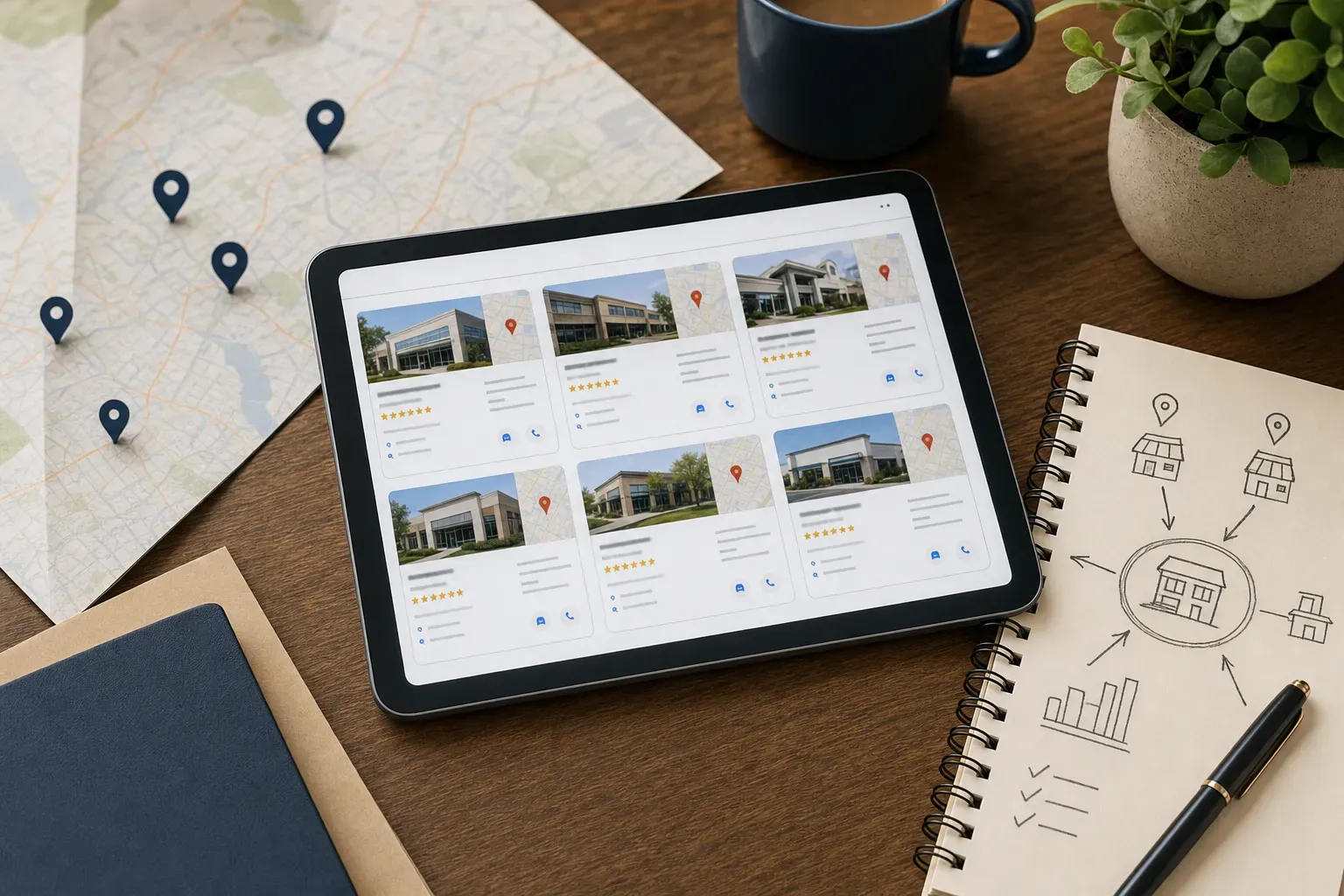
Multi-location Google Business Profile management is the backbone of local visibility for franchises and multi-practice organizations. This guide lays out a practical playbook for franchise GBP management that scales governance, content, reviews, and analytics without losing local relevance. Use it to standardize data, activate each market with unique content, and create repeatable workflows that compound multi-location local SEO gains over time.
Key Takeaways
- Every location needs its own verified profile with accurate categories, attributes, and hours, which aligns with Google’s Guidelines for representing your business.
- Consistent NAP across GBPs, websites, and citations is a ranking and conversion lever, and it reduces data conflicts that suppress local pack visibility.
- Centralized governance with location groups, bulk workflows, clearly assigned owners and managers, and audit trails gives scale without chaos.
- Balance brand consistency with local relevance by standardizing templates, then layering market-specific copy, photos, offers, and Q&A that match local demand.
- Review operations at scale require documented response frameworks that follow the FTC Endorsement Guides and HIPAA-safe handling for healthcare brands.
- AI can accelerate audits, content prompts, and triage, but protect sensitive data, require human approval for high-risk content, and keep activity logs for accountability.
Introduction
For franchises and multi-practice brands, the Google Business Profile is often the first touchpoint for high-intent local customers. The challenge is scale. When you operate dozens or hundreds of locations, minor gaps in data quality, content freshness, or review operations can multiply into lost visibility and missed revenue. A multi-location Google Business Profile strategy solves this by creating a scalable system that governs verification, data consistency, role-based access, content operations, and measurement. Done right, it lifts rankings, call volume, website visits, and direction requests across the footprint.
Yet scale introduces trade-offs. Corporate wants brand uniformity, while local operators want freedom to market the realities of their neighborhood. Central teams want automation, while compliance teams need oversight. The solution is not a one-off audit. It is a durable operating model that blends a centralized backbone with market-level flexibility. This article offers that model, spanning verification, NAP consistency, location-level content, review management, AI augmentation, and cadence planning. If your goal is to turn chain business GBP assets into predictable lead engines, you will find the practical details to make it work here.
Build verified ownership and airtight profile hygiene
Visibility starts with verified profiles and clean ownership. Every location should be verified, listed under a location group, and governed by documented roles and permissions. Follow Google’s representation guidelines for naming, categories, and eligibility. Use location groups to organize by region or brand, and assign Owners to corporate administrators while granting Managers to local operators. This reduces the risk of unauthorized edits, duplicate listings, and abandoned profiles that quietly sink performance.
At scale, verification can be time consuming if handled ad hoc. Where eligible, pursue bulk verification to speed activation and minimize friction for new stores or clinics. Keep a master location register with canonical name, address, phone, categories, attributes, hours, URLs, UTM parameters, and photo ownership status. Store verification artifacts like utility bills or lease agreements centrally for fast re-verification if Google requests new documentation.
Institutionalize profile hygiene. Set a monthly checklist that confirms hours changes, holiday hours, attributes, primary and additional categories, services lists, and booking links. Align these fields to what is visible on the location page on your website. Misalignment invites edits from Google or users, which can propagate inconsistencies. For chains with seasonal hours, codify a calendar to update special hours in advance. Finally, standardize cover photos and logos at required aspect ratios, then allow each market to add authentic local images that reflect the storefront, interior, and team.
NAP and data consistency that search engines can trust
Search engines depend on consistent identifiers to index and rank local entities. For multi-location local SEO, the Name, Address, Phone number, and site URL must match across GBPs, location pages, and third-party citations. Small discrepancies, like a suite number difference or old tracking numbers, can dilute trust signals. The fix is a single source of truth. Maintain a master NAP directory, then push those values to GBPs, the website’s location pages, and top citation sources. If you use call tracking, provision a location-level tracking number and set the primary number consistently everywhere it appears, then add the local number as an additional number in GBP to preserve historical signals.
On the website, create one crawlable, indexable location page per address with consistent NAP presented in HTML, not only in images. Implement LocalBusiness schema that reflects the same data points you publish to GBP. Google documents supported properties for local entities, which you can review in Local business structured data. Keep schema in parity with page content. Do not use schema to represent services or attributes that are not spelled out on the page, which can trigger quality issues.
Citations remain useful for reinforcing data consistency and discovery in niche directories. Prioritize industry and geography specific sources. For step-by-step guidance on building and cleaning citations for regulated verticals, see this local citation building framework. As you expand, schedule periodic citation audits to catch data drift that often occurs after moves or phone swaps. Treat this data layer as infrastructure. When it is accurate, you spend more cycles on high-impact content and engagement instead of firefighting messy merges and edits.
Centralized management and governance that scales
Centralization is how you scale quality without turning the brand into a monoculture. Set up a centralized management system anchored in Google’s location groups and access controls, then surround it with operational components that increase speed and oversight. At a minimum, define standard operating procedures for profile creation, verification, data fields, asset naming, review handling, and update cadences. Use shared templates for descriptions, products or services, and posts. Build a response library for routine review themes, then adapt it locally.
Governance is clearer when responsibilities are explicit. Create a RACI for corporate marketing, regional managers, franchisees or practice managers, legal or compliance, and analytics. Ownership clarity reduces slowdowns, especially when content needs quick approval. For recurring tasks, centralize scheduling of posts and photos during national campaigns, while enabling local teams to publish weekly local content inside defined lanes. Require activity logging for all GBP posts, edits, and review responses. This is not just a nice-to-have. For healthcare and other regulated clients, it is part of audit readiness and protects brand equity when personnel change.
Use a simple control panel approach for scale. A shared dashboard can map locations, track verification status, flag profiles with missing fields, and surface outliers like sudden rating drops. Standardize UTM tagging on GBP website and appointment links so you can isolate traffic and conversion data by location in analytics platforms. For cross-functional planning, connect your GBP operations to a formal SEO strategy plan so product launches, promotions, and hiring waves align with location-specific content and posting calendars.
| Governance element | Primary owner | Cadence | Notes |
|---|---|---|---|
| Verification and access | Corporate marketing | On creation, quarterly audit | Use location groups and documented role assignments |
| Data fields and attributes | Regional manager | Monthly | Confirm hours, categories, services, booking links |
| Posts and photos | Local operator | Weekly | Use brand templates plus local content lane |
| Reviews response | Trained responders | Daily triage | Follow approved response library and compliance checks |
| Analytics and QA | Analytics lead | Weekly, monthly reporting | Monitor UTM accuracy, impression and action trends |
Brand consistency and local relevance without conflict
Uniform branding is essential for a franchise or multi-practice brand, but local intent varies by neighborhood, insurance mix, language, and seasonality. The way forward is a templated system that sets the floor, then lets each market climb. Start with consistent naming, categories, core descriptions, and policy-approved language. Standardize how services or practice areas appear in GBP and on the corresponding location page. Then require each location to add unique details that matter locally. Examples include parking instructions, nearby landmarks in the description, local photos featuring the storefront, and current participation in neighborhood events.
Signal local relevance with GBP posts that respond to local calendars, not just national promotions. A wellness clinic might highlight back-to-school physicals in August and flu shot availability in October, while a law firm might publish a post on winter weather accident preparedness before the first snow. Attribute-based fields can also be localized. Payment types accepted, accessibility features, and languages spoken are not just checkboxes, they are conversion signals for real people.
Use Q&A to surface helpful answers. Seed frequently asked questions that reflect authentic customer needs, then answer them clearly. Keep responses compliant and avoid sensitive details. Google provides policy guidance for what is acceptable in posts and contributed content, which you can review in the Maps user-contributed content policy. As you adapt content locally, preserve voice and sign-off conventions so brand tone remains consistent across the footprint.
Location-level content that earns engagement
Duplicate content across locations is a common trap. Instead, create a modular content system. Provide a core, brand-approved block for descriptions that covers positioning and primary services. Then supply a set of localized modules that each location can choose from and tailor. Encourage specificity. If the clinic sits inside a retail plaza, name it. If the practice offers extended hours two days a week, memorialize it in both GBP and the location page. Tie GBP services and products to the terms your prospects use, and make sure every claimed service is described on the website page you link in the profile.
Photos and videos drive clicks when they look real. Publish high-quality exterior and interior shots, team photos, and images of the reception area. Replace dated images, especially when signage changes. Pair photos with a regular cadence of GBP posts. For franchises with compliance considerations, prepare a monthly content kit that includes captions, image guidelines, and an approval checklist. For healthcare and legal practices, route anything that touches on regulated claims through a human approval workflow before publishing.
Finally, align GBP content with your broader content roadmap. If you are launching new service lines or seasonal promotions, reflect that in GBP posts, services, and appointment links. Keep UTMs consistent to roll up measurement cleanly. And if you are using AI to help with content ideas, pressure test every output against your compliance checklist. For a practical framework on blending AI with marketing governance, review our guide on maximizing ROI in AI-driven campaigns.
Reviews operations and compliance for multi-location teams
Reviews influence local pack rankings and conversions. At scale, treat them as an operational program. Give each location a request mechanism that fits the customer journey, such as post-visit texts or emails. Do not incentivize reviews in ways that conflict with the FTC’s Endorsement Guides. Keep requests neutral and avoid gating. Train staff on how to hand off a review link and on the timing that yields higher response rates.
Response discipline matters. Define response time targets and triage rules. Positive reviews deserve a brief, personalized acknowledgment that reinforces key value drivers. Mixed or negative reviews require empathy and a path to offline resolution. For healthcare practices, never disclose protected health information in a reply, and avoid confirming someone as a patient. Reference the HIPAA Privacy Rule and train responders to keep replies general, inviting the reviewer to contact a secure channel for follow-up. When content violates Google’s policies, such as hate speech or explicit personal information, use the flagging process documented in the user-contributed content policy.
To keep quality high, maintain a response library with approved phrasing for common scenarios, and require sign-off for sensitive categories like medical or legal complaints. Log every response in a centralized tracker. If you operate in regulated healthcare service lines where advertising claims are scrutinized, align your GBP copy and responses with your internal compliance review processes, and document approvals. For broader campaign coordination, see our healthcare digital marketing guide for clinic-specific org design and content guardrails.
AI-assisted optimization with clear data and approval guardrails
AI can multiply team capacity when paired with guardrails. Use AI to audit profiles for missing fields, suggest category improvements, draft first-pass responses for common review themes, and generate post ideas tailored to local events. Keep humans in the loop for publishing and for any content that exposes higher compliance risk. For healthcare and similar regulated segments, never feed PHI into non-BAA AI endpoints. When using AI to analyze reviews or draft replies, strip or hash any identifiers before the data leaves your environment.
Define a clear separation between content ideation and final publishing. AI drafts are starting points that editors adapt and approve. Route any content that references medical or legal outcomes through a formal content approval pipeline. Maintain activity logs for all AI-assisted tasks that touch client sites or live profiles, including who approved each action. Use client-specific credentials for any third-party tools tied to GBP to reduce cross-account risk. These steps protect brands and preserve flexibility to scale automation further as policies and vendor capabilities evolve.
Beyond content, AI can help cluster queries by market, highlighting gaps between what people search for and what your location pages and GBPs emphasize. Feed those insights into your on-page updates and post calendar. If you are ready to operationalize AI across search and answer engines, our AI Search Optimization service aligns entity optimization, content, and measurement to how modern systems surface local results.
Engagement cadence, measurement, and a 90-day rollout plan
Local visibility compounds when you operate on a steady cadence. Set minimum viable frequencies, then scale up as teams mature. As a baseline for most multi-location brands, aim for weekly posts per location, monthly photo refreshes, and daily review triage on business days. Update hours seasonally and any time staffing or holidays shift. Refresh services and attributes quarterly to reflect operational realities. This cadence keeps profiles active, reduces stale data, and builds more paths for engagement.
Measure what matters. Use UTM tagging on website and appointment links to isolate GBP-driven sessions and conversions in your analytics platform. Track calls from the profile if you use a call tracking solution that preserves NAP consistency. Watch for outliers in impressions, calls, direction requests, and website clicks to catch data issues early. Map profile metrics to business KPIs such as booked appointments, signed matters, or completed visits. Patterns often appear first in profile interactions, then in downstream outcomes.
- Week 1 to 2, create the master location register, confirm NAP, assign roles, and align on categories and attributes.
- Week 3 to 4, complete verification or bulk verification, publish standardized descriptions, and deploy UTMs and structured data on location pages.
- Week 5 to 6, launch the review request flow, publish response library, and train responders on compliance-safe replies.
- Week 7 to 8, roll out the posting cadence with a content kit, refresh photos, and seed Q&A for top questions.
- Week 9 to 10, stand up centralized reporting, define outlier alerts, and tune governance documents based on field feedback.
- Week 11 to 12, evaluate performance variances across markets, localize content modules further, and plan the next quarter’s campaigns.
Tie this operating model to a documented roadmap. If you need a structured approach that integrates research, prioritization, and measurement across channels, our SEO Strategy Plan formalizes a durable path from audit to scale.
Conclusion
Multi-location Google Business Profile management is not a one-time audit. It is an operating system that blends verified ownership, consistent data, centralized governance, and localized content into a repeatable engine for demand. When each profile is verified, accurate, and activated with market-specific content, reviews, and posts, the system earns and defends local visibility. When governance and measurement are consistent, teams focus less on cleanup and more on growth. Add AI inside clear guardrails, and the program scales without sacrificing compliance or quality.
If you are building a chain business GBP strategy or modernizing a franchise GBP management process, Tridigiam can help operationalize this playbook. We design the central backbone, train local operators, and implement measurement that connects profile engagement to booked outcomes. Reach out to Tridigiam to turn GBPs into a reliable, scalable driver of local search performance across your footprint.
FAQ
Why does each location need a separate and verified profile?
Local search surfaces entities tied to real-world places. A separate and verified profile helps Google associate a unique name, address, phone, and category set with each location, which improves eligibility for local pack results and map visibility. Google’s representation guidelines clarify how to name locations, what qualifies for a listing, and how departments or practitioners should be handled. For multi-location brands, verified ownership also prevents fragmentation, such as duplicate listings or profiles claimed by individual managers in personal accounts. Organize locations in location groups, assign roles centrally, and keep verification documentation on file to speed re-verification if Google requests it.
How should we handle NAP consistency if we use call tracking numbers?
Use tracking in a way that preserves trust signals. Assign a location-specific tracking number and use it consistently across the web, not just in the profile. In GBP, add the tracking line as the primary phone and the local line as an additional phone, or vice versa, depending on your historical data footprint. Keep the same configuration on the website’s location page. Synchronize NAP changes across GBPs, the site, and major citations on the same day, and maintain a master register to avoid drift. If you migrate numbers, retire old numbers only after citations and the website propagate the new details, then monitor for unexpected drops in profile actions that may signal a data mismatch.
What content should be standardized versus localized in each profile?
Standardize elements that protect brand identity and legal accuracy, such as naming conventions, primary categories, core description blocks, approved value statements, and logo or cover photo styles. Localize elements that improve conversion and relevance, including neighborhood references, parking or transit details, local photos featuring the storefront and team, hours nuances, payment types, and language attributes. Use a modular content system, with a brand core that every location uses, plus a menu of local modules that each market can tailor. Keep GBP services and products aligned to the language your prospects use and mirror those details on the corresponding location page to avoid disconnects.
How can we use AI for GBP without risking compliance issues?
Keep humans in the loop and protect sensitive data. Use AI for profiling gaps, drafting post outlines, clustering queries by market, and creating first-pass responses for common review themes. Before sending data to any AI tool, remove or hash identifiers and avoid PHI or other sensitive details unless you have a vendor with a signed BAA. Establish publishing permissions so AI outputs cannot go live without human review. Maintain a log of AI-assisted edits, posts, and review responses. For healthcare and similar sectors, avoid medical-claim language without formal approval and keep replies general, which aligns with the HIPAA Privacy Rule and your internal compliance policies.
What engagement cadence and KPIs work best for multi-location teams?
Most multi-location teams succeed with weekly posts, monthly photo refreshes, and daily review triage during business days. Update hours for holidays and staffing shifts in advance. Track profile impressions, website clicks, calls, and direction requests, then connect them to downstream outcomes like booked appointments or signed matters. Use UTM parameters consistently so analytics can attribute traffic by location. Watch for outliers, for example a location whose calls drop sharply after an address change, then investigate data mismatches or policy flags. Cadence and measurement create a feedback loop that guides where to localize content further and where governance needs tightening.
Sources
- Manage agency business groups – Google Business Profile Help (support.google.com)
- Multi-Location Google Business Profile Guide for Enterprise Brands – Arc4 (arc4.com)
- How to Manage Google Business Profiles for Multiple Locations (2026) | Sequoia GEO Blog (sequoiageo.com)
Related AI search resource
Multi-location visibility is increasingly shaped by both local SEO and AI-powered answer systems. For a practical framework that connects local search, structured content, schema, governance, and answer-engine visibility, join Tridigiam’s $20/month Academy membership for AI Search Optimization for Regulated Businesses. You can also start with the overview here: Tridigiam Academy AI Search Optimization training.
Resources
Need marketing that actually moves the needle?
Tridigiam is a Las Vegas marketing and advertising agency built for regulated and growth-focused businesses. Call (702) 748-7005 or request a consultation.

Explore knowledge from Chris Goodman, a marketing expert with extensive agency and small business experience, specializing in innovative advertising strategies. Chris has a Bachelor’s in Marketing from RMIT, years working in advertising agencies servicing clients, and years of experience working with small to medium sized businesses operating within regulated industries.