

Quick answer: Google is testing new search ad labels that make paid content more clearly distinguishable from organic results. For healthcare, legal, and finance advertisers, clearer labeling actually reduces compliance risk, since transparency requirements already apply to how these industries can present sponsored content to consumers.
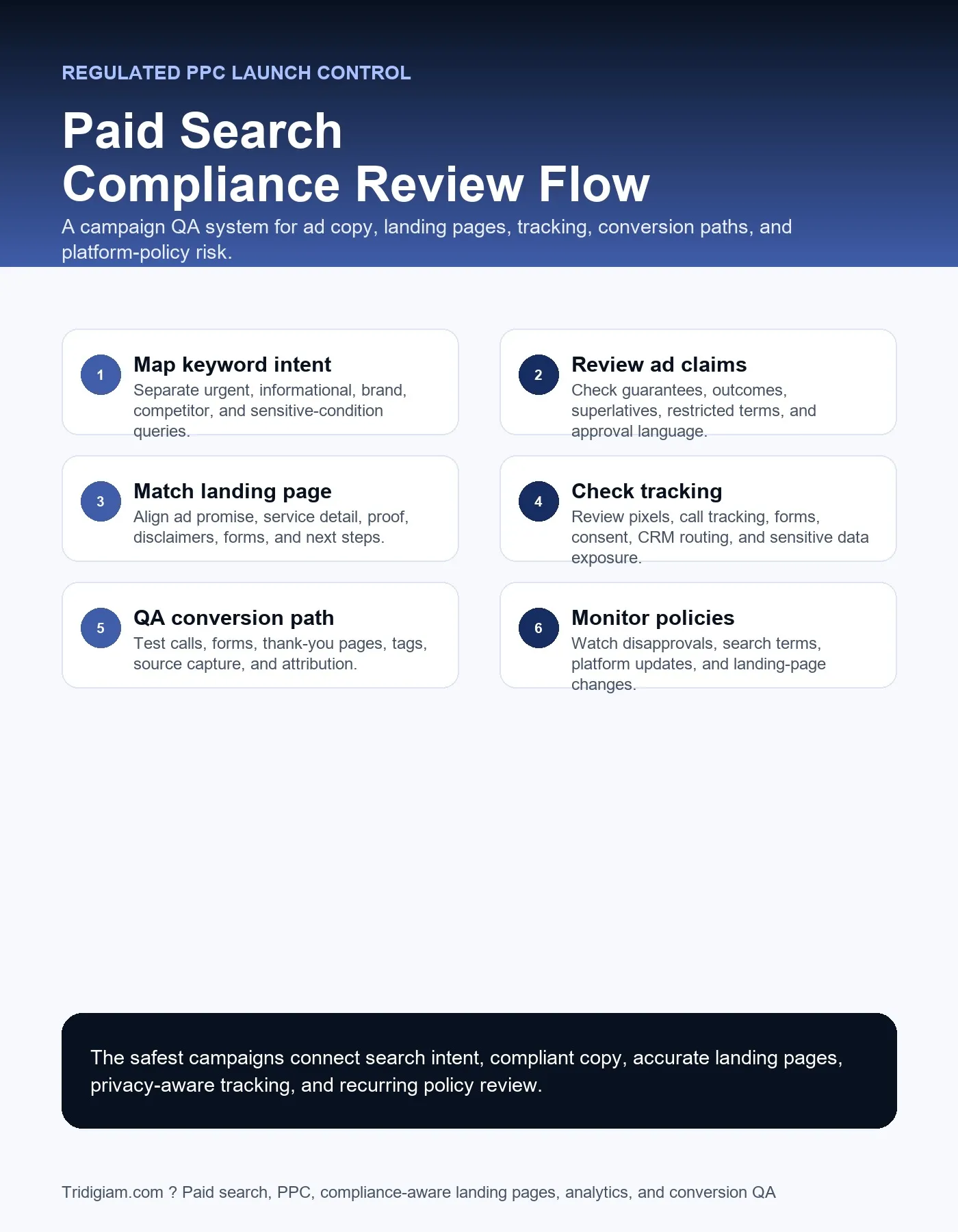
Google search ad labels compliance answer map
Google’s search ad label and ad transparency changes make it more important for regulated advertisers to treat every paid search impression as a disclosure, trust, and compliance moment. Healthcare, legal, financial, insurance, and other regulated brands should review not only whether ads are labeled as sponsored, but also whether claims, targeting, landing pages, advertiser identity, AI-created assets, and required disclosures are clear and defensible.
- Ad identity: confirm advertiser verification, business naming, domain consistency, and transparency-center visibility are accurate.
- Disclosure clarity: make sure paid placements, native-style ad experiences, AI-generated creative, and landing pages do not blur advertising with editorial or organic content.
- Regulated claims: review savings, outcomes, guarantees, eligibility, health, legal, financial, or insurance claims before launch.
- Targeting controls: avoid sensitive-category targeting, remarketing, or personalization patterns that conflict with Google Ads policy or industry rules.
- Landing-page consistency: align ad copy, disclosures, terms, privacy notices, and conversion forms with the promise made in the search ad.
Useful source anchors include Google’s update on AI transparency in ads, Google Ads guidance on advertiser verification, Google’s Ads Transparency Center, Google guidance on how ads work on Search, Google Ads advertising policies, and the FTC’s native advertising guide for businesses. Tridigiam connects this topic to regulated visibility in AI search, ads inside ChatGPT and legal marketing, local SEO and PPC strategy, paid social media advertising, and healthcare digital marketing.
Questions to answer before reacting to new search ad labels
Does the ad still earn trust when the paid label is more obvious?
Assume searchers can more clearly separate paid results from organic results. Strengthen the offer, proof, brand identity, reviews, landing-page message match, and disclosure quality so the ad feels credible even when its commercial nature is unmistakable.
Are regulated claims and disclosures visible before the conversion step?
Review ad copy, extensions, landing-page hero text, forms, testimonials, comparisons, financing language, healthcare claims, legal claims, and insurance promises. If a claim needs qualification, the qualification should be easy to find before a user submits information.
Will advertiser transparency expose anything inconsistent?
Check whether the advertiser name, domain, offer, entity, privacy policy, AI-created creative disclosure, and Ads Transparency Center footprint all tell the same story. In regulated industries, inconsistency can create trust problems even when the ad technically follows platform formatting rules.
Google’s latest testing of search ad labels changes how paid results appear to users, forcing marketers in healthcare, finance, and legal sectors to reevaluate their compliance strategies. These visual updates impact transparency requirements that already govern advertising in restricted industries, meaning your current campaigns may need immediate adjustment.
Key Takeaways
- Google tests Strongest match labels to signal higher ad relevance for search users.
- Regulated advertisers must align new label formats with strict brand compliance guidelines.
- Recent benchmarks show a 3.74 percent increase in click-through rates SQ Magazine.
- Cost per lead growth reached five percent in 2025 Google Ads data WordStream.
- Advertisers should monitor label changes to maintain legal accuracy in healthcare and finance sectors.
Understanding Google's New 'Strongest Match' Search Ad Labels
Google displays the “Strongest match” label on select Search ads to signal higher relevance between user intent and ad content Search Engine Land. This visual tag appears directly beneath the ad headline. It serves as a direct communication from the platform about quality thresholds.
Regulated industries face immediate scrutiny when ads carry this designation. The label implies that Google’s algorithm has verified strict alignment with search queries. Healthcare, legal, and finance marketers must ensure their ad copy meets these elevated standards without violating specific compliance rules. A misleading claim might trigger the relevance filter but still breach advertising regulations for those sectors.
You need to audit your current keyword-to-ad mapping. The label highlights ads that Google considers highly relevant. This shifts focus from broad matching to precise intent alignment. Broad match keywords often fail to meet the threshold for this label because they lack specificity. Narrowing your keyword lists helps maintain control over which queries trigger your ads.
Brand guidelines in regulated sectors often prohibit exaggerated claims or vague promises. The “Strongest match” tag does not override legal restrictions on financial disclosures or medical disclaimers. Your creative assets must satisfy both Google’s relevance criteria and industry-specific oversight bodies. Balancing these requirements demands careful copywriting. Every word in the ad text must support relevance while remaining legally defensible.
Monitor impression share for keywords that earn this label. Ads with the tag may experience different click-through patterns compared to standard ads. Tracking these metrics reveals whether the label drives qualified traffic or simply increases visibility among irrelevant users. Data from your Google Ads account will show performance shifts. Use this information to refine targeting parameters before scaling budgets.
How Enhanced Relevance Impacts User Experience and CTR
Users scan search results in under two seconds before deciding whether to click. That narrow window forces advertisers to earn attention through clear value propositions rather than aggressive formatting. The new “Strongest match” label acts as a visual cue that validates relevance for the user. It reduces cognitive load by signaling that the ad content aligns closely with their specific query. This alignment directly influences click-through rates by building immediate trust.
The impact on performance metrics requires careful monitoring across regulated verticals. Healthcare and legal firms often rely on high-intent keywords where precision matters most. When users see a relevance label, they feel more confident clicking through to detailed service pages or consultation requests. This confidence translates into higher quality traffic for your campaigns. You can track these shifts by reviewing average position data alongside impression share metrics in Google Ads.
- Monitor click-through rate fluctuations after the label rollout begins in your specific market.
- Analyze conversion rates to ensure higher clicks do not dilute lead quality.
- Adjust bidding strategies if the relevance signal improves performance for certain keyword groups.
Data from Search Engine Land highlights how these tests aim to refine user experience. The goal is to surface ads that genuinely answer the searcher’s question. For finance and healthcare marketers, this means double-checking that ad copy matches landing page content exactly. Misalignment between the ad promise and the landing page experience will hurt retention regardless of the label. Focus on maintaining consistency across all touchpoints. This approach supports long-term campaign stability while adapting to algorithm changes. You build authority by delivering what the user expects at every step.
Regulated Industry Compliance: Navigating Legal and Brand Guidelines
Regulated industries face stricter scrutiny on ad copy than standard commercial sectors. Healthcare, legal, and financial marketers must ensure every word in a paid search campaign aligns with federal regulations and internal brand standards.
Google’s new “Strongest match” labels highlight ads that closely align with user intent Search Engine Land. This visibility amplifies the risk if an ad contains non-compliant language or unapproved claims. Regulatory bodies like the FTC monitor advertising practices closely, and violations can result in significant fines or account suspensions.
Brand guidelines serve as a first line of defense. They define acceptable terminology, tone, and visual elements for all marketing materials. Adhering to these standards protects the organization from legal exposure and maintains consumer trust. Marketing directors should audit existing ad libraries before launching new campaigns with enhanced relevance labels.
- Review all ad copy for compliance with industry-specific regulations such as HIPAA for healthcare or FINRA rules for financial services.
- Verify that landing pages match the messaging and claims presented in the ads to avoid deceptive practices.
- Implement regular audits of AI-generated content to ensure it meets brand voice and legal requirements Puntt.
Automated bidding strategies may prioritize performance over compliance if not properly configured. Marketers need to set clear boundaries within Google Ads platforms to prevent disapproved assets from serving. This requires ongoing collaboration between legal, compliance, and marketing teams.
2025 Google Ads Benchmarks: Analyzing CTR and CPL Growth Trends
Paid search performance metrics shifted noticeably in 2025 as advertisers adjusted to new relevance signals and bidding structures. Industry data indicates an average click-through rate increase of 3.74% alongside a 5% rise in cost per lead SQ Magazine.
These figures reflect broader market adjustments rather than isolated campaign successes. Marketing directors must interpret these benchmarks within the context of their specific verticals to avoid misleading internal reporting. A higher CTR often results from improved ad relevance or refreshed creative assets. It does not automatically translate to lower acquisition costs when lead quality remains constant.
Healthcare and legal advertisers typically see different CPL trajectories compared to financial services. This divergence stems from varying conversion funnel lengths and compliance review cycles. Finance campaigns may experience sharper CPL fluctuations due to strict data privacy requirements during form submissions. Legal firms often contend with higher intent searches that drive up competition for premium keywords. Understanding these sector-specific variances prevents misallocation of budget toward underperforming segments.
Analyzing quarterly trends helps teams distinguish between temporary volatility and structural changes in user behavior. Advertisers should track CTR and CPL side by side to identify efficiency gains or losses. If clicks rise while costs remain stable, the campaign likely benefits from better targeting or creative resonance. When both metrics climb simultaneously, review keyword match types and negative lists to filter irrelevant traffic.
Adjusting bids based on these 2025 baselines allows for more precise control over spend. Teams can reallocate funds from high-CPL keywords to those delivering consistent returns. This approach supports sustainable growth without relying on short-term spikes in performance. Regular audits ensure that campaigns align with current market conditions and compliance standards.
Strategic Adjustments for Healthcare and Finance Advertisers
Healthcare and finance advertisers must audit keyword lists immediately to prevent broad match terms from triggering the new “Strongest match” label on non-compliant landing pages.
The label appears when Google determines high relevance between search intent and ad content Search Engine Land. This visibility boost increases click volume but also amplifies exposure to regulatory scrutiny. A single mismatched claim in a financial services ad or an unverified health outcome statement can trigger compliance violations that outweigh any performance gains from higher impressions.
Ad copy requires stricter alignment with brand guidelines and legal frameworks before scaling campaigns for 2026 Puntt. Marketing directors should implement automated pre-flight checks to verify that every variation meets industry-specific disclosure requirements. This proactive approach prevents manual review bottlenecks and ensures rapid deployment of compliant creatives.
- Review negative keyword lists to exclude queries that trigger disallowed medical claims or unlicensed financial advice.
- Align landing page content with the specific promise made in the ad text to maintain relevance without overstating benefits.
- Document all approval workflows for ad copy changes to create an audit trail for regulatory inquiries.
Benchmark data shows cost per lead grew by 5% in 2025 as competition tightened around high-intent keywords SQ Magazine. Regulated sectors cannot rely on volume alone to offset rising acquisition costs. Precision targeting becomes the primary lever for maintaining profitability while adhering to strict advertising standards.
Best Practices for Maintaining Compliance in an AI-Driven Landscape
Start by establishing a centralized repository for all approved ad copy and landing page assets before launching new campaigns. This single source of truth prevents unauthorized variations from slipping into automated bidding systems that now prioritize relevance signals like the “Strongest match” label Search Engine Land. Regulated sectors in healthcare, legal, and finance require strict adherence to specific compliance frameworks. AI-driven platforms optimize for performance metrics without understanding the nuances of HIPAA or FTC guidelines.
Your marketing team must implement pre-flight checks that validate every asset against current brand and legal standards. Automation tools can scale distribution efficiently, but they cannot interpret regulatory constraints. A systematic review process catches non-compliant language before it reaches the auction. This step reduces the risk of account suspension or fines resulting from misleading claims.
Use structured data feeds to enforce consistency across all channels. Manual reviews remain necessary for high-stakes industries where error margins are zero. Combine technical controls with human oversight to maintain compliance while leveraging AI capabilities. Wordstream outlines several major updates affecting Google Ads in 2025 that advertisers must address Wordstream. These changes impact how algorithms interpret quality scores and relevance.
Document every approval decision to create an audit trail for internal and external reviews. Clear records demonstrate due diligence during compliance audits. This documentation also helps teams understand which creative elements drive performance within legal boundaries. TrafficGuard highlights growing data privacy concerns that affect ad targeting strategies TrafficGuard. Advertisers must align their data collection practices with these evolving standards.
Regular training sessions keep your team updated on new platform features and regulatory changes. Knowledge gaps lead to compliance failures that damage brand reputation. Invest in continuous education to stay ahead of algorithm updates and policy shifts. Puntt discusses brand compliance best practices for 2026 that include rigorous content governance Puntt. Following these guidelines ensures your campaigns remain effective and lawful.
Preparing Your Search Strategy for 2026 Algorithm Updates
Review your Quality Score diagnostics every two weeks to catch relevance drops before they inflate costs. Google’s shift toward stronger matching signals means the algorithm penalizes weak keyword-to-ad alignment more aggressively than in previous years. Advertisers who ignore these micro-shifts see their cost per acquisition rise as the system stops serving ads for low-intent queries.
The average click-through rate rose by 3.74% in recent benchmarks, while costs per lead increased by approximately 5% SQMagazine. This divergence highlights a market where users respond better to highly relevant ads but pay more for that precision. Regulated sectors cannot rely on broad match terms to fill budget gaps because compliance reviews often flag generic phrasing as misleading or non-compliant.
- Audit negative keyword lists monthly to exclude terms that trigger irrelevant impressions under the new labeling system.
- Update landing page headers to mirror search intent exactly, ensuring the message matches the ad copy before the user clicks.
- Set up automated alerts for Quality Score changes below 7.0 to intervene before performance degrades significantly.
Plan your Q1 budget around these efficiency gains rather than volume growth. The move toward Performance Max and AI-driven bidding requires tighter control over creative assets, not looser constraints. Tridigiam helps legal, healthcare, and finance teams align their paid search strategies with these technical shifts while maintaining strict regulatory adherence.
Conclusion
Google’s updated ad labels shift how users perceive sponsored content. Regulated industries must align bidding strategies with these visibility changes to maintain trust. Compliance requires strict adherence to platform policies and industry-specific rules. Tridigiam.com helps healthcare, legal, and finance clients adapt their paid search tactics for these updates. We focus on measurable results that respect regulatory boundaries while maximizing qualified traffic. Contact us to review your current campaign structure against the new labeling standards.
Frequently Asked Questions
What is the new 'Strongest match' label?
Google tests this label on Search ads to highlight high relevance. It aims to improve user experience by clearly distinguishing top results. Regulated industries must ensure ad copy aligns with these signals while maintaining strict compliance with legal advertising standards.
How do 2025 benchmarks affect regulated sectors?
Data shows a 3.74% increase in CTR and 5% CPL growth SQ Magazine. Regulated industries face higher acquisition costs due to strict compliance requirements. Agencies must optimize for quality over volume to maintain profitability.
Does this change impact brand safety?
Yes. New labels require tighter alignment between ad text and landing pages. Healthcare and finance sectors must verify all claims meet regulatory standards. This reduces the risk of disapproved ads or compliance violations during Google's testing phase.
What should agencies prioritize now?
Focus on strict brand guideline adherence and accurate targeting. Review ad copy for relevance to avoid mismatched signals. Monitor performance metrics closely as Google adjusts algorithms, ensuring all campaigns remain compliant with industry-specific advertising rules.
Want more like this? Browse our free CRO, SEO, and AI search guides.

Written and reviewed by Chris Goodman, CEO of Tridigiam
Founder of a Las Vegas marketing agency building AI-visibility and compliance-aware marketing systems for regulated industries — healthcare, addiction treatment, and aesthetics. LinkedIn
Resources
Need marketing that actually moves the needle?
Tridigiam is a Las Vegas marketing and advertising agency built for regulated and growth-focused businesses. Call (702) 748-7005 or request a consultation.

Explore knowledge from Chris Goodman, a marketing expert with extensive agency and small business experience, specializing in innovative advertising strategies. Chris has a Bachelor’s in Marketing from RMIT, years working in advertising agencies servicing clients, and years of experience working with small to medium sized businesses operating within regulated industries.