
Quick answer: Programmatic vs. direct buy comes down to a budget tradeoff: programmatic stretches dollars further through algorithmic reach, while direct buys guarantee placement and context control. Most advertisers get the strongest return by blending both in a single plan with shared reporting, using direct buys where brand safety matters most and programmatic to scale efficiently elsewhere.
Programmatic vs direct buy is a practical budget question, not a debate club topic. If you need reach and algorithmic efficiency, programmatic usually stretches dollars further. If you need certainty on placement and context, direct buys provide guaranteed delivery and brand control. The highest ROI often comes from blending them in a single plan with shared reporting and clear guardrails.
Key Takeaways
- Programmatic vs direct buy is not either-or; most marketers increase ROI by combining both in a single plan with unified goals and measurement.
- Direct programmatic advertising, including private marketplaces and programmatic guaranteed, closes the gap between open exchange buying and traditional direct deals.
- For guaranteed vs programmatic, guarantee means fixed delivery and context control, while programmatic means dynamic pricing, audience optimization, and faster testing.
- Use an ad buying comparison table and a shared scorecard to decide which tactic owns which objective, then hold both to the same performance metrics.
- Trends favor programmatic access across CTV, audio, and even linear TV, while premium direct deals remain valuable for tentpoles, sponsorships, and sensitive brand adjacencies.
Introduction
Marketing leaders face a recurring question each planning cycle: where should the next marginal dollar go in the programmatic vs direct buy split. The answer is never identical across brands or quarters, because objectives, inventory access, and risk tolerance vary. Still, there is a durable pattern. Programmatic excels at scale, speed, and audience precision, while direct buys win on control, predictability, and context. When you frame the decision against business outcomes instead of channel preferences, the right mix gets clearer. This article provides definitions, a grounded ad buying comparison, real-world use cases, and a practical method to align channels with metrics. It also explains how direct programmatic advertising variants, including private marketplaces and programmatic guaranteed, narrow the trade-offs. Use this guide to map each tactic to the moments it performs best, then align budgets, flighting, and creative so that your portfolio behaves like one system rather than separate silos.
Definition of Programmatic Advertising
Programmatic advertising is the automated buying and selling of digital ad inventory through software platforms. Demand-side platforms evaluate available impressions in real time, compare them to your targeting rules, and bid accordingly. Supply-side platforms package publisher inventory, apply auction mechanics and brand safety rules, and transmit bid requests. The flow is mediated by ad exchanges and real-time bidding protocols that enable millisecond decisions. This automation is not limited to open exchanges. It also includes private marketplaces with curated sellers and programmatic guaranteed deals that lock pricing and delivery while still using platform pipes. In short, programmatic is a transaction method. It touches display, mobile, native, audio, connected TV, and even digital out-of-home. The core advantages are reach, audience-based buying, and continuous optimization. The trade-offs are less deterministic placement and variable CPMs. When clean data, creative testing discipline, and brand safety tools are in place, programmatic’s feedback loop can compound efficiency over the campaign’s life, especially across multiple formats where algorithms learn from shared signals.
Definition of Direct Buy Advertising
Direct buy advertising is the practice of purchasing inventory directly from a publisher or network, typically via an insertion order. The deal may guarantee fixed impressions, share of voice, specific placements, sponsorship units, or custom content packages. Delivery is bound by clear flight dates, ad specs, and make-good terms. Direct buys can also encompass native integrations like newsletters, takeovers, and editorial sponsorships that are unavailable on open exchanges. Control is the defining trait. You can confirm page-level or section-level adjacency, align with calendar events, and negotiate added value. The trade-off is flexibility. Optimizing mid-flight often requires renegotiation, and testing many audience segments can become costly. Direct does not equal old-fashioned, though. Direct programmatic advertising blends these worlds by executing guaranteed inventory through the same pipes used for automated media, enabling frequency unification and centralized reporting. Said differently, guaranteed vs programmatic is no longer a binary. You can have guaranteed delivery executed programmatically, preserving many measurement benefits while keeping the certainty you need for tentpole moments.
Advantages of Programmatic Advertising
Programmatic’s core strength is efficiency at scale. Algorithms evaluate massive pools of impressions, finding lookalikes and micro-moments that manual plans miss. This reach pairs with audience-based buying, so your budget follows the person rather than a single domain or app. Another advantage is speed. You can deploy, learn, and iterate creatives and bids within hours. This matters when promotions change weekly or competitive activity spikes suddenly. Cross-channel orchestration is another benefit. A single demand-side platform can coordinate display, video, native, audio, and connected TV, with shared frequency and lift measurement. That reduces waste and supports sequential storytelling. Programmatic also provides granular controls that improve brand safety and suitability. You can apply curated inventory lists, pre-bid filters, and third-party verification for viewability and invalid traffic. Many advertisers use custom bidding algorithms and clean-room audiences to unlock performance without exposing sensitive first-party data to external environments. Finally, programmatic democratizes access to premium screens. Private marketplaces put curated broadcasters and streaming publishers within reach, and programmatic guaranteed gives you the determinism of a deal with centralized pacing and unified caps. When budgets must stretch and learning velocity matters, programmatic often delivers a lower blended CPA and faster optimization cycles than manual alternatives.
Advantages of Direct Buy Advertising
Direct deals shine when context carries as much value as audience. Sponsoring a trusted publisher’s weekly business briefing, a site-wide takeover during a product launch, or a premium pre-roll before a flagship show can influence perception and lift consideration. With a direct buy, you can negotiate exact placements, secure first look at custom units, and lock in share of voice that programmatic auctions cannot always provide during competitive windows. Creative collaboration is another differentiator. Editorial teams can build co-branded content, host webinars, or develop multi-asset storytelling that aligns with a publisher’s voice. These integrations rarely exist on exchanges. Predictability also favors direct. Guaranteed impression delivery and fixed pricing simplify forecasting. Finance teams appreciate the clarity for accruals, and brand managers can chill the anxiety around big moments because the placements are booked. Finally, certain categories, such as highly regulated services or brands with strict adjacency rules, often require deterministic control over where ads appear. An insertion order with page-level commitments and explicit blocklists can de-risk the plan. Direct buying does not eliminate the need for testing or measurement, but it increases the probability that your message is delivered beside content that enhances, rather than distracts from, the brand story.
Current Trends in Programmatic Advertising
Three shifts define current programmatic practice. First, premium video and television ecosystems continue opening their inventory to automated access. Connected TV was the headliner, but programmatic options are now visible across broadcast, streaming, and addressable linear. This expands audience reach with deterministic or predictive targeting while preserving television’s brand-building power. Second, privacy-focused activation is reshaping data strategy. Contextual intelligence and clean-room matching support audience precision without reliance on third-party cookies. Brands invest in first-party identifiers, publisher data alliances, and consent frameworks so that programmatic decisions remain relevant and compliant. Third, quality curation is accelerating. Instead of tapping the entire open exchange, buyers increasingly lean on curated marketplaces built around outcomes, verified supply paths, or vertical-specific bundles. This reduces fraud risk and simplifies optimization by limiting the universe to trustworthy sellers. On the operations side, programmatic guaranteed deals and private marketplaces are standard for major tentpoles, while the open exchange remains a proving ground for creative and audience tests. As streaming audio, retail media networks, and digital out-of-home scale their programmatic hooks, advertisers can manage frequency across more surfaces in one platform. The result is a more unified reach curve, fewer accidental oversaturations, and improved budget efficiency across the full funnel.
Cost Comparison: Programmatic vs Direct Buy
Cost evaluation should account for more than CPM. Different buying methods distribute value differently: programmatic compresses costs through competition and optimization, while direct buys package context, services, and brand access. A clean comparison considers media CPM, non-working expenses, and performance outputs like qualified visits and incremental conversions. The table below outlines typical contrasts that help teams plan budgets.
| Dimension | Programmatic | Direct Buy |
|---|---|---|
| Pricing Model | Dynamic CPM via auctions, floors, and deal terms | Fixed CPM or flat fee per placement or package |
| Fee Structure | Platform tech fees, data fees, verification, potential managed service | Publisher margin embedded in CPM, potential production or sponsorship fees |
| Optimization Cost | Lower marginal cost to test many segments and creatives | Higher cost to shift targeting mid-flight or add variants |
| Inventory Access | Broad reach across open exchange, PMPs, and programmatic guaranteed | Premium placements, custom units, adjacency promises |
| Predictability | Variable delivery and CPMs tied to demand and eligibility | Guaranteed impressions or placements with make-goods |
| Total Cost of Outcome | Often efficient CPA via ongoing bid and audience tuning | Often higher CPM, but stronger brand lift in key contexts |
To decide where each dollar goes, compute blended cost per qualified action with shared attribution. For lower-funnel goals, programmatic frequently wins on cost efficiency because algorithms suppress low-yield segments and reallocate spend quickly. For brand-defining moments, direct buys can be the smarter investment if the context increases ad recall and click intent among high-value audiences. The practical approach is to model both paths against historical conversion rates and expected reach, then let controlled tests validate assumptions before scaling.
Performance Metrics for Advertising Strategies
Effective measurement holds both channels to the same business outcomes. Start with aligned north stars, such as incremental revenue, qualified leads, or verified store visits. Then add diagnostic metrics tied to tactic strengths. For programmatic, track reach and frequency distribution, viewable impressions, cost per completed view, and conversion rate by audience and creative. Layer in supply-path analysis to concentrate budget through efficient routes. For direct buys, incorporate placement verification, share of voice during the flight, scroll depth for native content, and brand lift studies if available. Both paths benefit from incrementality testing. Geo holdouts, audience lift tests, or matched-market designs can reveal whether observed conversions are truly additive. Because programmatic can change tactics rapidly, establish guardrails so optimization focuses on durable gains rather than short-term ranking quirks. For direct sponsorships and takeovers, plan pre-post analysis windows and ensure tags or pixels are live well ahead of the flight. Finally, unify reporting in a single dashboard that compares apples to apples. If your team needs help structuring this, Tridigiam’s marketing automation frameworks can harmonize channel data, normalize costs, and surface reliable ROI signals across both buying methods.
Direct Programmatic Advertising and Hybrid Deals
Direct programmatic advertising closes functional gaps between open-market programmatic and traditional insertion orders. Private marketplaces offer curated access to selected publishers with negotiated floors and priority. Programmatic guaranteed goes further by fixing delivery and price, while still trafficking and optimizing through your platform. The benefits are practical. You get unified frequency caps, consolidated pacing, and the ability to plug verification and brand safety into every impression. You also keep the deterministic comfort of a deal. For audiences that warrant control, such as high-net-worth segments or sensitive categories, this blend reduces risk without sacrificing operational efficiency. Hybrid strategies often assign roles: programmatic open exchange handles prospecting and rapid creative testing, PMPs concentrate on quality reach in brand-safe environments, and guaranteed deals secure must-have placements during launches. All three run inside the same platform, which improves cross-learning. When creative that wins in PMPs gets ported to open exchange at scale, cost per action can drop. When open-exchange signals reveal a high-performing content theme, you can negotiate a direct programmatic package with that publisher for deeper integration. The key is to write the media plan as a connected system with shared naming, taxonomies, and KPIs so insights flow across the portfolio.
Future Projections for Digital Advertising Spending
While short-term budgets flex with macroeconomic conditions, the structural trajectory favors automation and addressability. As premium video becomes more accessible through programmatic pipes, brands will push for unified reach and frequency across screens. Expect increased alignment between retail media networks, connected TV publishers, and mobile ecosystems that share identifiers or clean-room matches. That will make it easier to connect media exposure to verified outcomes like add-to-cart events, store visits, or qualified lead completions. At the same time, brand governance will get stricter. Suitability frameworks, supply-path transparency, and sustainability reporting will influence which partners receive budget. This creates additional lift for curated marketplaces and direct programmatic deals, which can encode these preferences contractually. Direct buys will continue to matter for flagship moments, exclusive content series, and editorial integrations that algorithms cannot replicate. Programmatic will continue compounding its strengths in learning speed and multi-surface reach. For planning purposes, assume more inventory becomes targetable and measurable each quarter, assume privacy standards elevate, and assume your analytics stack must handle both guaranteed vs programmatic outputs together. Teams that treat the mix as a single performance system will adapt faster and protect ROI when market conditions change.
A Practical Decision Framework to Maximize Budget
Use a structured sequence to decide the role of programmatic vs direct buy for each objective. The goal is to map channels to outcomes, then validate with small controlled tests before committing major spend. The following ordered steps work well for brands at different maturity levels.
- Clarify the objective and horizon. Are you driving immediate sales, generating qualified demos, or building awareness for a launch next quarter. Write a one-sentence objective with a date.
- Set the governing KPI and constraints. Choose one primary metric, such as cost per qualified lead, with guardrails like max frequency and approved contexts.
- Allocate roles. Assign programmatic open exchange to prospecting and rapid testing, PMPs to quality at scale, and direct or programmatic guaranteed to tentpoles or controlled adjacencies.
- Design the test. Split budget to compare cost per outcome across methods. Keep creatives and landing pages consistent, then rotate variants deliberately to isolate effects.
- Instrument measurement. Implement unified frequency caps where possible, audience exclusions to reduce overlap, and a lift methodology to validate incremental impact.
- Optimize and document. Make changes weekly based on statistically meaningful signals, then document learning for the next planning cycle.
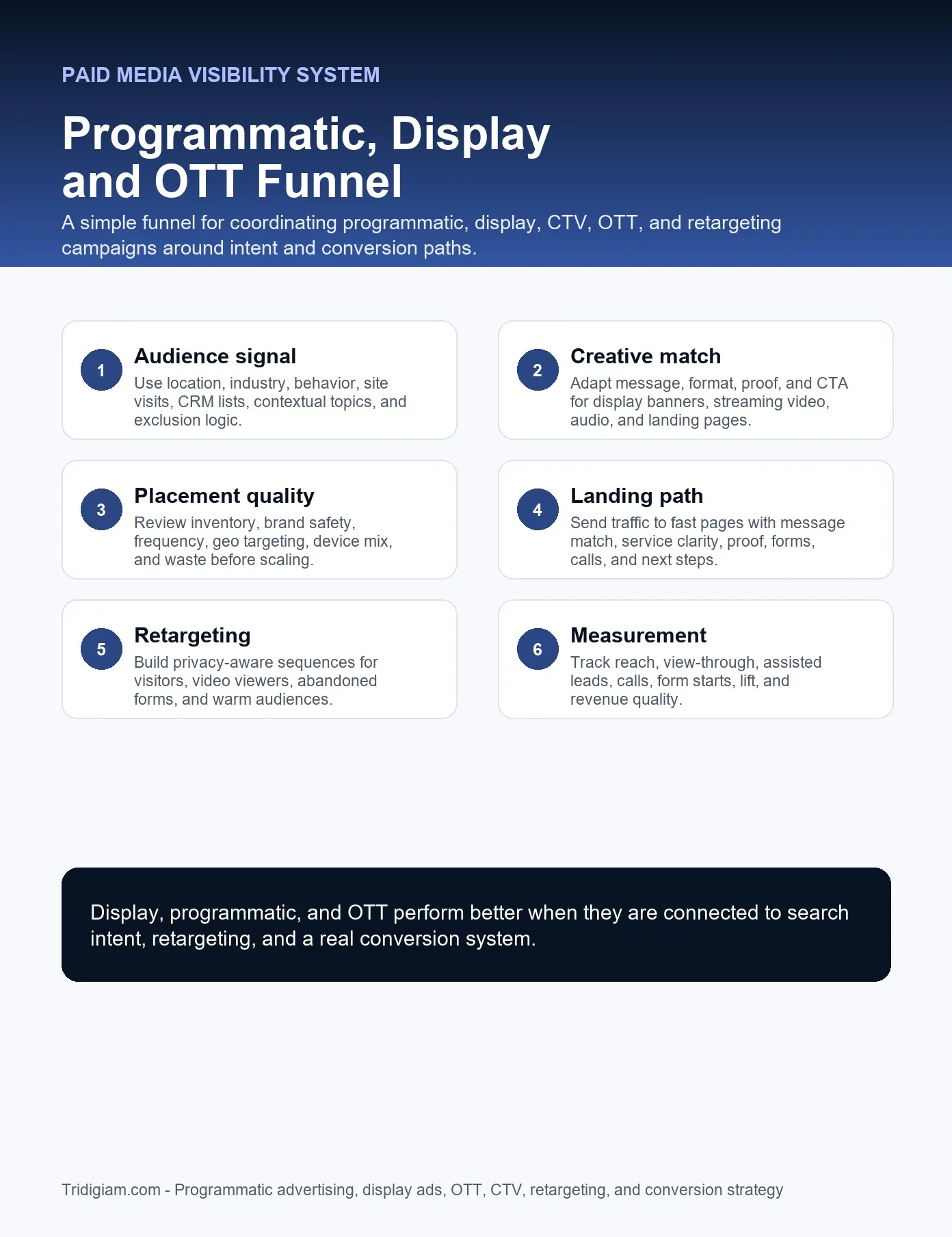
When you need an execution partner to build this test-and-scale loop, Tridigiam’s display advertising and analytics playbooks can centralize the workflow so that every dollar carries lessons forward. For video-heavy plans, connect this with your creative roadmap and consider our guidance on OTT advertising strategy for streaming audiences to align screens, storytelling, and measurement from day one.
Ad Buying Comparison: Real-World Scenarios
Scenario 1, national product launch. The brand wants rapid awareness among business decision-makers over a two-week window. A balanced plan secures direct, high-impact placements on targeted business publishers for takeover days and newsletter sponsorships. Simultaneously, programmatic PMPs with those same publishers increase reach to the broader decision-maker audience. Open exchange programmatic runs short video and display for prospecting, rotating creative every 72 hours based on completion rates. The result is high share of voice in critical contexts, supported by scaled reach that learns fast. Scenario 2, lead generation for a B2B SaaS with a long sales cycle. Programmatic drives most of the budget, using lookalike models and layered intent segments. PMPs supply quality environments where form fills have historically converted with higher lifetime value. A smaller direct programmatic guaranteed deal secures placements with a niche industry publication during a conference week. Scenario 3, retail promotion with daily price changes. Programmatic dominates to exploit speed and bid flexibility. Direct is reserved for weekend circular placements or app takeover opportunities when traffic peaks. In each scenario, both methods share a scorecard that tracks cost per qualified action, frequency control, and incremental lift. This keeps everyone focused on outcomes, not channel loyalty. To deepen the strategy, align campaign-level learnings with your broader growth efforts using insights from performance marketing ROI frameworks and, for awareness goals, practical guidance on building brand awareness that compounds over time.
Conclusion
There is no universal winner in the programmatic vs direct buy discussion. Each method excels under specific constraints. If the job is fast learning, audience precision, and scaled reach, programmatic typically makes the budget go farther. If the job is contextual authority, sponsorship equity, and delivery certainty, direct buys earn their keep. The strongest plans assign clear roles, measure with the same business KPIs, and use hybrid deals to close gaps. Treat the portfolio like one system, not a set of fiefdoms, and your budget will work harder across the quarter. If you want help designing a measurement-first media mix, Tridigiam builds compliance-aware strategies, from PMPs and programmatic guaranteed to premium direct placements, all mapped to a shared ROI model. Explore how our team structures roadmaps, creative, and reporting to scale what works and cut what does not.
FAQ
What is the main difference between programmatic and direct buys?
Programmatic is an automated transaction method that uses platforms to evaluate impressions and bid in real time. It emphasizes scale, audience-based targeting, and rapid optimization across formats like display, video, audio, and connected TV. Direct buys are negotiated with publishers, often via insertion orders, and emphasize control over placement, context, and delivery guarantees. With direct, you can secure specific sections, sponsorships, or custom units. With programmatic, you can flex budgets quickly and test many variables at low marginal cost. A hybrid approach, especially via private marketplaces and programmatic guaranteed, blends automation benefits with determinism when control is essential.
When should I choose guaranteed inventory over programmatic bidding?
Choose guaranteed inventory, either via a traditional insertion order or programmatic guaranteed, when certainty on delivery and context matters more than auction efficiency. Typical cases include tentpole launches with strict flight windows, brand safety sensitivities, or placements that carry unique value such as homepage takeovers and premium pre-roll against marquee content. If you face volatile auction prices during peak demand or competitors are likely to outbid you for key moments, guarantees can stabilize results. For evergreen prospecting or rapid creative testing, open exchange or curated PMPs often provide better budget efficiency.
How do I compare ROI across programmatic and direct channels fairly?
Use one scorecard with a shared primary KPI, like cost per qualified lead or incremental revenue per thousand impressions. Standardize viewability thresholds, invalid traffic filters, and attribution windows. Implement lift testing, such as geo holdouts or matched markets, to measure incrementality rather than credit assignment alone. Keep creatives, landing pages, and offers consistent where possible, and rotate variants evenly to isolate channel effects. Finally, consolidate reporting and pacing controls so that frequency and exclusions apply across both buying methods. If needed, Tridigiam’s search engine marketing and analytics frameworks can unify these elements under one measurement plan.
What is direct programmatic advertising, and how is it different from a standard direct deal?
Direct programmatic advertising refers to transactions, like private marketplaces and programmatic guaranteed, that execute within programmatic platforms while preserving elements of a negotiated deal. A standard direct deal is typically managed via an insertion order with trafficking handled by the publisher’s ad server. Programmatic guaranteed, by contrast, secures fixed price and delivery but traffics through your demand-side platform. This allows centralized frequency, pacing, and verification across the portfolio. Private marketplaces sit between open exchange and guaranteed, offering curated access to vetted publishers with negotiated floors and priority access.
How should I allocate budget between programmatic and direct buys?
Start with objectives. If you are optimizing for lower-funnel conversions and need fast learning, weight budget toward programmatic. If you are building brand equity around a launch or require strict adjacency control, carve out funds for direct or programmatic guaranteed. Many advertisers begin with a 70/30 or 60/40 split in favor of programmatic, then adjust quarterly based on cost per outcome, reach quality, and lift results. Use controlled tests to validate assumptions, and remember to reforecast during peak seasons when direct placements may protect performance. For execution discipline and unified optimization, explore Tridigiam’s paid social media advertising and cross-channel media operations support.
Frequently asked questions
What’s the difference between programmatic and direct buy advertising?
Programmatic advertising uses automated, real-time bidding to place ads across a network of sites and apps, while direct buy means negotiating and purchasing ad space directly from a specific publisher.
Which is better for a limited budget?
Programmatic generally offers more control over budget pacing and targeting efficiency, while direct buys can guarantee premium placement but usually require larger minimum spends.
Do regulated industries face extra restrictions with programmatic buying?
Yes, programmatic networks often have their own content and targeting policies for healthcare and other regulated categories, so campaigns need to be reviewed against both platform and legal requirements.
Sources
- Programmatic Advertising vs. Direct Buying (playwire.com)
- Direct Media Buying vs Programmatic Advertising | Multiview (multiview.com)
- Programmatic vs Direct Ad Buying: Cost, Control, and When Each Makes Sense (stackmatix.com)
- Programmatic Ads vs. Direct Buying: Which to choose? – Adbeat (blog.adbeat.com)

Written and reviewed by Chris Goodman, CEO of Tridigiam
Founder of a Las Vegas marketing agency building AI-visibility and compliance-aware marketing systems for regulated industries — healthcare, addiction treatment, and aesthetics. LinkedIn
Want more like this? Browse our free CRO, SEO, and AI search guides.
Resources
Need marketing that actually moves the needle?
Tridigiam is a Las Vegas marketing and advertising agency built for regulated and growth-focused businesses. Call (702) 748-7005 or request a consultation.

Explore knowledge from Chris Goodman, a marketing expert with extensive agency and small business experience, specializing in innovative advertising strategies. Chris has a Bachelor’s in Marketing from RMIT, years working in advertising agencies servicing clients, and years of experience working with small to medium sized businesses operating within regulated industries.