
Quick answer: Healthcare sites meet Google’s YMYL (Your Money or Your Life) standards by demonstrating real Experience, Expertise, Authoritativeness, and Trustworthiness, backed by verified medical credentials and transparent sourcing. Building E-E-A-T this way is what earns rankings for high-stakes medical content, since Google holds health information to a stricter bar than most other topics.
Healthcare websites face stricter scrutiny from search engines because medical misinformation can directly harm patient outcomes. Google’s YMYL standards require content to demonstrate clear Expertise, Experience, Authoritativeness, and Trustworthiness before ranking for sensitive health queries.
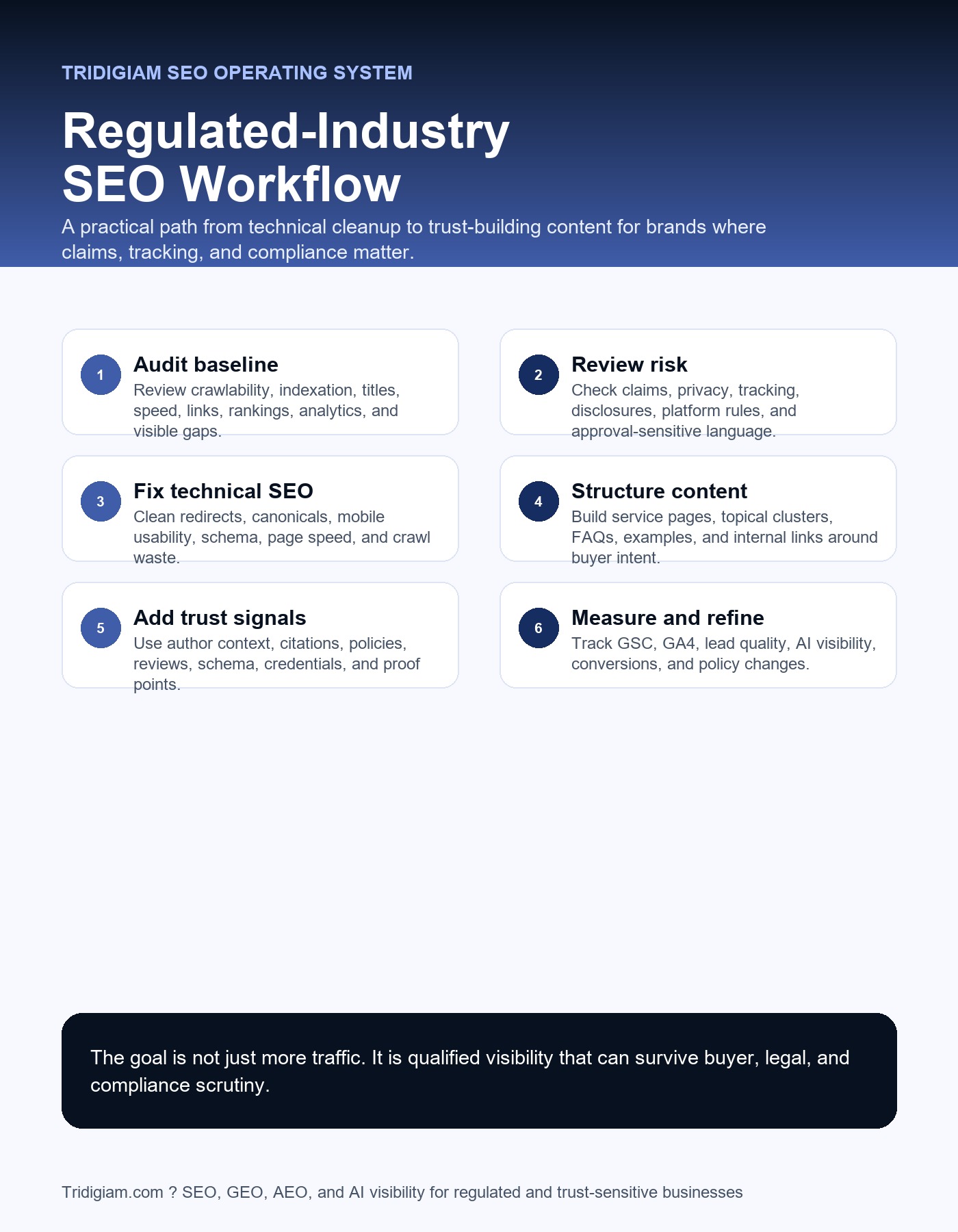
YMYL SEO for healthcare answer map
YMYL SEO for healthcare means building medical and compliance-sensitive pages that are accurate, helpful, transparent, and trustworthy enough for high-stakes decisions. Healthcare pages should show who created or reviewed the content, why the content is reliable, what sources support it, when it was updated, and how the advice fits within patient safety, privacy, and compliance boundaries.
- Make expertise visible: show author, reviewer, credentials, relevant experience, and editorial review where the topic affects patient health or safety.
- Support claims with sources: connect medical, regulatory, and compliance claims to authoritative sources rather than vague “research says” language.
- Write for patients first: answer real questions clearly, explain limits, avoid fear-based persuasion, and make next steps easy without overpromising outcomes.
- Protect trust signals: keep privacy practices, HIPAA-sensitive workflows, reviews, testimonials, and advertising claims aligned across the page and funnel.
- Prepare for AI search without gimmicks: use clear structure, original expert insight, helpful summaries, internal links, and source anchors; do not rely on special AI markup or thin answer stuffing.
Useful source anchors include Google Search Central’s helpful, reliable, people-first content guidance, Google’s Search Quality Rater Guidelines overview, Google’s SEO Starter Guide, Google’s guide to optimizing for generative AI features in Search, and Google’s page on AI features and your website. Tridigiam connects YMYL trust-building to healthcare content marketing, healthcare schema markup, healthcare SEO for Google answers, healthcare digital marketing, HIPAA-compliant marketing, and AI Search Optimization.
Questions to answer before publishing YMYL healthcare content
What makes healthcare content YMYL?
Healthcare content is YMYL when inaccurate or misleading information could affect someone’s health, safety, treatment decisions, privacy, finances, or access to care. That includes medical advice, treatment claims, compliance guidance, mental health content, and sensitive service pages.
How can healthcare websites demonstrate E-E-A-T?
They can show E-E-A-T through qualified authors or reviewers, accurate sourcing, clear update dates, transparent ownership, real operational experience, patient-safe language, privacy-aware workflows, and internal links that connect related expertise across the site.
Does AI search change YMYL SEO for healthcare?
AI search increases the value of clear, source-backed, answer-first healthcare content, but the foundation is still SEO: helpful content, crawlable pages, technical reliability, trust signals, and content that goes beyond generic summaries.
Key Takeaways
- Healthcare content requires verifiable expertise to satisfy Google’s YMYL quality guidelines.
- Cite credible medical sources to build authority and trust in your articles.
- Respond to patient reviews ethically while strictly maintaining HIPAA compliance standards.
- Author bios must highlight relevant credentials to demonstrate professional experience clearly.
- Accurate, well-researched content helps search engines assess your site’s trustworthiness.
Understanding YMYL in Healthcare: Why Google Demands Higher Standards
Google’s Search Quality Evaluator Guidelines classify health content as Your Money or Your Life (YMYL) because poor information can cause immediate physical harm or financial loss. This classification triggers stricter quality standards than those applied to hobby blogs or local restaurant reviews.
The search engine treats medical advice, treatment options, and symptom descriptions with heightened scrutiny to protect user safety. Content that lacks clear evidence or expert oversight faces lower rankings regardless of keyword density or technical speed. The goal is to surface information that prevents harm rather than promotes misinformation. Practice Builders notes that this elevated standard applies specifically to pages influencing a person’s long-term health or financial stability.
You must structure your site to prove credibility at every level. Google evaluates the entire page, not just the text body. It looks for author credentials, editorial review processes, and transparent sourcing. A medical blog post written by an unverified contributor will struggle to rank against a page reviewed by licensed professionals. The algorithm signals trust through visible expertise.
This regulatory pressure means your SEO strategy cannot rely on generic content templates. You need a compliance-aware approach that aligns with search quality guidelines. Workshop Digital highlights that financial and health sectors face unique challenges in demonstrating authority without violating privacy laws. Ignoring these standards leads to visibility drops that are difficult to reverse.
- Identify all YMYL pages on your site including service descriptions and educational articles.
- Audit existing content for clear attribution of medical claims.
- Ensure every health-related page displays author qualifications prominently.
Decoding E-E-A-T: The Four Pillars of Trustworthy Medical Content
Google’s Search Quality Evaluator Guidelines define four distinct signals that determine how search engines assess the quality of health content. These signals are Experience, Expertise, Authoritativeness, and Trustworthiness. Understanding the specific weight of each pillar prevents wasted effort on low-impact optimization tasks.
Experience refers to first-hand knowledge of the subject matter. For a medical practice, this means showcasing real patient outcomes or clinician insights rather than generic stock advice. A dermatologist sharing photos of actual treatment results demonstrates experience that a general wellness blogger cannot replicate. This personal connection builds immediate credibility with users seeking specific solutions.
Expertise requires verifiable credentials and deep subject knowledge. Content should clearly attribute medical information to licensed professionals. Listing degrees, board certifications, and professional affiliations in author bios signals competence to both readers and algorithms. Practice Builders notes that clear attribution helps search engines understand who is responsible for the information.
Authoritativeness builds on expertise by establishing a reputation within the specific medical niche. This comes from citations, mentions, and links from other respected healthcare entities. A local clinic cited by regional health departments or featured in peer-reviewed journals demonstrates authority. It shows that peers recognize the practice as a reliable source of information.
Trustworthiness underpins all other pillars. It involves transparent contact information, clear privacy policies, and secure website connections. Users must feel safe sharing personal health data. Workshop Digital emphasizes that transparency is non-negotiable for YMYL sites. If a site lacks clear ownership details or uses misleading claims, trust drops immediately. Search engines penalize this lack of transparency heavily. Building all four pillars creates a robust defense against algorithm updates and user skepticism.
Demonstrating Expertise: Leveraging Clinician Credentials and Author Bios
Google’s Search Quality Evaluator Guidelines require visible author information for all YMYL pages. This means your medical service pages must display the name and credentials of the clinician who wrote or reviewed the content. Visitors need to verify that a qualified professional stands behind the advice.
An anonymous “admin” byline fails this test. Search engines look for specific signals of expertise, such as board certifications or years of practice. You should list these details in a dedicated author bio section on every article. Include a photo and a brief professional summary to build immediate credibility. This transparency helps search algorithms confirm the content meets high-quality standards.
Avoid generic staff pages that lack context. Instead, create detailed profiles that highlight relevant medical training and specializations. Link directly from the article text to these bios so users can click through easily. This structure supports both user trust and technical SEO requirements. It demonstrates that real experts produce your content rather than automated systems or untrained writers.
Regularly update these profiles to reflect current roles and achievements. Outdated credentials damage perceived authority. Ensure the bio matches the actual contributor to maintain accuracy. This practice aligns with Google’s emphasis on demonstrable expertise in healthcare topics. Users trust information more when they know exactly who provided it.
Proving Experience: Integrating Real-World Patient Stories and Case Studies
Patient narratives provide the “Experience” signal in Google’s E-E-A-T framework. This element distinguishes clinical theory from practical application. Search algorithms look for evidence that content creators understand real-world patient journeys. You cannot fake this depth of knowledge with generic stock photos or fabricated quotes. Authentic stories demonstrate how treatments work outside a controlled environment.
Collecting these stories requires strict adherence to privacy laws. Most healthcare providers operate under HIPAA regulations in the United States. You must obtain explicit written consent before publishing any identifiable patient information. This legal requirement protects your business from severe penalties and reputational damage. It also builds genuine trust with readers who value discretion. The process involves more than just getting a signature. You need a clear protocol for handling data securely throughout the content creation lifecycle.
Use anonymized case studies when full consent is not possible or practical. Focus on the clinical challenge, the intervention, and the measurable outcome. Remove all protected health information (PHI) before publication. This approach maintains compliance while providing specific details that validate your expertise. Readers see the direct impact of your services without risking patient privacy. Structured data can help search engines understand the context of these medical narratives. Schema markup for medical conditions or treatments adds clarity to the page. It signals relevance to both users and algorithms.
Avoid overly promotional language in patient testimonials. Google penalizes content that appears manipulative or lacking in substance. Keep the tone objective and informative. Let the results speak for themselves. This strategy aligns with Google’s Search Quality Evaluator Guidelines. It also respects the ethical standards expected in regulated industries. Your content should educate, not just sell.
Building Authority: Strategic Link Building with High-Quality Medical Citations
Backlinks from established medical institutions serve as strong signals of authority for search algorithms evaluating healthcare websites. Google interprets these citations as votes of confidence from peers who understand the industry standards and regulatory requirements. This form of endorsement matters more than volume because a single link from a reputable university hospital or government health agency carries significant weight in ranking calculations.
Many healthcare marketing teams focus heavily on content creation while neglecting the strategic acquisition of high-quality citations. This imbalance limits their ability to demonstrate authority to search engines that prioritize trust signals for YMYL topics. Building a diverse backlink profile requires targeted outreach and relationship building rather than mass submission tactics.
Effective strategies include guest contributing to peer-reviewed journals or professional association newsletters where editorial standards are strict. Practitioners can also sponsor local health initiatives or provide expert commentary for news outlets covering public health issues. These activities naturally generate relevant links from domains that align with medical expertise and community trust.
- Pursue citations from.edu and.gov domains associated with health departments or academic research centers.
- Submit practice profiles to verified medical directories like those maintained by specialty boards.
- Collaborate on community health reports that require attribution to participating providers.
Avoid link schemes or paid placements from low-quality networks as these violate search engine guidelines and risk penalties. Quality matters more than quantity in regulated sectors where credibility matters. A few authoritative citations often outperform dozens of links from unrelated blogs or generic article directories. Search engines analyze the relevance and trustworthiness of linking domains to assess the subject matter expertise of the linked content.
Ensuring Trustworthiness: HIPAA Compliance and Ethical Review Management
HIPAA violations carry penalties ranging from $100 to $50,000 per instance. This financial risk extends to how your marketing team handles patient feedback online. You must verify that every review response protects Protected Health Information (PHI) while maintaining an ethical tone. Google’s quality raters look for trust signals that include legal compliance and transparent business practices.
Trustworthiness in the E-E-A-T framework goes beyond technical security certificates. It requires a demonstrated commitment to patient privacy and ethical communication standards. Healthcare websites must implement strict protocols for managing user-generated content. This includes moderating comments and verifying review authenticity without exposing sensitive medical details. The research indicates that prioritizing credible citations and ethical review responses directly supports YMYL SEO performance Workshop Digital.
You need to audit your current review management process immediately. Check if your staff has access to PHI when replying to patients on Google Business Profile or social media platforms. If they do, you are creating a compliance liability. Switch to a system where marketing teams only see aggregated data or anonymized feedback. This separation of duties protects your practice from accidental disclosures. It also signals to search engines that your organization respects user privacy. Ethical review management involves acknowledging criticism professionally without arguing or revealing patient identities.
- Implement access controls that block PHI visibility for marketing staff
- Create templates for responding to negative reviews without medical details
- Audit past responses for accidental disclosures of treatment information
- Train team members on HIPAA boundaries in digital communications
Search algorithms increasingly favor sites that demonstrate responsible data handling. A breach or unethical review practice can trigger a rapid decline in rankings. Focus on building a culture of compliance within your content team. This approach supports long-term visibility while protecting your patients and your business.
Technical Foundations: Site Security, Accuracy Checks, and Structured Data for Health Pages
HTTPS encryption protects patient data in transit and satisfies Google’s baseline security requirements for ranking health pages. Search engines prioritize sites that transmit information securely because users expect their personal details to remain private during every interaction. A site without a valid SSL certificate triggers browser warnings that deter visitors before they even read the content. This technical failure directly impacts user experience metrics that influence search placement.
Technical accuracy extends beyond security certificates to include structured data markup that helps crawlers understand page context. Schema.org health and medical schemas allow you to define specific entities like diseases, procedures, or medications within your HTML code. When search engines parse this structured information, they can display rich results that clarify the intent of the page. Proper implementation reduces ambiguity for algorithms evaluating complex medical topics. You must validate your markup using tools like Google’s Rich Results Test to ensure no errors prevent proper indexing.
Regular audits of technical SEO elements keep your site compliant with evolving platform standards. Broken internal links or slow load times degrade the quality signals associated with your content. Search crawlers may interpret these technical failures as indicators of poor maintenance, which lowers perceived trustworthiness. Automated monitoring tools identify crawl errors and performance bottlenecks before they affect rankings. Addressing these issues promptly maintains the integrity of your digital presence.
Structured data also supports accessibility by helping screen readers interpret page structure correctly. This aligns with broader compliance goals that emphasize inclusivity and user safety. Technical foundations support the visible expertise demonstrated in author bios and clinical credentials. Without a secure and well-coded site, those content signals lose their effectiveness. Focus on clean code and validated schemas to strengthen overall E-E-A-T signals.
| Pillar | What It Requires |
|---|---|
| Experience | First-hand knowledge of the subject; real patient outcomes or clinician insights rather than generic advice |
| Expertise | Verifiable credentials and deep subject knowledge; degrees, board certifications, and professional affiliations in author bios |
| Authoritativeness | A reputation within the medical niche built through citations, mentions, and links from other respected healthcare entities |
| Trustworthiness | Transparent contact information, clear privacy policies, and secure website connections |
Conclusion
Healthcare SEO demands strict adherence to compliance standards while building genuine trust with readers. You must prioritize accuracy and authority over quick traffic wins. Tridigiam.com helps regulated businesses navigate these complex requirements through strategic content planning. We focus on measurable results that align with industry regulations. Contact our team to review your current strategy and identify opportunities for growth. Build a sustainable online presence that serves patients and satisfies search engine guidelines.
Frequently Asked Questions
What defines YMYL content in healthcare?
Your Money or Your Life content impacts a patient’s health, safety, or financial stability. Search engines scrutinize these pages more heavily because poor information can cause real-world harm. Medical sites must demonstrate higher standards of accuracy and trustworthiness than general commercial websites to rank well.
How do I prove Experience in medical content?
Showcase the actual clinical background of your writers and editors. Display professional credentials, board certifications, and years of practice directly on author bios. This helps search engines verify that qualified professionals create or review the information before publication.
What builds Authority for a medical website?
Authority comes from recognized expertise and positive reputation signals. Publish content backed by reputable medical journals and industry standards. Encourage satisfied patients to leave reviews on platforms like Google, as these social proofs help validate your practice’s standing in the community.
How does HIPAA affect SEO efforts?
You must protect patient privacy while managing online presence. Never share identifiable health information in blog comments or review responses. Use secure communication channels for patient inquiries and ensure your website uses proper encryption to maintain compliance with federal privacy regulations.
Why is Trustworthiness the most important E-E-A-T factor?
Trust underpins all other signals in high-stakes content. Users need clear contact information, transparent pricing, and honest medical advice. Search engines evaluate whether a site acts with integrity, making accurate citations and ethical patient interactions essential for long-term visibility.
Want to check where you stand? Run our free AI Visibility Grader — it’s built on the same Discoverability, Clarity, Authority, and Trust framework AI engines actually weigh.
Want more like this? Browse our free CRO, SEO, and AI search guides.

Written and reviewed by Chris Goodman, CEO of Tridigiam
Founder of a Las Vegas marketing agency building AI-visibility and compliance-aware marketing systems for regulated industries — healthcare, addiction treatment, and aesthetics. LinkedIn
Resources
Need marketing that actually moves the needle?
Tridigiam is a Las Vegas marketing and advertising agency built for regulated and growth-focused businesses. Call (702) 748-7005 or request a consultation.

Explore knowledge from Chris Goodman, a marketing expert with extensive agency and small business experience, specializing in innovative advertising strategies. Chris has a Bachelor’s in Marketing from RMIT, years working in advertising agencies servicing clients, and years of experience working with small to medium sized businesses operating within regulated industries.