
Quick answer: The ethics of AI in marketing center on transparency, consent, data privacy, bias, and not deceiving audiences with synthetic content. Responsible use means disclosing AI where it matters, protecting customer data, checking outputs for bias and accuracy, and keeping a human accountable for what ships.
The way businesses approach marketing has been completely transformed by artificial intelligence (AI). Artificial intelligence (AI) technologies enable marketers to make better decisions and provide individualized experiences for their clients by analyzing massive data sets, finding patterns, and making predictions. AI is being used in digital marketing to enhance customer segmentation, optimize ad targeting, & automate tasks.
Key Takeaways
- AI in marketing offers personalized customer experiences and improved targeting
- Benefits of AI in digital marketing include increased efficiency and cost-effectiveness
- Ethical considerations in AI marketing include data privacy and consumer manipulation
- Transparency and accountability are crucial in AI-driven marketing to build trust
- Privacy and data protection are essential in AI-enabled marketing to maintain consumer trust and compliance
- Fairness and bias in AI-driven marketing require careful monitoring and mitigation
- The future of AI in marketing will require ongoing ethical considerations and regulation to protect consumers
In a recent article on Tridigiam, the benefits of social media automation tools are discussed in relation to the ethics of AI in marketing. The article explores how automation tools can streamline marketing efforts, but also raises important ethical considerations about the potential for misuse and manipulation. It’s a thought-provoking read that adds another layer to the ongoing conversation about the responsible use of AI in marketing. You can check out the article here.
| Ethical Area | Key Consideration |
|---|---|
| Impact on Consumers | Marketers must weigh AI’s effect on consumer well-being, privacy, and autonomy, including disclosure when chatbots are used. |
| Data Collection & Usage | Ensure explicit permission to collect and use consumer data, and protect it from unauthorized access. |
| Transparency in Methods | Be open about how AI methods work and how customer data is collected, processed, and shared. |
| Accountability | Marketers are responsible for unfavorable outcomes that result from AI-driven decisions. |
| Data Protection & Privacy | Uphold consumers’ right to privacy, follow data protection laws, and obtain informed consent for data use. |
| Fairness & Bias Mitigation | Actively work to reduce bias in AI algorithms so marketing doesn’t unintentionally reinforce prejudice. |
FAQs
What is AI in marketing?
AI in marketing refers to the use of artificial intelligence technologies and tools to analyze consumer behavior, automate tasks, personalize customer experiences, and optimize marketing strategies. This can include machine learning, natural language processing, and predictive analytics.
What are the ethical considerations of AI in marketing?
Ethical considerations of AI in marketing include issues such as consumer privacy, data security, transparency in AI decision-making, potential biases in AI algorithms, and the impact of AI on jobs and society. Marketers must ensure that AI is used responsibly and ethically to avoid negative consequences.
How can AI in marketing benefit businesses?
AI in marketing can benefit businesses by enabling more targeted and personalized marketing campaigns, improving customer segmentation and targeting, automating repetitive tasks, analyzing large volumes of data for insights, and enhancing the overall customer experience. This can lead to increased efficiency and effectiveness in marketing efforts.
What are some potential risks of AI in marketing?
Potential risks of AI in marketing include the misuse of consumer data, the potential for AI algorithms to perpetuate biases, the loss of human touch in customer interactions, and the potential for job displacement as AI automates certain marketing tasks. It is important for businesses to carefully consider and mitigate these risks.
How can businesses ensure ethical use of AI in marketing?
Businesses can ensure ethical use of AI in marketing by being transparent about their use of AI, obtaining proper consent for data collection and usage, regularly auditing AI algorithms for biases, prioritizing data security and privacy, and considering the broader societal impact of their AI marketing efforts. Additionally, businesses can adhere to industry standards and regulations related to AI and data privacy.
Related service: Learn more about Tridigiam’s digital marketing services.
Resources
Need marketing that actually moves the needle?
Tridigiam is a Las Vegas marketing and advertising agency built for regulated and growth-focused businesses. Call (702) 748-7005 or request a consultation.
Want more like this? Browse our free CRO, SEO, and AI search guides.
Frequently asked questions
Does using AI in marketing content need to be disclosed to the audience?
Disclosure expectations are evolving and vary by context and platform, but transparency is generally recommended, especially for synthetic media like AI-generated images of people or voices, where audiences could otherwise be misled about authenticity.
How does AI bias actually show up in marketing outputs?
AI models trained on existing data can reflect and amplify biases present in that data, which can show up as skewed audience assumptions, stereotyped imagery, or messaging that doesn’t represent a business’s full customer base.
Who should be accountable when an AI-generated marketing claim turns out to be inaccurate?
A human on the marketing or compliance team should always review AI-generated claims before publishing, since accountability for accuracy and compliance can’t be outsourced to the AI tool itself.

Written and reviewed by Chris Goodman, CEO of Tridigiam
Founder of a Las Vegas marketing agency building AI-visibility and compliance-aware marketing systems for regulated industries — healthcare, addiction treatment, and aesthetics. LinkedIn
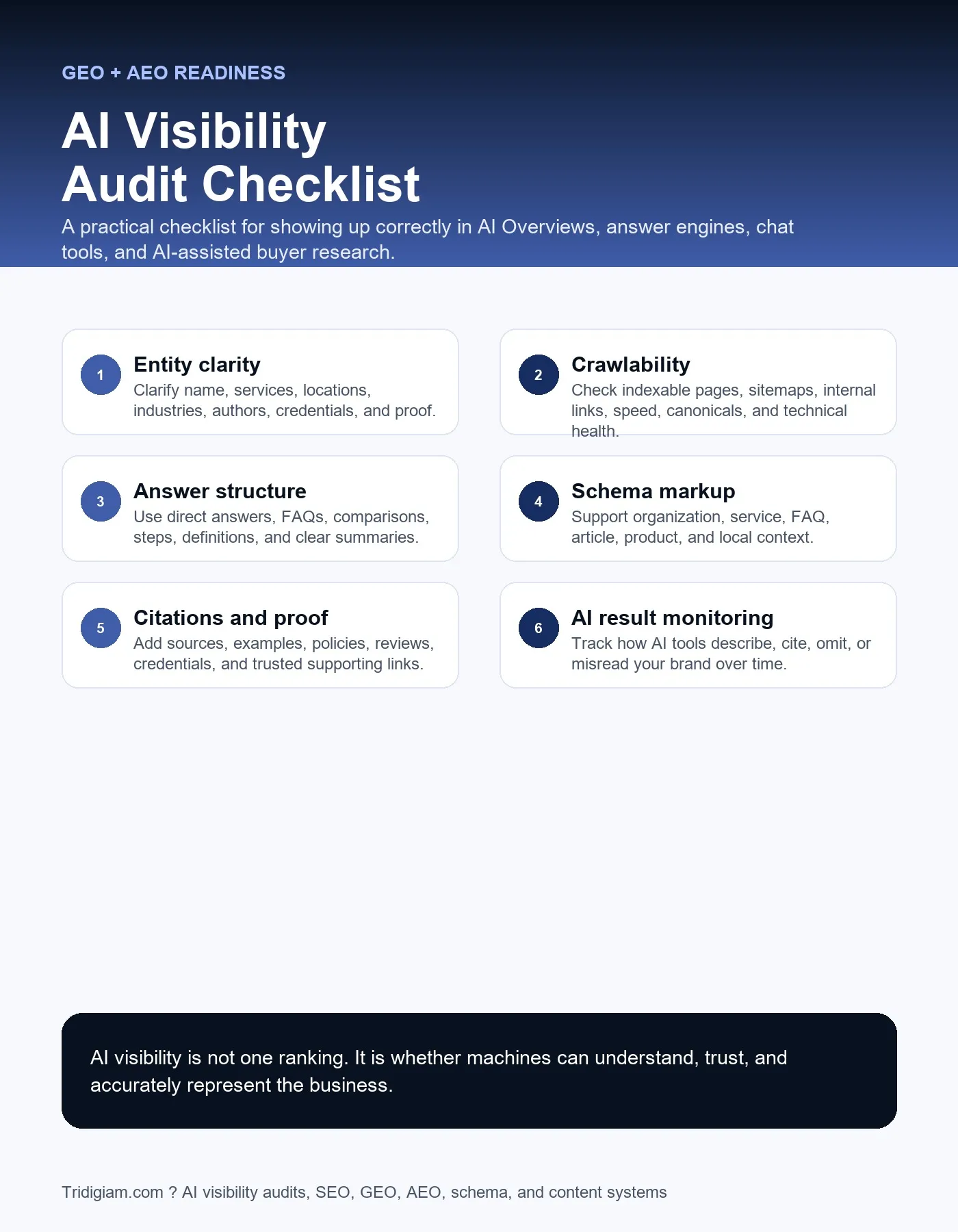
Related book: Want a clearer way to audit AI search visibility? See The AI Visibility Audit by Chris Goodman.

Explore knowledge from Chris Goodman, a marketing expert with extensive agency and small business experience, specializing in innovative advertising strategies. Chris has a Bachelor’s in Marketing from RMIT, years working in advertising agencies servicing clients, and years of experience working with small to medium sized businesses operating within regulated industries.