Quick answer: SEO, GEO, and AEO are three lenses on visibility: SEO optimizes for classic search rankings, GEO (generative engine optimization) optimizes to be cited in AI answers, and AEO (answer engine optimization) optimizes for direct answer boxes and assistants. They overlap heavily, since clear, accurate, well-structured content wins in all three. This covers the differences and how AI search changes the playbook.
SEO vs GEO vs AEO comparison answer map
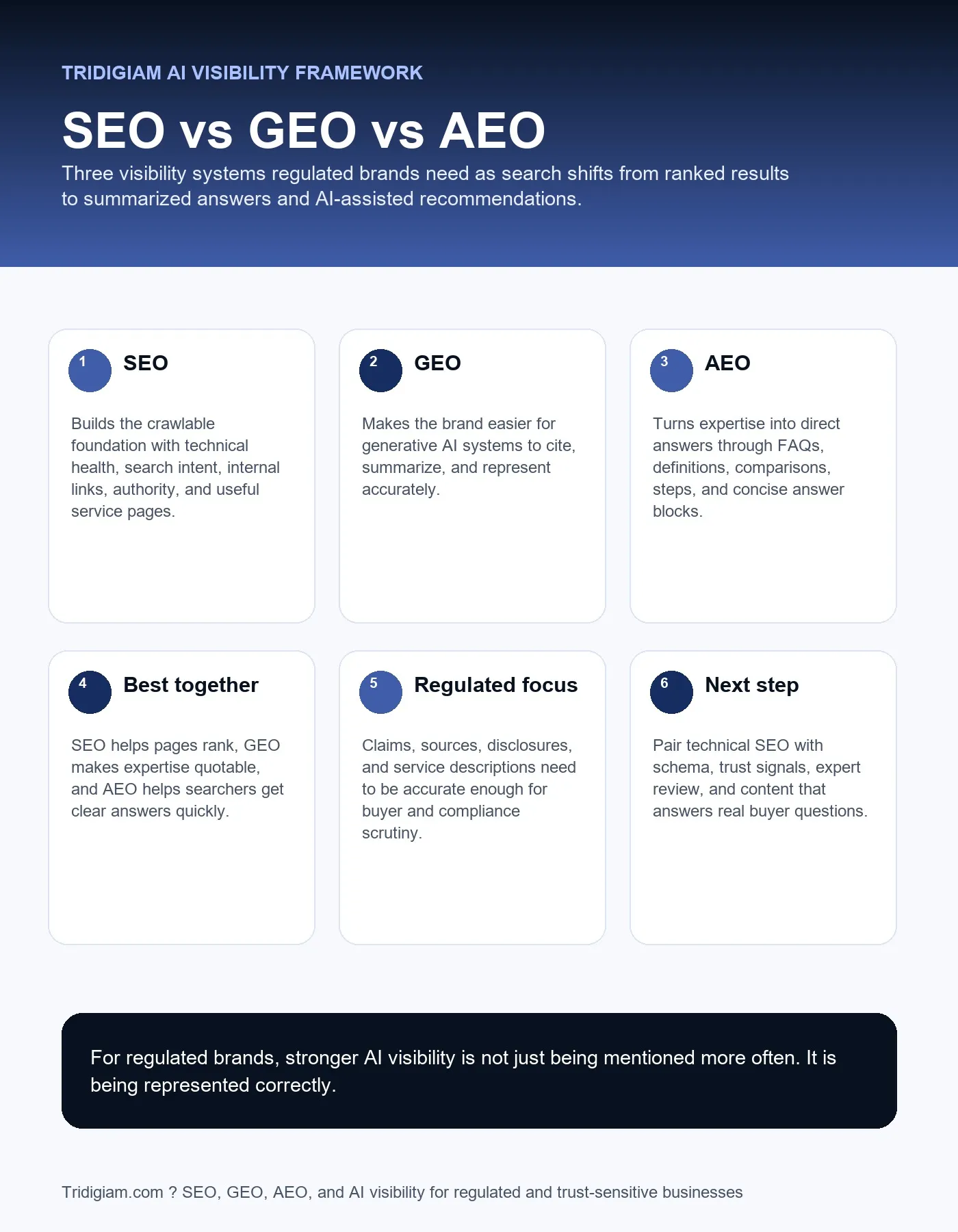
SEO, GEO, and AEO are related visibility strategies for different answer surfaces. SEO helps pages rank and earn clicks in traditional search results. GEO helps brands get cited, summarized, or recommended by generative AI engines. AEO helps content become the direct answer for snippets, voice results, AI Overviews, and question-led search experiences.
- SEO: optimize crawlable pages, technical health, helpful content, links, local relevance, and user experience so search engines can rank the page.
- GEO: optimize factual clarity, source anchors, entity signals, citations, internal evidence, and extractable explanations so AI systems can trust and reference the content.
- AEO: optimize direct answers, question headings, concise definitions, schema, lists, and comparison tables so search and AI systems can return a clear answer quickly.
- Overlap: all three require trustworthy content, structured information, strong internal links, and answers that match real user intent.
- Measurement: SEO tracks rankings, impressions, clicks, and conversions; GEO tracks AI citations, prompt coverage, and brand mentions; AEO tracks answer inclusion, featured snippets, voice-style answers, and question visibility.
Useful source anchors include Google’s SEO Starter Guide, Google’s helpful content guidance, Google’s structured data introduction, OpenAI’s ChatGPT search overview, and OpenAI’s publisher and developer FAQ. Tridigiam connects SEO, GEO, and AEO to SEO vs GEO visibility, FLUQs for AI search visibility, AI search trust signals, AI and voice search optimization, and Google Search Console AI data.
Questions to answer before choosing SEO, GEO, or AEO tactics
Which answer surface matters most for this topic?
Decide whether the page needs to win a traditional ranking, an AI-generated citation, a direct answer, a local result, or a conversion path. The right tactic depends on where the user expects the answer to appear.
Does the page answer the query clearly enough to be reused?
Use concise definitions, comparison language, source anchors, internal links, and proof. If a search engine or AI assistant cannot extract the answer without guessing, the page needs stronger structure.
How will visibility be measured beyond rankings?
Track rankings, clicks, conversions, AI citations, answer inclusion, branded mentions, prompt coverage, and sales-call language. Modern search visibility is broader than one blue-link ranking.
Key Takeaways
- SEO helps your website rank higher on traditional search engines and improves your presence in search engine results.
- GEO targets AI systems like ChatGPT, Gemini, and Perplexity.
- AEO focuses on earning direct answers in search and voice tools.
- Each affects visibility, authority, and engagement.
- Businesses need all three to compete in the search landscape.
Introduction
Search used to be simple. You typed a keyword, clicked a link, and landed on a website. That world is fading fast.
AI-driven platforms now change how people find information. Search engines like Google and Bing still matter, but users are also turning to ChatGPT, Perplexity, and Gemini for answers. These systems don’t show ten blue links. They generate responses that are optimized for AI-powered interactions.
This shift demands new strategies. Traditional SEO alone no longer guarantees visibility. Generative Engine Optimization (GEO) and Answer Engine Optimization (AEO) now play critical roles.
If your business depends on online discovery, understanding how these three connect is essential. Let’s break down what each one does, how they differ, and what steps help you stay visible.
What Is SEO (Search Engine Optimization)?
SEO improves how well your website appears on traditional search engines like Google and Bing, but adapting to AI-powered search is equally important. The goal is to rank higher when people search for products, services, or information related to your business.
SEO includes three main areas:
- On-page SEO focuses on content, headings, internal links, and keyword placement.
- Off-page SEO builds credibility through backlinks, social signals, and authoritative content.
- Technical SEO ensures your site loads fast, works on mobile, and follows indexing rules.
For example, a local HVAC company might optimize a page for “best HVAC company near me” using geo strategies. If the content matches the query and the site has good authority, it will rank higher.
SEO works by helping search engines understand relevance. But the rise of AI-driven search means algorithms now interpret intent, not just keywords, emphasizing the need for geo strategies. This is where GEO and AEO take over.
What Is AI-Driven GEO (Generative Engine Optimization)?
Generative Engine Optimization, or GEO, is the process of making your content visible to AI systems that generate answers instead of listing links.
Think of GEO as SEO for AI models. Platforms like ChatGPT, Gemini, and Perplexity pull data from millions of pages. They use this information to create answers that sound natural. GEO helps your brand be part of those answers by optimizing content for AI answers.
AI-Generated GEO Focuses On:
- Writing content that provides clear, factual information.
- Using context-rich language that AI tools can easily parse is crucial for improving search engine results.
- Structuring data so AI models recognize and reuse it.
- Publishing content that builds topical authority in your niche.
Example: If a skincare brand writes detailed product guides that mention ingredients, effects, and use cases, ChatGPT might reference that brand when users ask about “best anti-aging serums,” enhancing their SEO strategy.
GEO is not about ranking on a results page. It’s about earning inclusion in AI-generated responses. Businesses that adapt now will own the next phase of digital visibility by leveraging AI-powered strategies.
What Is AEO (Answer Engine Optimization) and Does AEO Matter?
Answer Engine Optimization (AEO) focuses on earning direct answers in search engines and voice assistants.
AEO works for tools like Google’s Featured Snippets, Bing’s AI Overviews, and devices like Alexa or Siri. When someone asks a question, AEO ensures your content provides the response.
To succeed with AEO and optimizing for AI, your website should focus on optimizing content for AI answers.
- Use structured data like schema markup.
- Include FAQ sections that answer questions directly.
- Keep answers short, clear, and factual.
- Align headings with common user questions.
Example: A dental clinic might answer, “How often should you get a cleaning?” directly in its content. If formatted properly, Google can pull that snippet into the top of the search results or voice response.
AEO builds credibility through authoritative content. Users trust brands that deliver quick, accurate answers, especially when powered by generative AI. In a world driven by voice search and AI assistants, AEO keeps your business part of the conversation.
SEO vs GEO vs AEO – Key Differences
| Category | SEO | GEO | AEO |
|---|---|---|---|
| Focus | Ranking on search engines | Visibility in AI-generated answers | Appearing in direct search and voice answers |
| Platform | Google, Bing, Yahoo | ChatGPT, Gemini, Perplexity | Google, Bing, Alexa, Siri |
| Optimization Target | Web pages and backlinks | Context-rich AI content | Structured data and concise answers |
| Example Tool | Ahrefs, SEMrush | ChatGPT, Perplexity Labs | Google Search Console, Schema.org, and AI-powered search are essential tools for webmasters. |
| Content Style should align with the expectations of AI-powered search algorithms. | Informational and keyword-driven | Conversational and factual | Short, direct, and structured |
SEO builds visibilityGeo ensures an authoritative presence in the digital landscape. authority, and AEO builds trust.
They’re not competitors. They work together. A website strong in all three reaches traditional search users, AI platforms, and voice assistants.
How AI Search Is Changing the Game in Digital Marketing
AI-driven search is now mainstream. Google’s AI Overviews and Bing’s Copilot summarize answers instead of showing pages. ChatGPT and Perplexity generate full responses based on AI training data.
This means fewer clicks and more citations. Instead of visiting your website, users may see your brand mentioned inside an AI-generated answer.
To stay visible, your content must:
- Be accurate and verifiable.
- Use structured data for easy parsing, which is essential for generative AI applications.
- Maintain brand authority through consistent messaging.
- Be cited across trusted platforms.
AI systems reward authority and precision, which are critical in the context of AEO and GEO. Brands that produce vague or repetitive content will vanish from visibility.
Building a Unified Search Optimization Strategy for The Future of SEO
A strong digital strategy connects SEO, GEO, and AEO into one system.
Step 1: Audit your SEO.
Review current keywords, backlinks, and technical setup. Identify ranking gaps to improve your existing SEO and prepare for 2025.
Step 2: Add structured data for AEO to Rank Higher.
Use schema markup, FAQs, and optimizing for AI to enhance your site's visibility. Answer common questions in short paragraphs.
Step 3: Optimize for GEO.
Create factual, expert-driven content that AI models, including Google AI, can reference. Cite credible sources. Avoid fluff or filler.
Step 4: Track visibility.
Measure rankings, citations in AI responses, and featured snippet appearances.
Step 5: Refresh content regularly.
AI platforms prefer updated data. Add new statistics and insights every few months.
Example: A financial advisor publishing well-structured, trustworthy articles on retirement planning may appear both on Google search and inside ChatGPT’s answer summaries.
Unified optimization means your business reaches people wherever they search—whether on a browser, AI chatbot, or voice device, ensuring visibility in answer boxes.
The Future of Search Optimization and Beyond
Traditional search isn’t disappearing. It’s merging with AI systems. Google and Bing now integrate generative responses into their results. Users expect fast, accurate information without multiple clicks.
Search visibility depends less on keywords and more on authority. Content must be original, sourced, and useful.
AI tools like ChatGPT, Gemini, and Perplexity already shape how people research products and services. This shift will expand. Brands that rely only on SEO will lose ground to competitors who adapt to GEO and AEO.
The future belongs to those who build trust through clarity, evidence, and AI-powered insights. If your information helps users and AI systems alike, your visibility will rise naturally across all search platforms.
Conclusion to GEO VS AEO VS SEO for Search Visibility and AI Optimization
SEO, GEO, and AEO each serve a unique purpose.
SEO helps you rank in traditional search engines.
GEO helps AI platforms understand and reference your brand.
AEO helps you appear as the trusted answer to direct questions.
Together, they form a complete strategy for modern visibility.
Search is evolving fast, and the brands adapting now with AEO and GEO strategies will lead the way for the future.
To improve your search visibility and adapt to AI-driven search, contact Tridigiam at 702-748-7005 for expert marketing services.
FAQs About SEO VS AEO VS GEO
What’s the main difference between SEO, GEO, and AEO?
SEO targets traditional search rankings. GEO focuses on appearing in AI-generated content. AEO ensures your business provides direct, structured answers across search and voice systems.
Do GEO and AEO replace traditional SEO?
No. They extend it. SEO builds the foundation. GEO and AEO expand your reach into AI and voice search.
How does AI direct answers affect search rankings?
AI-driven search reduces clicks and rewards authority, making it crucial for businesses to adapt to AI search engines. Brands with accurate, well-structured data appear more often in summaries and responses.
What type of content works best for AEO?
Short, factual answers with schema markup and question-based headings. FAQ pages and how-to guides perform well.
How can businesses measure GEO success?
Track brand mentions inside AI platforms, analyze referral traffic from AI-driven tools, and monitor engagement from generative search features.
Why does optimizing for ChatGPT and Google both matter?
People use both traditional search engines and AI search engines to find information. Google still leads in search traffic, but AI tools like ChatGPT influence decision-making. Being visible in both ensures complete digital presence.
Resources
https://www.semrush.com/blog/aeo-vs-seo
https://ahrefs.com/blog/geo-is-just-seo
https://writesonic.com/blog/aeo-vs-geo
https://www.yext.com/blog/2025/09/seo-vs-aeo-vs-geo
Related Reading
Related service: Learn more about Tridigiam's search engine marketing services.
Frequently asked questions
Is GEO replacing SEO?
No, GEO builds on SEO rather than replacing it. The fundamentals, like accurate content, good structure, and authority signals, still matter; GEO just adds a layer focused on being cited inside AI-generated answers.
What's the practical difference between AEO and GEO?
AEO focuses on being selected for a direct answer box or voice-assistant response, usually pulling from a single well-structured page, while GEO focuses on being cited or referenced within a broader AI-generated answer that may draw from multiple sources.
Do I need a separate content strategy for GEO and AEO, or does good SEO cover it?
Strong SEO content, clear structure, direct answers, credible sourcing, covers most of the ground for GEO and AEO too, since AI systems reward the same clarity and accuracy that search engines do.
Want more like this? Browse our free CRO, SEO, and AI search guides.

Written and reviewed by Chris Goodman, CEO of Tridigiam
Founder of a Las Vegas marketing agency building AI-visibility and compliance-aware marketing systems for regulated industries — healthcare, addiction treatment, and aesthetics. LinkedIn
Want to apply this framework step by step? Tridigiam Marketing Academy offers a $20/month membership with practical SEO, GEO, AEO, schema, trust-signal, AI visibility monitoring, and compliance-safe implementation training for regulated businesses. Join Tridigiam Academy.
Need marketing that actually moves the needle?
Tridigiam is a Las Vegas marketing and advertising agency built for regulated and growth-focused businesses. Call (702) 748-7005 or request a consultation.

Explore knowledge from Chris Goodman, a marketing expert with extensive agency and small business experience, specializing in innovative advertising strategies. Chris has a Bachelor’s in Marketing from RMIT, years working in advertising agencies servicing clients, and years of experience working with small to medium sized businesses operating within regulated industries.