

Quick answer: Law firm SEO turns qualified searchers into consultations by aligning site structure, local listings, and content with how people actually research legal problems. This guide covers building out practice-area pages, strengthening Google Business Profile and local citations, and tracking leads from first search to signed case, so rankings translate into real intake.
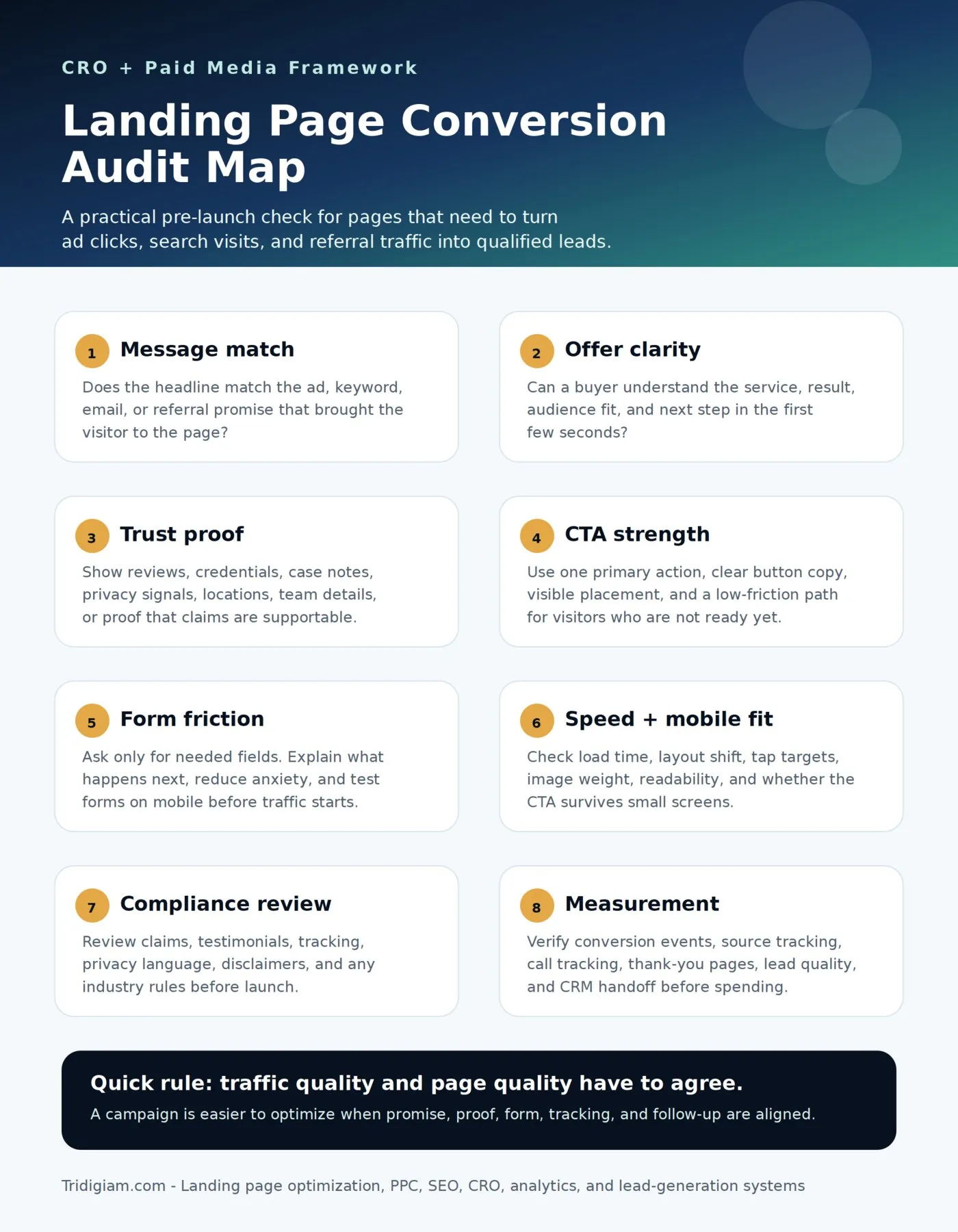
Law firm SEO answer map
Law firm SEO turns qualified legal searches into signed consultations by aligning practice-area pages, local visibility, reputation signals, and compliant content with how clients research legal help. The strongest strategy combines technical SEO, Google Business Profile optimization, attorney and practice-area authority, local proof, intake-focused conversion paths, and legal advertising review.
- Local visibility: optimize Google Business Profile, office location pages, reviews, categories, phone tracking, and local citations for each market.
- Practice-area depth: create clear pages for the legal matters clients search for, including eligibility, process, FAQs, outcomes, and next steps.
- Trust signals: strengthen attorney bios, credentials, case experience, reviews, awards, policies, citations, and accurate contact information.
- Compliance: avoid misleading guarantees, unsupported results claims, and testimonials or comparisons that conflict with applicable lawyer advertising rules.
- Measurement: track rankings, calls, consultation requests, signed cases, lead quality, practice-area pipeline, and local pack visibility.
Useful source anchors include Google’s SEO Starter Guide, Google’s guidance on helpful, reliable, people-first content, Google Business Profile guidance on improving local ranking, Google Search Console, Google Search Central’s structured data overview, and ABA Model Rule 7.2 on lawyer advertising. Tridigiam connects this topic to local SEO and PPC strategy, schema markup for technical SEO, increasing website ranking on Google, SEO keyword analysis, and on-page vs off-page SEO.
Questions to answer before investing in law firm SEO
Which signed cases are worth ranking for?
Start with economics, not search volume. Identify the practice areas, case types, geographic markets, and client situations that create the best-fit consultations and signed matters.
Is the firm locally trustworthy enough to win the click?
Review Google Business Profile completeness, reviews, attorney bios, office pages, phone visibility, contact forms, consultation offers, and local proof. Legal searchers compare trust signals quickly before calling.
Can the content pass both SEO and legal advertising review?
Make sure claims, testimonials, results, comparisons, and calls to action are accurate, substantiated, and reviewed against the firm’s jurisdiction-specific advertising rules. SEO content should drive leads without creating compliance risk.
Law firm SEO is a systematic way to turn qualified searchers into consultations and signed cases by aligning your site architecture, local presence, and content with how clients research legal problems. This article outlines a practical legal SEO strategy that connects rankings to intake performance, so attorney digital marketing drives measurable case leads.
Key Takeaways
- Law firm SEO works when site structure, local listings, and content align with real search intent across every practice area and location.
- Prioritize local SEO for lawyers by perfecting Google Business Profile data, localized pages, citations, and consistent NAP details.
- Content that answers client questions, explains options, and sets expectations attracts higher-intent leads and improves conversion rates.
- Track pipeline metrics from impression to signed case, and attribute organic-assisted conversions to reveal true ROI of legal content.
- AI-driven search and conversational assistants reward structured content, clear entities, and authoritative answers that are easy to extract.
Introduction
Law firm SEO is the backbone of predictable, compounding inbound demand for legal services. Organic search makes it possible to meet potential clients at the exact moment they are researching a problem, comparing options, and deciding whom to contact. The firms that win consistently do not chase shortcuts. They combine reliable technical foundations, a local presence aligned to real-world geography, and content that maps to client questions from first touch to consultation. This piece breaks down a legal SEO strategy that any practice, from solo to multi-location, can implement. It focuses on lawyer website optimization that improves speed, clarity, and conversion, and it shows how to connect rankings to intake outcomes. Along the way, you will see how conversational AI changes the way people discover attorneys and how to prepare your site for answer engines without losing sight of fundamentals in attorney digital marketing.
Law Firm SEO Basics and Technical Foundations
Successful law firm SEO starts with a clear site architecture and a technically sound foundation. Every practice area, sub-service, and location needs an indexable, crawlable page that targets distinct user intent. For example, a personal injury firm should separate pages for car accidents, motorcycle accidents, and truck accidents, and each of those should reference local modifiers aligned to where the firm practices. This creates clean internal linking and reduces keyword cannibalization, two common causes of unstable rankings.
Technical quality sets the ceiling. Slow TTFB and bloated JavaScript quietly depress rankings and conversions. Aim for a lean theme, compress and properly size images, preconnect to critical domains, and lazy load non-critical assets. Use semantic HTML so headings, lists, and tables communicate structure to search engines and assistive technologies. Implement canonical tags to avoid duplicate content from paginated or filtered pages. On every practice page, include schema types like LegalService and LocalBusiness with accurate sameAs links and consistent NAP to reinforce entity clarity.
Conversion signaling matters as much as ranking. Prominent phone numbers, persistent contact CTAs, and short multi-step forms reduce friction. Add trust signals like attorney bios with bar numbers, case types handled, and jurisdiction coverage. These elements help both users and search engines connect your entity to the relevant legal topics. If your firm is building or rebuilding a site, align the structure to organic acquisition by partnering on a plan like Tridigiam’s Search Engine Optimization (SEO) service so the technical and content strategy move in lockstep.
The Role of Keywords in Law Firm SEO
Keywords in legal SEO strategy should reflect how clients describe their problems, not just how attorneys label services. Seed your research with three input types: client language from intake calls and emails, competitor page topics that already earn impressions, and autosuggest or People Also Ask questions. Group phrases by intent tiers. For example, “what to do after a car accident” is informational, “car accident lawyer near me” is transactional and local, and “average settlement for rear-end collision” signals problem-aware users evaluating value and process.
Build topic clusters for each practice area. A primary practice page targets the head term with clear jurisdiction language, while supporting articles cover subtopics such as statutes of limitation by state, fault rules, evidence gathering, and insurance communication. Link supporting articles back to the core page using descriptive anchor text to consolidate authority. This cluster model improves topical coverage and allows pages to rank collectively for a wider surface of long-tail queries.
Use an ordered process for keyword execution on each practice page:
- Choose a primary keyword that matches the page’s service and jurisdiction.
- Map 4 to 6 secondary variants that reflect phrasing differences and nearby intent.
- Draft a title tag that pairs the service with city or state and a value proposition.
- Write an H1 that mirrors search language and an H2 outline that answers follow-up questions.
- Integrate FAQs from People Also Ask to preempt objections and reduce pogo-sticking.
- Add internal links from related practice pages and recent articles to strengthen context.
- Measure impressions and query mix in Search Console, then expand content where demand appears.
Finally, protect brand reputation by aligning claims to bar advertising rules. Use plain, verifiable statements about experience and scope. This alignment supports credibility signals that affect engagement, which indirectly supports rankings.
Local SEO for Lawyers: Turning Proximity into Pipeline
Local visibility is often the difference between a phone call today and a lead drifting to a directory tomorrow. Start with an accurate, complete Google Business Profile for each physical office and ensure your primary category matches the core service, such as “Personal injury attorney” or “Family law attorney.” Write a concise business description that reflects practice areas and jurisdictions, set regular hours and holiday hours, and upload original photos of the office and team so clients recognize your location.
Location pages should stand on their own as useful resources, not doorway pages. Include directions from local landmarks, parking details, nearby courthouses, the counties served, and attorney bios tied to that office. Add localized testimonials where permitted and cite local organizations you support. Embed a map but avoid stacking multiple iframes that slow load. Each location page should internally link to relevant practice pages and to other nearby locations where conflicts and jurisdiction make sense.
Consistency of NAP across citations reduces ambiguity. Audit major directories and legal-specific profiles for name, address, and phone number parity. For service areas without offices, build tailored content that clarifies where you accept clients and how jurisdiction applies. Collect first-party reviews that mention the matter type and city, and respond to them in a professional tone. Reviews influence click-through rates in map packs and reinforce local relevance. Above all, ensure calls and form fills from local pages route to the right intake team so you do not lose the hard-won proximity advantage.
Content Marketing Strategies for Law Firms that Convert
Content should do more than rank. It should shorten time to trust and make it easier to take the next step. Think in content layers mapped to the client journey. Educational guides and checklists help potential clients understand what to do first. Comparison content explains options and trade-offs between handling a matter alone, using a generalist, or hiring a specialist. Process explainers demystify what happens after contact and how fees work. Case stories, where permitted and anonymized, show the types of matters handled and outcomes categories without promising specific results.
Build a publishing calendar that groups topics around actionable clusters. For example, a family law firm might cover parenting plans, relocation rules, mediation, and enforcement. Each post should state the jurisdiction clearly because family law varies by state and county. Include plain-language definitions of legal terms and link to statutes or court resources where appropriate. This helps search engines and readers understand topical depth and authority. For YMYL topics that affect safety or finances, strengthen E-E-A-T by having an attorney review key guides and adding reviewer bylines and credentials. For a deeper dive on YMYL, see Tridigiam’s guidance on YMYL SEO best practices.
Publish in multiple formats to fit different preferences. Turn a long-form guide into a short video overview, an infographic checklist, and a series of FAQs. Use clear headings, bullet lists, and tables where it clarifies complex comparisons, such as fee structures or timelines. Above all, connect each piece of content to a conversion action that fits its intent. Educational posts should invite a low-friction consultation or resource download, while service pages should make phone contact prominent and immediate.
Measuring ROI from Legal Content and Intake Alignment
Law firm marketing teams often know traffic and rankings but cannot quantify which pages contribute to signed cases. Close this gap by tracking a full-funnel model. On the top end, measure impressions, queries, rankings, and click-through rates with Search Console. In the middle, capture session engagement, scroll depth, and calls or form starts with analytics. At the bottom, integrate call tracking and CRM to attribute consultations and signed retainers back to the landing page and channel.
Create a framework for content ROI attribution. Tag each content item with its core intent and practice area. In your CRM or case management system, log the first-touch landing page for each lead. When a lead converts to a client, attribute a portion of value to the pages that influenced the path. This multi-touch model is imperfect, but it reveals which clusters reliably move people to contact. Use this data to prioritize updates, internal links, and new pieces that extend winning themes.
Revenue impact depends on intake discipline. If phones ring but calls go to voicemail or forms sit unanswered, ROI will look weak regardless of rankings. Establish response time goals and train intake staff on common objections. Use call scoring to identify which topics or promises attract unqualified inquiries and refine content accordingly. Over time, you should see query mix shift toward specific matter types and local modifiers that match your ideal profile. This is the signal that law firm SEO and intake are aligned.
Analyzing SEO Metrics and Performance for Law Firms
A dashboard that surfaces actionable metrics avoids vanity detours. Segment performance by practice area, location, and intent type. For each segment, track keywords reaching page one, organic conversions, assisted conversions, and consultation-to-retainer rate. When traffic rises without a lift in conversions, look for mismatched intent or content that attracts research-stage readers without a clear path to contact.
Diagnose volatility with technical and content checks. Crawl the site monthly to catch broken internal links, redirect chains, or noindex tags set during edits. Monitor Core Web Vitals and server response times, especially if you embed chat widgets or third-party scheduling tools that can slow the page. Watch for cannibalization where multiple pages target near-identical terms. In those cases, consolidate lower-performing content into the most authoritative page and 301 redirect to preserve equity.
For content performance, study the Queries report in Search Console. If you see rising impressions for a subgroup of questions, such as “how long after” or “can I do X,” add sections or standalone FAQs that answer those precisely. Expand internal links from related articles to concentrate authority on the main service page. Tag and compare revisions so you can connect specific updates to lifts in ranking or conversion. This evidence-based cycle turns SEO from a guess into an operational habit.
Technical Lawyer Website Optimization that Lifts Conversion
Technical improvement often doubles as conversion improvement. Start with site speed, since slow pages bleed calls. Use server-level caching, optimized image formats like AVIF or WebP, HTTP/2 or HTTP/3 for multiplexing, and defer non-critical scripts until user interaction. Reduce DOM size and use CSS for simple interactive states where possible. These steps usually cut initial load and make the site feel responsive on mobile connections where many legal searches occur.
Accessibility and clarity influence engagement, a signal that correlates with better outcomes in search. Set a logical heading hierarchy, add descriptive alt text to images, and ensure color contrast meets standards. Use keyboard-navigable menus and clear focus states. For forms, label fields unambiguously and split long forms into two or three short steps with progress indicators. Provide clear next steps after submission with expected response times, which can reduce duplicate calls and improve satisfaction.
Structured data ties the entity together. Use Organization, LegalService, LocalBusiness, Attorney, and Breadcrumb schema where relevant, and include sameAs links to bar profiles and firm social pages. Test schema with validators before deployment. Maintain a clean XML sitemap segmented by content type, and verify robots.txt does not block key directories. If your firm is preparing for AI search and assistant experiences, pairing these fundamentals with Tridigiam’s AI Search Optimization can help your answers surface in both traditional and conversational results.
Future Trends and AI Integration in Attorney Digital Marketing
Search behavior is shifting as conversational assistants and AI overviews summarize answers. Law firms can prepare without chasing every novelty by making content easier for models to parse. Clear headings that map to common questions, concise answer paragraphs near the top of sections, and authoritative citations to statutes or court resources all support extraction. Entity clarity helps too. Consistent naming of parties, jurisdictions, and practice types makes it easier for systems to connect your pages to a query accurately.
Large language models learn patterns across vast text corpora. Research on transformer-based approaches to content optimization suggests that structure, context, and semantic relationships affect how well information can be identified and assembled into useful responses. See the transformer-based content optimization research on arXiv for conceptual grounding that supports this direction. For law firm SEO, this means your pages should present discrete, verifiable facts and procedures in plain language, supported by internal links to deeper resources.
AI can also accelerate production and analysis when used with safeguards. Use models for outlines, meta description variants, and draft FAQs, then have attorneys review and refine for accuracy and jurisdiction. Employ embeddings to cluster client questions from intake transcripts, which can reveal content gaps. Be careful with data handling. Do not send client identifiers to non-BAA tools, and keep sensitive details out of prompts. Over time, use AI to synthesize recurring queries into concise answers that appear in both on-page FAQs and structured data. For legal marketing teams exploring generative placements, Tridigiam’s piece on family law ads inside ChatGPT shows how conversational environments are opening new discovery paths.
Finally, evaluate how AI summaries impact attribution. Some users may read a summarized answer and still click for verification or local context. Track changes in branded search demand, direct traffic, and assisted conversions alongside rankings to understand the net effect. Another useful reference is the arXiv preprint on transformer models, which underscores that clarity and structure improve machine comprehension, a principle that aligns with sound editorial practice regardless of algorithm shifts.
Conclusion
Law firm SEO is a durable growth engine when it connects technical quality, local precision, and helpful content to the moments when clients seek answers. The firms that win consistently do two things well. They map topics to real intent across each practice area and city, and they measure outcomes through to signed cases so strategy evolves on evidence. With a thoughtful approach to lawyer website optimization, structured content that is easy to extract, and local signals that match the real world, your site can earn more qualified conversations and create a steadier pipeline. If you want a plan built for regulated services and measured on intake, Tridigiam can help with strategy, on-site execution, and analytics to make organic search a reliable channel for your firm.
FAQ
What is law firm SEO and how is it different from general SEO?
Law firm SEO is search optimization tailored to legal services, jurisdictions, and bar advertising rules. It emphasizes local signals for offices and service areas, practice area clustering, and content that answers sensitive YMYL questions with authority. Intake alignment and attribution to signed cases are prioritized so organic performance ties to real matters, not just traffic.
How long does it take for a legal SEO strategy to generate leads?
Timelines vary with site history, competition, content depth, and technical health. New pages often take weeks to be crawled and months to stabilize on competitive terms. Firms that ship a complete architecture, publish helpful content on a consistent cadence, and maintain excellent local signals typically see steady lifts that compound as internal links and authority grow.
What pages should every law firm website include for SEO?
At a minimum, create a homepage that clarifies practice focus and geography, individual practice area pages, location pages with practical details, attorney bios with credentials, and privacy and disclaimers. Add resource hubs with FAQs and guides that map to common questions. Each page needs clear calls to action, schema, and internal links that reflect how users move from research to contact.
How do I measure ROI from legal content?
Track the path from impression to signed case. Use Search Console for queries and CTR, analytics for engagement and form starts, call tracking for source and quality, and a CRM or case system for consultation and retainer events. Attribute revenue influence to the landing pages and clusters that recur in winning paths and invest more in those themes.
How should law firms use AI in their marketing?
Use AI for drafts, outlines, and insight generation, then route through attorney review to ensure accuracy and compliance. Structure content so answers are easy for both humans and models to understand. Protect sensitive data by stripping identifiers from prompts and keeping client information in systems with appropriate safeguards. For strategy around answer engines, consider specialized support like Tridigiam’s AI-focused services.
Frequently asked questions
What’s the difference between law firm SEO and general SEO?
Law firm SEO accounts for how legal buyers actually search, which is often local and urgent, plus practice-area specific content, review generation, and directory listings that general SEO strategies don’t prioritize.
How long does law firm SEO take to show results?
Most firms start seeing meaningful movement in 3 to 6 months, with compounding gains after that as content, local listings, and links accumulate authority.
Does SEO work for every practice area?
It works best for practice areas people actively search for, like personal injury, family law, or criminal defense; highly referral-based practices see smaller but still measurable gains.
Sources
- The Definitive Guide to Law Firm SEO Strategy (2025)| Spark Digital Group (sparkdigitalgroup.com)
- From 100 to 7,900+ Visitors | US Law Firm SEO Case Study (linkible.io)
- Law Firm SEO Case Study: 67% Organic Growth in 30 Days — Ritner Digital (ritnerdigital.com)
- Best Law Firm SEO Strategies in 2026 (With AI Tools) (eve.legal)

Written and reviewed by Chris Goodman, CEO of Tridigiam
Founder of a Las Vegas marketing agency building AI-visibility and compliance-aware marketing systems for regulated industries — healthcare, addiction treatment, and aesthetics. LinkedIn
Want more like this? Browse our free CRO, SEO, and AI search guides.
Resources
Need marketing that actually moves the needle?
Tridigiam is a Las Vegas marketing and advertising agency built for regulated and growth-focused businesses. Call (702) 748-7005 or request a consultation.

Explore knowledge from Chris Goodman, a marketing expert with extensive agency and small business experience, specializing in innovative advertising strategies. Chris has a Bachelor’s in Marketing from RMIT, years working in advertising agencies servicing clients, and years of experience working with small to medium sized businesses operating within regulated industries.