
Quick answer: An integrated marketing communications (IMC) brief aligns every channel on one message, audience, and objective so a campaign feels unified everywhere it appears. It is the blueprint for consistent execution. This covers writing an effective IMC brief.
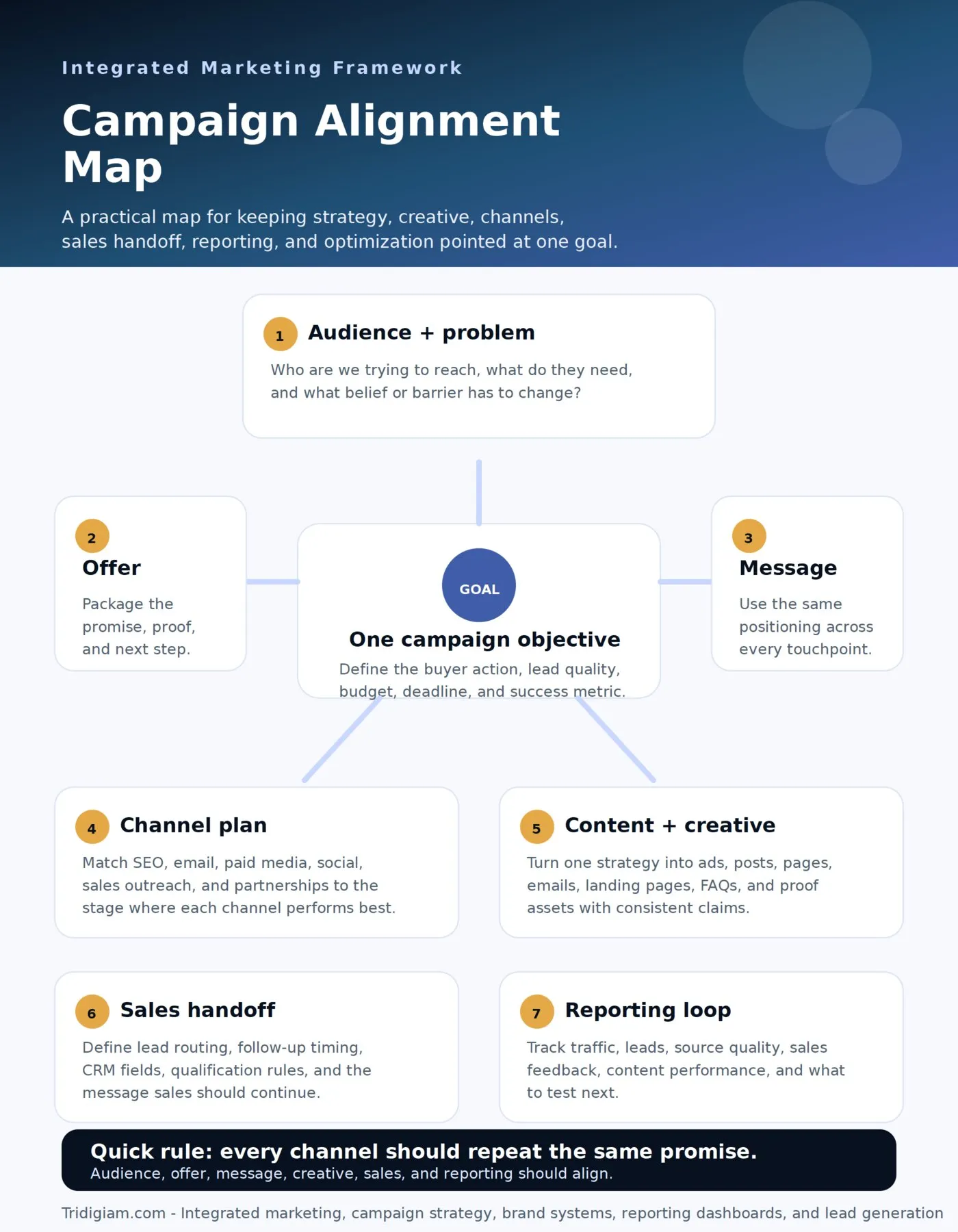
An Integrated Marketing Communications (IMC) brief helps businesses align their marketing efforts across different channels. It ensures that all messaging is consistent, clear, and focused on the right audience. This document serves as a roadmap for the marketing team, guiding them on objectives, strategies, and execution.
Key Takeaways
- The IMC brief keeps marketing efforts aligned and consistent.
- It defines the target audience to create content that resonates.
- Using multiple marketing channels ensures a seamless brand experience.
- Setting clear goals and KPIs helps measure campaign success.
- A consistent brand identity and tone strengthen the brand’s image.
Steps to Building an Effective IMC Brief
1. Identify Your Target Audience
Understanding your audience is crucial. Consider:
- Age, gender, income level
- Interests and behaviors
- Buying habits
This information helps create marketing messages that truly connect with potential customers.
2. Define Key Messages
Your marketing messages should:
✔ Align with your brand’s values
✔ Be clear, engaging, and consistent
✔ Emotionally connect with your audience
A strong message builds trust and strengthens brand recognition.
3. Highlight Your Unique Selling Points (USP)
Your USP explains what makes your brand stand out.
Ask yourself: Why should customers choose us over competitors?
Your USP could be:
✅ Better quality
✅ Competitive pricing
✅ Outstanding customer service
4. Use Multiple Marketing Channels
Your IMC brief should outline where and how you’ll promote your message.
Common channels include:
📢 Social Media – Engage with customers and build brand awareness
📧 Email Marketing – Nurture leads and retain customers
🔍 SEO & PPC – Improve visibility in search engines
📰 Traditional Media – Print, radio, and TV ads
A successful campaign integrates multiple channels to create a unified brand experience.
5. Set Clear Goals & KPIs
To measure success, your IMC brief should include:
🎯 Goals – What do you want to achieve? (More sales, leads, or brand awareness)
📊 KPIs – Metrics to track performance (website traffic, conversions, engagement)
Set SMART goals – Specific, Measurable, Achievable, Relevant, and Time-bound.
6. Keep Branding Consistent
Your IMC brief should outline:
- Brand voice (formal, friendly, professional)
- Visual identity (logo, colors, typography)
- Messaging guidelines
A consistent brand helps build trust and recognition.
7. Plan Your Budget & Resources
Decide how much to spend on each marketing channel. Allocate resources for:
💰 Advertising (digital and traditional)
🎨 Content production (graphics, videos, and copywriting)
📅 Marketing tools & staff
Clear budgeting ensures efficient use of resources.
8. Review and Adjust
Marketing is not static. Keep updating your IMC brief based on:
- New market trends
- Changes in customer behavior
- Performance metrics (KPIs)
Regular reviews keep your campaign effective and relevant.
| Step | What To Do |
|---|---|
| 1. Identify Your Target Audience | Know exactly who the campaign needs to reach before writing anything else. |
| 2. Define Key Messages | Nail down the core messages every channel needs to carry. |
| 3. Highlight Your Unique Selling Points (USP) | Spell out what makes the offer different from competitors. |
| 4. Use Multiple Marketing Channels | Plan how the message will show up across channels, not just one. |
| 5. Set Clear Goals & KPIs | Define what success looks like and how it will be measured. |
| 6. Keep Branding Consistent | Make sure tone, visuals, and messaging match across every channel. |
| 7. Plan Your Budget & Resources | Map out what the campaign will cost and who is doing the work. |
| 8. Review and Adjust | Build in a checkpoint to revisit the brief and adjust based on results. |
Conclusion
A well-structured IMC brief ensures that all marketing efforts work together. It provides clear direction, helps teams stay on track, and improves brand consistency. By defining your audience, messaging, channels, and goals, you can create a cohesive marketing strategy that drives results.
If you’re looking to enhance your understanding of digital marketing, you may want to check out this article on Understanding and Capitalizing on Micro-Moments in SEO and PPC. This article delves into the concept of micro-moments and how they can be leveraged in search engine optimization and pay-per-click advertising to effectively reach and engage with consumers. Understanding these micro-moments can be a valuable addition to your integrated marketing communication brief.
FAQs
What is an IMC (Integrated Marketing Communication) Brief?
A document that outlines a company’s marketing strategy, including target audience, messaging, and channels.
Why is an IMC Brief important?
It ensures all marketing efforts are aligned and working toward the same goal.
What are the key components of an IMC Brief?
- Target audience details
- Key messages
- Marketing channels
- Budget and resources
- Goals and KPIs
How to write an effective IMC Brief?
Define goals, understand the audience, create engaging messaging, choose the right channels, and measure results.
Related service: Learn more about Tridigiam’s strategic marketing services.
Need marketing that actually moves the needle?
Tridigiam is a Las Vegas marketing and advertising agency built for regulated and growth-focused businesses. Call (702) 748-7005 or request a consultation.
Frequently asked questions
How is an IMC brief different from a standard creative brief?
An IMC brief coordinates messaging across every channel a campaign will touch, so it includes channel-specific considerations, while a standard creative brief usually scopes a single piece of creative or one channel’s execution.
What happens if a campaign skips an IMC brief and each channel team works independently?
Messaging tends to drift, different tone, competing calls to action, mismatched visuals, which fragments the customer’s experience and weakens the campaign’s overall impact compared to a coordinated rollout.
Who typically owns and approves the IMC brief before execution begins?
A marketing lead or campaign manager usually owns it, with sign-off from stakeholders across the channels involved, so everyone executing has agreed to the same objective and message before work starts.
Want more like this? Browse our free CRO, SEO, and AI search guides.

Written and reviewed by Chris Goodman, CEO of Tridigiam
Founder of a Las Vegas marketing agency building AI-visibility and compliance-aware marketing systems for regulated industries — healthcare, addiction treatment, and aesthetics. LinkedIn

Explore knowledge from Chris Goodman, a marketing expert with extensive agency and small business experience, specializing in innovative advertising strategies. Chris has a Bachelor’s in Marketing from RMIT, years working in advertising agencies servicing clients, and years of experience working with small to medium sized businesses operating within regulated industries.