

Quick answer: SEO for small businesses focuses on the highest-leverage basics: a clear site structure, helpful content around what customers search, an optimized Google Business Profile, local citations, and reviews. You do not need a huge budget, just consistency on the fundamentals that help nearby customers find you.
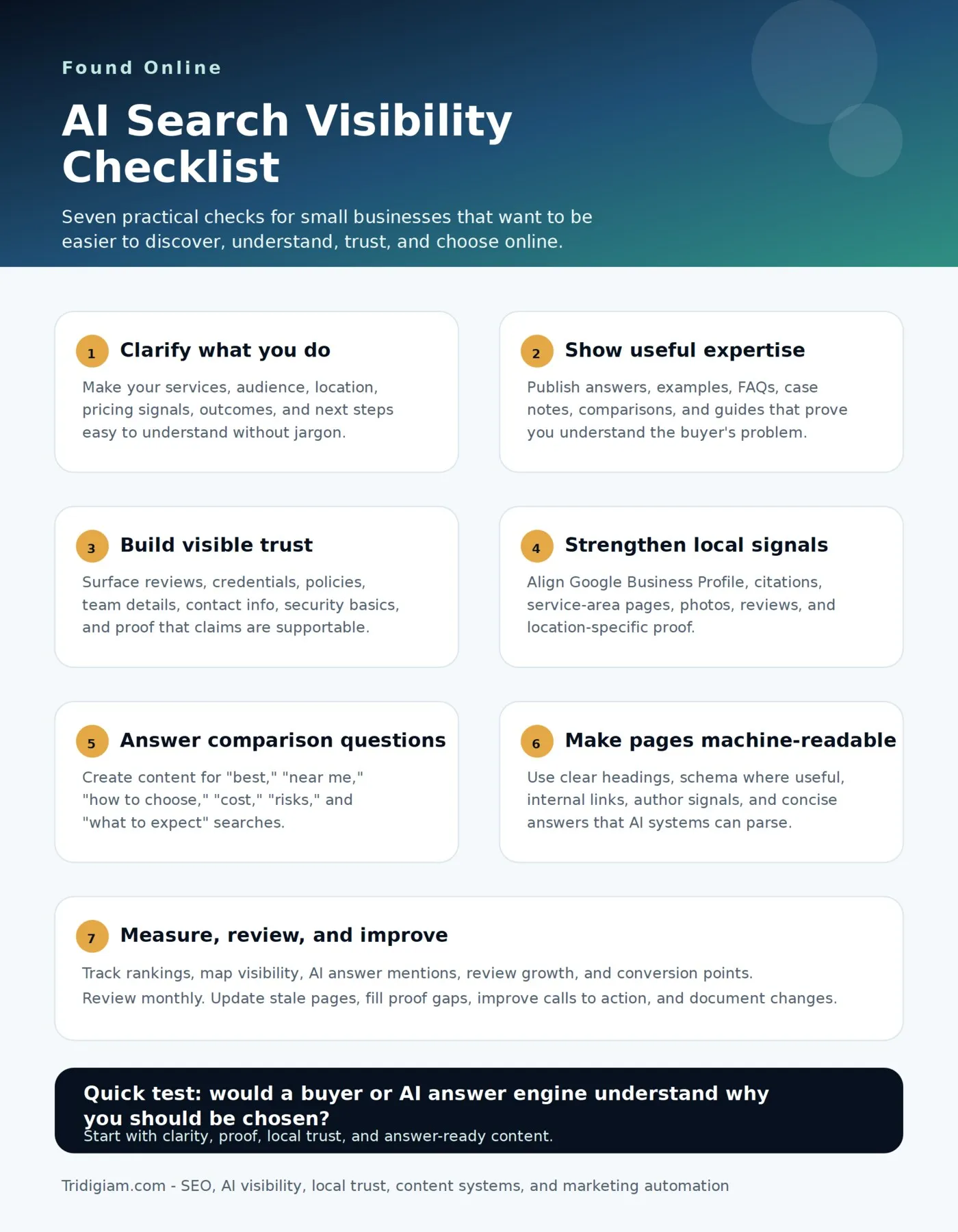
Small business SEO answer map
Small business SEO works best when the basics are complete, consistent, and local-intent focused. A small business should start with a crawlable website, clear service pages, helpful local content, an accurate Google Business Profile, consistent business information, reviews, and simple tracking in Search Console and analytics.
- Website foundation: make the site fast, mobile-friendly, secure, easy to navigate, and clear about services, locations, and contact options.
- Content strategy: create pages that answer real customer questions, explain services, show proof, and match local search intent.
- Local visibility: keep the Google Business Profile accurate, choose the right categories, add photos, update hours, and earn legitimate reviews.
- Authority signals: build internal links, local citations, partner references, customer testimonials, and relevant backlinks over time.
- Measurement: use Search Console, Business Profile insights, calls, forms, bookings, and revenue data to decide what to improve next.
Useful source anchors include Google’s SEO Starter Guide, Google Business Profile guidance on improving local ranking, Google Business Profile guidance on managing customer reviews, Google Search Console guidance on the Performance report, and Google’s Search Console overview. Tridigiam connects this topic to increasing website ranking on Google, technical SEO best practices, local SEO and PPC, local citation building, and Google Search Console AI data.
Questions to answer before doing SEO for a small business
Which customers and locations matter most?
Define the services, service areas, neighborhoods, and customer problems that should drive the SEO plan. Small business SEO works better when pages are built around real buyer intent instead of broad generic keywords.
Is the local trust foundation complete?
Check the Google Business Profile, business name/address/phone consistency, review process, service pages, contact information, testimonials, and local citations. These basics often create the fastest visibility gains.
How will SEO success be measured?
Track search impressions, clicks, local actions, calls, forms, bookings, direction requests, and revenue. Rankings are useful, but a small business SEO plan should ultimately produce qualified local demand.
A strong online presence is essential for small businesses to succeed in the modern digital era. Search engine optimization (SEO) is one of the best methods for achieving this. The process of improving a website for search engines to increase its exposure and ranks on search engine results pages (SERPs) is known as SEO. Through the application of SEO tactics, small businesses can raise their profile online, draw in more natural traffic, and eventually boost conversion rates. It’s crucial to remember, though, that SEO is a continuous endeavor. Keeping up with the constantly evolving algorithms of search engines like Google takes constant effort & adaptation.
Key Takeaways
- SEO is important for small businesses to increase their online visibility and attract more customers.
- Website design plays a crucial role in SEO as it affects user experience and search engine rankings.
- SEO consists of various components such as keyword research, on-page optimization, and off-page optimization.
- On-page optimization techniques include optimizing title tags, meta descriptions, and content for relevant keywords.
- Off-page optimization strategies include building backlinks and social media marketing to improve website authority and visibility.
Introduction
Small business owners may find SEO intimidating due to its intricacy and ongoing changes. However, with the right information and tactics, small businesses can use SEO to effectively compete with larger rivals and reach their target audience.
The Importance of Website Design in SEO
Mobile Responsiveness
Website design is very important when it comes to SEO. A well-designed website not only improves user experience but also raises its position in search results. One of the many factors that search engines like Google take into account when evaluating the quality and relevancy of a website is its design. A website needs to be mobile responsive first and foremost. Mobile traffic has overtaken desktop traffic due to the growing use of smartphones and tablets. Mobile-friendly websites are therefore ranked higher by search engines. A website with a mobile responsive design will adjust to various screen sizes and offer a consistent user experience on various devices.
Site Speed
An additional crucial component of website design that influences SEO is site speed. Because users frequently leave slow-loading websites, search engines give preference to websites that load quickly. Using caching strategies, minifying code, and optimizing images are a few strategies to increase website speed.
Understanding SEO Components
On-Page Optimization
To apply SEO strategies effectively, it’s critical to understand its various components. The three primary components of SEO are technical optimization, off-page optimization, and on-page optimization. The process of optimizing specific web pages to increase their visibility on search engine results pages is known as “on-page optimization.” This includes optimizing title tags, meta descriptions, header tags, and URL structures, as well as creating excellent, pertinent content with targeted keywords.
Off-Page Optimization
On the other hand, off-page optimization concentrates on enhancing a website’s reputation and authority through outside sources. This includes techniques like social media marketing, link development, and online reputation management. Search engines can better comprehend the relevance and authority of a website with the aid of off-page optimization.
Technical Optimization
Technical optimization involves making a website’s technical elements better so that search engines can crawl and index it more easily. This entails applying schema markup, enhancing website speed, and ensuring URL canonicalization is done correctly. Technical optimization ensures that a website’s content is easily accessed and comprehended by search engines.
On-Page Optimization Strategies for Small Businesses
Optimizing Title Tags
For websites owned by small businesses, on-page optimization is essential to SEO. Here are some strategies:
- Ensure that title tags are optimized: A web page’s title is defined by the title tag, an HTML element. It is shown on search engine results pages as the headline that can be clicked. Including pertinent keywords and crafting attention-grabbing titles are two aspects of title tag optimization.
Writing Effective Meta Descriptions
- Write effective meta descriptions: A meta description is a succinct synopsis of a website that shows up beneath the title tag in search engine results. It should entice users to click through and accurately describe the page’s content. You can increase click-through rates by using pertinent keywords and a call-to-action.
Using Header Tags
- Make use of header tags (H1, H2, H3, etc.): These HTML elements define the headings and subheadings on a web page. They aid in the hierarchy and structure of the content being understood by search engines. A webpage’s visibility can be increased by including pertinent keywords in the header tags.
Improving URL Structures
- Improve URL structures: URLs should be brief, informative, and full of keywords. They should faithfully convey the information on the webpage. Avoid lengthy, intricate URLs that contain unnecessary numbers or parameters.
| On-Page Tactic | What It Involves |
|---|---|
| Optimize title tags | Craft clickable, keyword-relevant titles since the title tag is what shows as the headline in search results. |
| Write effective meta descriptions | Summarize the page accurately with a call-to-action and relevant keywords to boost click-through rates. |
| Use header tags (H1, H2, H3) | Structure content with headings so search engines understand hierarchy, working in keywords where they fit naturally. |
| Improve URL structures | Keep URLs short, descriptive, and keyword-rich, avoiding long strings of numbers or parameters. |
Off-Page Optimization Tactics for Small Businesses
Building Quality Backlinks
For small businesses, off-page optimization is equally crucial. Here are some tactics:
- Provide backlinks to your website from other websites: Backlinks are references to your website that point to it. They have a significant role in search engine ranking. Obtaining high-quality backlinks from reliable and pertinent websites can raise a website’s authority and search engine rankings. Influencer outreach, content promotion, and guest blogging are some ways to achieve this.
Utilizing Social Media Marketing
- Make use of social media marketing: These channels give you the chance to interact with your target market, increase brand recognition, and increase website traffic. Increasing the visibility and search engine rankings of your website can be achieved by sharing excellent content, interacting with followers, and taking part in pertinent discussions.
Encouraging Positive Reviews
- Encourage positive online reviews and testimonials: These can enhance the credibility and reputation of your website. Encourage happy customers to share their experiences on Yelp, Google My Business, and industry-specific review sites. Responding to both positive and negative reviews demonstrates your appreciation for client feedback.
Participating in Industry Forums
- Take part in industry forums and communities: By participating in these platforms, you can position yourself as an authority in your field. You can enhance your online reputation and drive natural traffic to your website by responding to inquiries, offering insightful commentary, and posting pertinent content.
The Role of Keyword Research
Tools and Techniques
One of the most important components of SEO for small business websites is keyword research. It involves identifying the terms and phrases that members of your target market use when looking for goods or services associated with your company. Here are some resources and methods:
- Employ keyword research tools: Tools like Moz Keyword Explorer, SEMrush, and Google Keyword Planner can help you find relevant keywords and analyze their search volume, competition, and potential traffic.
Analyzing Competitor Keywords
- Examine competitor keywords: Researching the keywords your rivals are using can help you find new keyword opportunities and gain insightful information. Tools like SpyFu and SEMrush can analyze the organic and sponsored keywords of your rivals.
Considering Long-Tail Keywords
- Take long-tail keywords into consideration: These are more specialized, longer keyword phrases that often have higher conversion rates but less search volume. They help target a more niche market and are less competitive.
Monitoring Keyword Performance
- Analyze keyword performance: Regularly evaluate the performance of your chosen keywords. Track organic traffic, analyze user engagement metrics, and monitor your website’s rankings for particular keywords to determine which generate the highest traffic and conversion rates.
Creating High-Quality Content
Using Targeted Keywords
High-quality content creation is necessary for SEO success. Websites that offer users relevant and useful content are given priority by search engines. Here are some methods:
- Use targeted keywords: Including targeted keywords in your content helps search engines determine how relevant your website is to particular search queries. However, avoid keyword stuffing, which can hurt your rankings.
Providing Value to Readers
- Provide value to readers: Focus on producing content that assists readers with their problems, responds to their inquiries, and offers practical advice. Superior content that offers solutions and useful information has a higher chance of being shared and linked to, raising your website’s visibility and search engine rankings.
Experimenting with Content Formats
- Use captivating formats: Experiment with various content formats like blog entries, videos, infographics, podcasts, and interactive material to keep your audience engaged. Use attention-grabbing headlines, images, and storytelling.
Optimizing for Readability
- Optimize for readability: Create content that is easy to read and understand. Utilize bold text, bullet points, subheadings, and brief paragraphs to break up the information. Avoid technical terms or jargon that could confuse your audience in favor of clear, concise language.
Enhancing UI/UX for SEO
Improving Navigation
SEO heavily relies on the design of the user interface (UI) and user experience (UX). A well-designed website that offers a smooth user experience increases user engagement and raises search engine rankings. Here are some strategies:
- Ensure easy navigation: Sort your material into sensible categories and give your navigation menus meaningful labels. Make it simple for users to locate the information they require.
Enhancing Page Load Times
- Enhance page load times: Improve the speed of your website by employing a content delivery network (CDN), caching strategies, minifying code, and compressing images. Both search engine rankings and user experience are greatly impacted by page load times.
Using Responsive Design
- Employ responsive design: Ensure that your website adjusts to various screen sizes and offers a consistent user experience across devices. Test your website across a range of hardware and web browsers to guarantee compatibility.
Optimizing Forms and CTAs
- Improve forms and CTAs: Make sure any forms or calls-to-action (CTAs) on your website are user-friendly. Make forms brief and easy to understand, and make it obvious why completing them will be beneficial. Use attention-grabbing copy and contrasting colors for your CTAs to increase conversions.
Leveraging Social Media for SEO
Distributing Content
For small businesses, social media can have a big impact on SEO. Social media signals can indirectly affect search engine rankings. Here are some methods:
- Distribute excellent content: Share your website’s content on social media platforms to expand its visibility and audience. Make sure your material is valuable to your audience and shareable. Adding social media sharing buttons to your website can promote social sharing.
Engaging with the Audience
- Engage with your audience: Participate in pertinent conversations, reply to inquiries, and respond to remarks on social media platforms. A strong social media presence can increase your website’s visibility and draw in organic traffic.
Utilizing Influencer Marketing
- Utilize influencer marketing: Identify influential people in your industry and cultivate a relationship with them. Interact with their material, distribute their posts, and collaborate to produce content. Influencer marketing can spread the word about your content and increase website traffic.
Optimizing Social Media Profiles
- Optimize social media profiles: Add a link to your website, an engaging description, and pertinent keywords to your social media profiles. This can raise the likelihood that your profiles will show up in search engine results and increase your visibility on social media networks.
Measuring and Analyzing SEO Success
Using Google Analytics
Small businesses must measure and analyze SEO success to assess the efficacy of their strategies and make informed decisions. Here are some resources and methods:
- Employ Google Analytics: This robust tool provides important information about the functionality of your website. It enables you to monitor data like conversions, average session duration, bounce rate, and organic traffic. Establish objectives and conversion tracking to assess the effectiveness of your SEO campaigns.
Tracking Keyword Rankings
- Track keyword rankings: Continually track the positions of specific keywords on your website. Tools like SEMrush and Moz help track keyword ranking and performance analysis, enabling you to determine which keywords are bringing in the most visitors and profits.
Monitoring Backlinks
- Track backlinks: Keep an eye on the quantity and caliber of backlinks pointing to your website. Tools like Ahrefs and Majestic offer thorough backlink analysis, helping you track both newly established and departed backlinks. Analyzing your backlink profile can aid in rebuilding links and enhancing your website’s authority.
Analyzing User Engagement Metrics
- Examine user engagement metrics: These metrics indicate how visitors interact with your website and include time on page, pages per session, and bounce rate. Analyze these metrics to enhance the user experience on your website and pinpoint areas for improvement.
Conclusion
In summary, search engine optimization (SEO) is an essential component of small business internet marketing. It facilitates increased visibility, organic traffic, and conversions. Small businesses can successfully compete with larger rivals and reach their target audience by comprehending the various SEO components and implementing the appropriate strategies. Nonetheless, it’s critical to remember that SEO is a continuous endeavor requiring constant optimization to keep up with changes in search engine algorithms. Small businesses should conduct regular evaluations and assessments of their SEO campaigns, monitor pertinent data, and make decisions based on facts. With the right information and tactics, small businesses can use SEO to build a strong online presence, draw in more clients, and achieve long-term success. Invest in SEO, and watch your small business prosper in the online world.
If you’re interested in learning more about digital marketing strategies for small businesses, you might also find our article on email marketing helpful. Email marketing is a powerful tool that can complement your SEO efforts and help you reach a wider audience. To find out how to effectively integrate email marketing into your overall marketing strategy, check out our page on email marketing.
FAQs
What is SEO?
SEO stands for Search Engine Optimization. It is the process of optimizing your website to rank higher in search engine results pages (SERPs) for specific keywords and phrases.
Why is SEO important for small businesses?
SEO is important for small businesses because it helps them to increase their online visibility, attract more traffic to their website, and ultimately generate more leads and sales. It is a cost-effective way to compete with larger businesses and reach a wider audience.
What are some key SEO strategies for small businesses?
Some key SEO strategies for small businesses include conducting keyword research, optimizing website content and meta tags, building high-quality backlinks, and ensuring that your website is mobile-friendly and has a fast loading speed.
How long does it take to see results from SEO?
The time it takes to see results from SEO can vary depending on a number of factors, including the competitiveness of your industry, the quality of your website content, and the effectiveness of your SEO strategies. Generally, it can take several months to start seeing significant improvements in your search engine rankings.
Can small businesses do SEO on their own?
Yes, small businesses can do SEO on their own. However, it can be a complex and time-consuming process, and it may be more effective to hire an experienced SEO professional or agency to help you develop and implement a comprehensive SEO strategy.
Related service: Learn more about Tridigiam’s search engine marketing services.
Need marketing that actually moves the needle?
Tridigiam is a Las Vegas marketing and advertising agency built for regulated and growth-focused businesses. Call (702) 748-7005 or request a consultation.
Want more like this? Browse our free CRO, SEO, and AI search guides.
Frequently asked questions
Do small businesses need a big budget to do SEO effectively?
No, the highest-leverage moves, an optimized Google Business Profile, clear site structure, local citations, and helpful content, cost time more than money and can meaningfully move local visibility.
What’s the fastest local SEO win for a small business just getting started?
Fully completing and actively managing a Google Business Profile, accurate categories, photos, posts, and responding to reviews, tends to produce visible results faster than most other tactics.
How important are online reviews for small business SEO?
Very, review volume and rating factor into local search rankings directly, and reviews also influence whether searchers actually click through and choose that business over a competitor.

Written and reviewed by Chris Goodman, CEO of Tridigiam
Founder of a Las Vegas marketing agency building AI-visibility and compliance-aware marketing systems for regulated industries — healthcare, addiction treatment, and aesthetics. LinkedIn
Related book: For a practical small-business visibility system, see Found Online: A Small Business Guide to Visibility in the AI Search Era by Chris Goodman.

Explore knowledge from Chris Goodman, a marketing expert with extensive agency and small business experience, specializing in innovative advertising strategies. Chris has a Bachelor’s in Marketing from RMIT, years working in advertising agencies servicing clients, and years of experience working with small to medium sized businesses operating within regulated industries.