

Quick answer: Google’s new AI Mode ad formats move beyond keyword-matched ads into conversational, answer-style placements, which now appear in a meaningful share of AI search results. Regulated advertisers in healthcare, legal, and finance need to align creative and claims with compliance rules first, since these formats reward authoritative content over clickbait.
Google’s new AI mode ad formats shift how users discover services, moving beyond traditional keyword matches to conversational answers.
This change raises compliance risks for healthcare, finance, and legal firms that must keep automated messaging within strict regulatory boundaries.
Understanding these mechanics helps agencies protect client data while maintaining visibility in search results.
Google AI Mode ads answer map
Google’s AI-era ad formats expand paid visibility into AI Overviews, AI Mode tests, and AI-powered Search campaign automation. Regulated advertisers should treat these placements as high-intent discovery surfaces, but they still need the same controls around claims, sensitive data, landing pages, audience eligibility, disclaimers, and measurement.
- Separate available inventory from tests: Ads in AI Overviews and AI Max features have specific eligibility and campaign requirements, while AI Mode ad formats may still vary by market, format, and pilot availability.
- Review claims before scaling automation: AI-generated headlines, descriptions, final URL expansion, and contextual matching can create compliance risk if landing pages, disclaimers, and regulated claims are not reviewed.
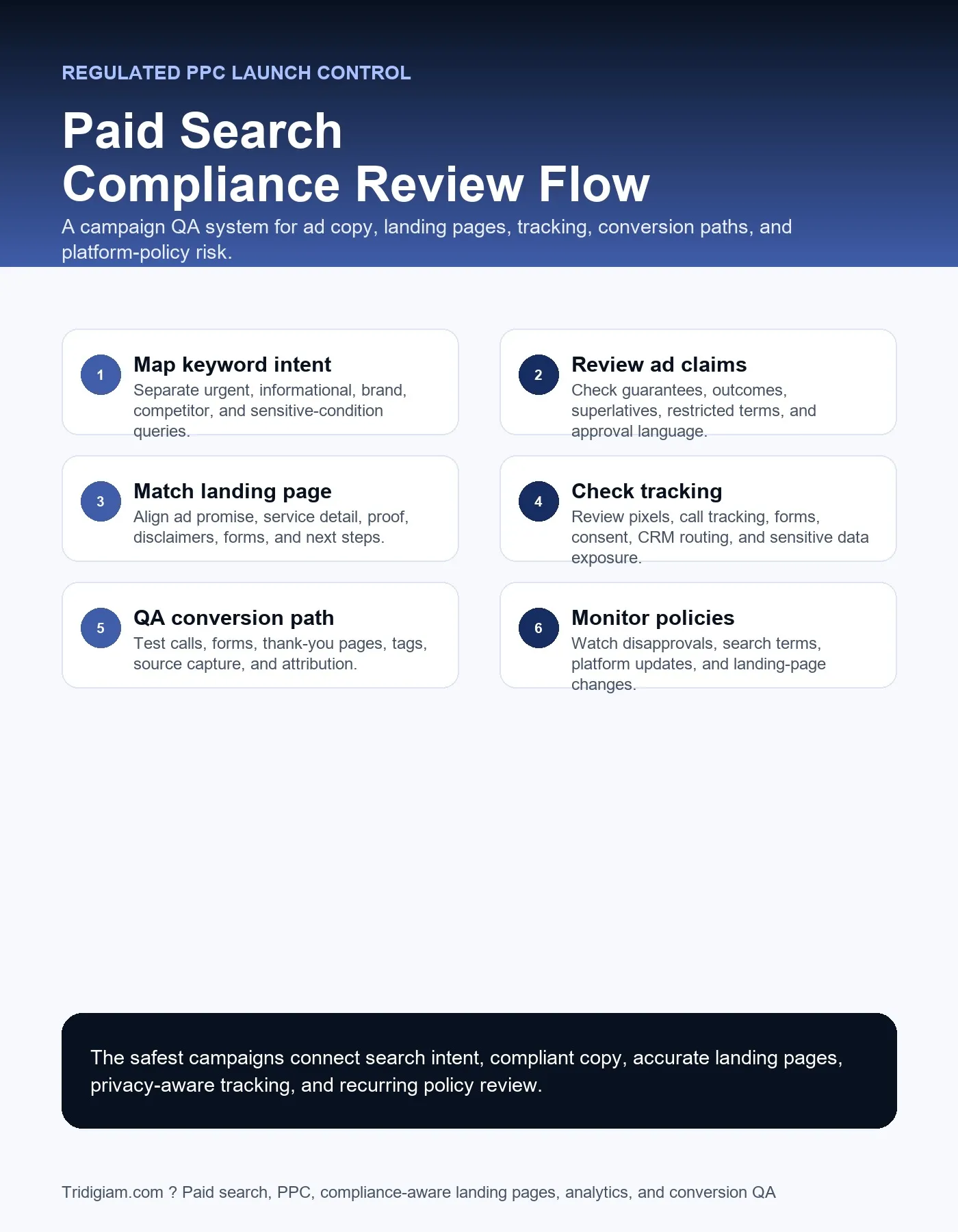
- Protect sensitive audiences: healthcare, finance, legal, addiction treatment, and other regulated advertisers should audit targeting, remarketing, conversion tracking, forms, call tracking, and CRM integrations before using AI-expanded delivery.
- Measure intent quality, not only clicks: AI search surfaces can reduce traditional click paths, so teams should track qualified leads, assisted conversions, branded search lift, Search Console query changes, and downstream revenue quality.
- Prepare landing pages for answer-led search: ads perform better when the destination page clearly answers the user’s question, supports claims with sources, and gives Google enough context to match the page safely.
Useful source anchors include Google Ads Help on ads and AI Overviews, Google Ads Help on how AI Max for Search campaigns works, Google’s new generation of ads for the AI era of Search, and Google’s update on AI in Search for business discovery. Tridigiam connects Google AI ad strategy to HIPAA-conscious paid ads, Google Search Console AI data, AI Overviews for healthcare SEO, AI search trust signals, and HIPAA-compliant marketing.
Questions to answer before testing Google AI ad formats in regulated industries
Which Google AI ad surface is actually available for this campaign?
Confirm whether the campaign is eligible for Ads in AI Overviews, AI Max for Search, Performance Max, Shopping, or an AI Mode pilot. Availability, controls, and reporting can differ, so the launch plan should match the actual product being used.
What claims or landing-page elements need compliance review?
Review headlines, descriptions, extensions, final URLs, AI-generated assets, testimonials, pricing, guarantees, comparisons, medical or financial claims, disclaimers, and forms before automation is allowed to expand delivery.
How will success be measured if AI search changes click behavior?
Use click and conversion metrics, but also watch qualified lead rate, assisted conversions, branded search demand, Search Console query shifts, call quality, CRM outcomes, and revenue quality to understand whether AI search traffic is commercially useful.
Key Takeaways
- Google AI Mode ads now appear in roughly a quarter of all AI search results.
- Direct Offers format launched in February 2026 to support this new advertising era.
- Regulated sectors must align creative assets with strict platform advertising policies.
- Traditional click-through rate metrics decline significantly as AI Overviews expand reach.
- Marketers should adapt measurement strategies beyond standard CTR tracking methods.
What Are Google AI Mode Ads and Why They Matter for Regulated Industries
Google AI Mode ads now appear in 25.5% of AI-generated search results Digital Applied. This format launched in February 2026 as part of Google’s effort to integrate paid media directly into conversational AI responses Google Blog. The shift moves advertising from traditional blue-link lists to integrated summaries where users get answers without clicking away.
This change forces regulated industries to rethink how they present information. Healthcare providers, financial advisors, and legal firms face strict advertising standards that do not bend for new interfaces. Ad Age notes that these new ad formats require advertisers to understand how AI interprets and displays sponsored content. You cannot rely on legacy compliance checks alone. The AI engine synthesizes data from multiple sources, which means your ad copy must stand up to automated scrutiny before it even reaches the user.
Traditional performance metrics lose their usual predictive power in this environment. Click-through rate no longer tells the whole story because users often find what they need within the AI summary itself DataLayer. Marketing directors must prepare for a future where brand visibility matters more than immediate clicks. Your agency partner needs to align creative assets with AI-friendly structures while maintaining strict adherence to industry-specific rules. This is not just a technical adjustment. It is a fundamental shift in how regulated businesses communicate value through paid channels.
Understanding Direct Offers: The New Standard for B2B and Service-Based Marketing
Google launched the Direct Offers ad format in February 2026 to capture high-intent B2B and service-based queries within AI Mode results Google. This shift moves advertising away from traditional click-through metrics toward direct action completion inside the search interface.
Regulated industries like healthcare, finance, and legal services face unique constraints when using these formats. Ad copy must remain compliant with strict industry regulations while providing immediate value to users who expect instant answers from AI summaries. The Direct Offers format allows advertisers to present specific service details, pricing structures, or appointment booking options directly in the response window. This reduces friction for prospects who prefer to evaluate providers without leaving the search page.
Marketing directors must audit their current creative assets to ensure they align with this new interaction model. Traditional landing page funnels may underperform if users can complete research or initiate contact through the ad unit itself. Agencies serving regulated clients should prioritize clear, compliant calls-to-action that respect data privacy and advertising standards. The focus shifts from driving traffic to facilitating immediate, verifiable engagement.
Direct Offers enable precise measurement of lead quality by tracking actions taken within the AI interface. This provides clearer attribution for service-based campaigns where the customer journey is often short and decisive. Advertisers can adjust bids based on the likelihood of a user completing a desired action rather than merely clicking through. This approach supports more efficient budget allocation for high-value prospects.
Implementing Direct Offers requires a strategic review of existing keyword targeting and bid strategies. Teams should identify queries where users demonstrate strong intent to hire or purchase services immediately. Aligning ad creative with these high-intent moments improves conversion rates and reduces wasted spend on low-quality clicks. The format supports a more direct path from discovery to decision for regulated service providers.
Navigating Compliance: Advertising Policies Specific to Healthcare and Finance
Google’s automated ad placement systems evaluate creative assets against strict policy frameworks before serving them in AI Mode results. Healthcare and finance advertisers face heightened scrutiny because these sectors operate under rigid regulatory standards that restrict promotional language. A single compliance violation can trigger account suspension or limit ad visibility across Google’s AI surfaces. The shift toward zero-click answers amplifies this risk since the algorithm prioritizes concise, factual responses over traditional persuasive copy.
AdAge reports that advertisers must align their messaging with evolving platform policies to maintain presence in these new formats AdAge. This requirement forces marketing teams to audit existing creatives for prohibited claims, especially regarding financial returns or medical outcomes. Regulated industries cannot rely on broad generalizations when crafting ad copy for AI environments. The platform demands precise, verifiable statements that adhere to sector-specific guidelines without compromising clarity.
Finance campaigns must avoid promising specific investment results or using misleading risk disclosures. Healthcare advertisements need to ensure all health claims are substantiated and free from exaggerated benefits. Tridigiam.com helps clients structure compliant ad libraries that satisfy both Google’s automated filters and industry regulators. We focus on building sustainable visibility through rigorous policy adherence rather than chasing short-term clicks. This approach protects your brand reputation while maintaining access to high-intent audiences within AI-driven search interfaces.
The Impact on Traditional Metrics: Why CTR Is No Longer the Sole KPI
Traditional click-through rates drop as users find answers without leaving the search interface. This shift forces marketing directors to look beyond volume metrics and focus on conversion quality.
AI-generated summaries often satisfy user intent directly, reducing the need for clicks that drive traffic to your website. When a query is answered in the results page, the click metric loses its predictive power for revenue generation. You must measure success by actions taken after any interaction, such as form submissions or phone calls from AI-assisted inquiries.
Regulated industries face unique challenges because compliance rules limit how aggressively you can optimize for clicks alone. Healthcare and legal firms cannot rely on high-volume traffic to justify ad spend if those visitors do not convert into qualified leads. Finance clients need clear attribution models that connect AI interactions to closed deals rather than just page views.
You should implement tracking mechanisms that capture value from zero-click engagements. This approach ensures you account for brand exposure and assisted conversions within the AI environment. Tools like Google Analytics 4 allow you to model offline conversions and attribute them to digital touchpoints Google.
Focus on metrics that reflect business outcomes. Cost per acquisition remains a reliable indicator of performance even when clicks decline. Return on ad spend provides a clear view of profitability across different campaign structures.
Adjust your reporting dashboards to highlight these outcome-based KPIs. This change aligns your measurement strategy with the reality of AI-driven search behavior. It also helps justify budget allocations to stakeholders who demand measurable ROI.
Optimizing Ad Creative for AI-Generated Summaries and Zero-Click Results
Creative assets must deliver value within the first two lines of text to survive AI summarization algorithms. Google’s AI Mode prioritizes concise, factual statements that directly answer user intent without requiring a click for basic information Ad Age. This shift forces marketers to treat ad copy as an information snippet rather than a teaser.
Regulated industries face unique constraints here. Healthcare and financial services cannot use sensational claims or vague promises, which limits the creative flexibility often seen in e-commerce ads Audit Socials. You must align your headline and description with strict compliance guidelines while ensuring the content remains engaging enough to stand out in a list of AI-generated summaries. The algorithm scans for relevance and authority, so generic phrases like “best services” or “top rated” carry less weight than specific, verifiable statements about your offerings.
Focus on structured data integration. Embedding clear contact information, service areas, and compliance badges directly into the ad creative helps the AI model extract and display accurate details Google. This approach supports zero-click interactions by providing immediate utility to the searcher. If a user gets their answer from the summary, your brand still establishes trust through clear, compliant messaging. Testing different variations of factual statements can reveal which phrasing triggers positive engagement signals without violating advertising standards. Prioritize clarity over cleverness in every asset.
Strategic Bidding and Placement in an Expanded AI Search Landscape
Bidding strategies must account for placement volatility in AI Mode results where ad visibility fluctuates more than in standard search grids. Campaigns rely on automated bidding to capture high-intent queries across these dynamic placements. Marketers need to shift focus from static impression share to value-based metrics that reflect actual conversions.
Traditional cost-per-click targets often fail in this environment because user behavior changes significantly within AI-generated summaries. Users may find answers without clicking through to a website which reduces overall traffic volume but increases the quality of leads that do convert. This shift requires a reevaluation of how success is measured and optimized.
- Prioritize automated bidding strategies like Target CPA or Maximize Conversions to let Google’s algorithm adjust bids in real time based on conversion likelihood rather than fixed CPC limits.
- Implement granular placement adjustments by reviewing search term reports specific to AI Mode queries. Exclude irrelevant terms that trigger broad matches but do not align with your service offerings.
- Monitor impression share data closely to identify lost opportunities due to rank or budget constraints in these new ad positions. Adjust budgets dynamically to maintain visibility during peak query times.
These tactics help stabilize performance metrics amidst the unpredictability of AI-driven ad placements. The goal is to maximize return on ad spend while maintaining strict adherence to compliance standards inherent in regulated industries. Proper bid management ensures that your ads reach the right audience at the right moment without wasting budget on low-value impressions.
Ad Age notes that advertisers must adapt quickly to these new formats to stay competitive Ad Age. Digital Applied provides detailed insights into placement dynamics and bidding adjustments necessary for success Digital Applied. By focusing on these strategic elements you can navigate the expanded AI search landscape effectively.
Actionable Steps to Prepare Your Campaigns for the Shift to AI Mode
Audit your current landing pages for clear, structured data before the rollout completes. Google’s Direct Offers format relies on precise schema markup to populate contact buttons and service details directly within AI summaries. If your site lacks valid HTML5 semantic tags or missing Open Graph metadata, the system may fail to extract necessary information, resulting in incomplete ad displays. This technical gap often leads to wasted spend on impressions that do not convert into actionable user interactions.
Start by mapping every campaign to a dedicated landing page with explicit conversion paths. Healthcare providers need clear appointment booking links while legal firms require immediate case consultation forms. Finance clients must display secure login portals or verified product calculators. These pages serve as the primary data source for Google’s automated extraction tools. Ensure each target URL loads quickly and displays the same core value proposition found in your ad copy. Inconsistent messaging between the AI snippet and the destination page increases bounce rates and lowers Quality Scores over time.
Update your tracking infrastructure to capture interactions beyond simple clicks. Users now engage with phone numbers, contact forms, and direct booking widgets embedded within the search interface itself. Standard click-based analytics miss these high-intent actions. Implement server-side tagging or enhanced measurement features in Google Analytics 4 to record off-page conversions accurately. This approach provides a complete view of user behavior across both traditional search results and AI-generated overviews.
Review your keyword lists for broad match terms that may trigger irrelevant AI interpretations. Narrow targeting reduces the risk of serving ads for queries outside your compliance boundaries. Legal advertisers, for instance, must avoid triggering responses for unrelated criminal defense topics if they specialize in family law. Finance marketers need to exclude predatory loan products from their bid strategies. These refinements protect brand reputation and ensure ad spend reaches qualified prospects only.
Schedule monthly reviews of AI Mode performance metrics using Google reports. Identify trends in engagement rates and adjust creative assets accordingly. This ongoing optimization process maintains campaign effectiveness as the platform evolves.
| Regulated Industry | Landing Page Requirement |
|---|---|
| Healthcare | Clear appointment booking links |
| Legal | Immediate case consultation forms |
| Finance | Secure login portals or verified product calculators |
Conclusion
Google AI mode changes how users find answers. Regulated industries must adapt fast. Compliance rules stay strict while search evolves. You need a partner who understands both code and law. Tridigiam helps healthcare, finance, and legal firms adjust their strategy. We focus on sustainable growth that meets industry standards. Your marketing should drive traffic without risking penalties. Let us help you build campaigns that work within your specific rules.
Frequently Asked Questions
What share of AI results currently features ads?
Ads now appear in roughly 25.5% of Google AI Mode results Digital Applied. This placement rate indicates significant visibility opportunities within the growing AI search ecosystem for advertisers willing to adapt their strategies.
When did Google launch Direct Offers for AI Mode?
Google introduced the Direct Offers ad format in February 2026 Google Blog. This update allows advertisers to present specific offers directly within AI-generated responses, streamlining the path from discovery to conversion.
How do regulated industries handle compliance in AI ads?
Regulated sectors must strictly adhere to Google advertising policies and industry-specific regulations AuditSocials. Compliance requires careful review of ad copy, targeting parameters, and landing page content to avoid policy violations.
How does AI Mode affect traditional click-through rates?
AI overviews have reduced traditional click-through rates by approximately 61% DataLayer. Advertisers must shift focus from pure volume metrics to quality interactions and downstream conversion data.
Want more like this? Browse our free CRO, SEO, and AI search guides.

Written and reviewed by Chris Goodman, CEO of Tridigiam
Founder of a Las Vegas marketing agency building AI-visibility and compliance-aware marketing systems for regulated industries — healthcare, addiction treatment, and aesthetics. LinkedIn
Resources
Need marketing that actually moves the needle?
Tridigiam is a Las Vegas marketing and advertising agency built for regulated and growth-focused businesses. Call (702) 748-7005 or request a consultation.

Explore knowledge from Chris Goodman, a marketing expert with extensive agency and small business experience, specializing in innovative advertising strategies. Chris has a Bachelor’s in Marketing from RMIT, years working in advertising agencies servicing clients, and years of experience working with small to medium sized businesses operating within regulated industries.