
Generative engine optimization and answer engine optimization are becoming important parts of search strategy. Buyers are asking more detailed questions in AI tools, featured snippets, voice search, local results, and answer-style search experiences. Regulated businesses need to prepare for that shift without creating avoidable compliance risk.
This guide explains how GEO and AEO fit into a practical AI search strategy for healthcare, legal, financial, insurance, and other approval-sensitive organizations.
What GEO means
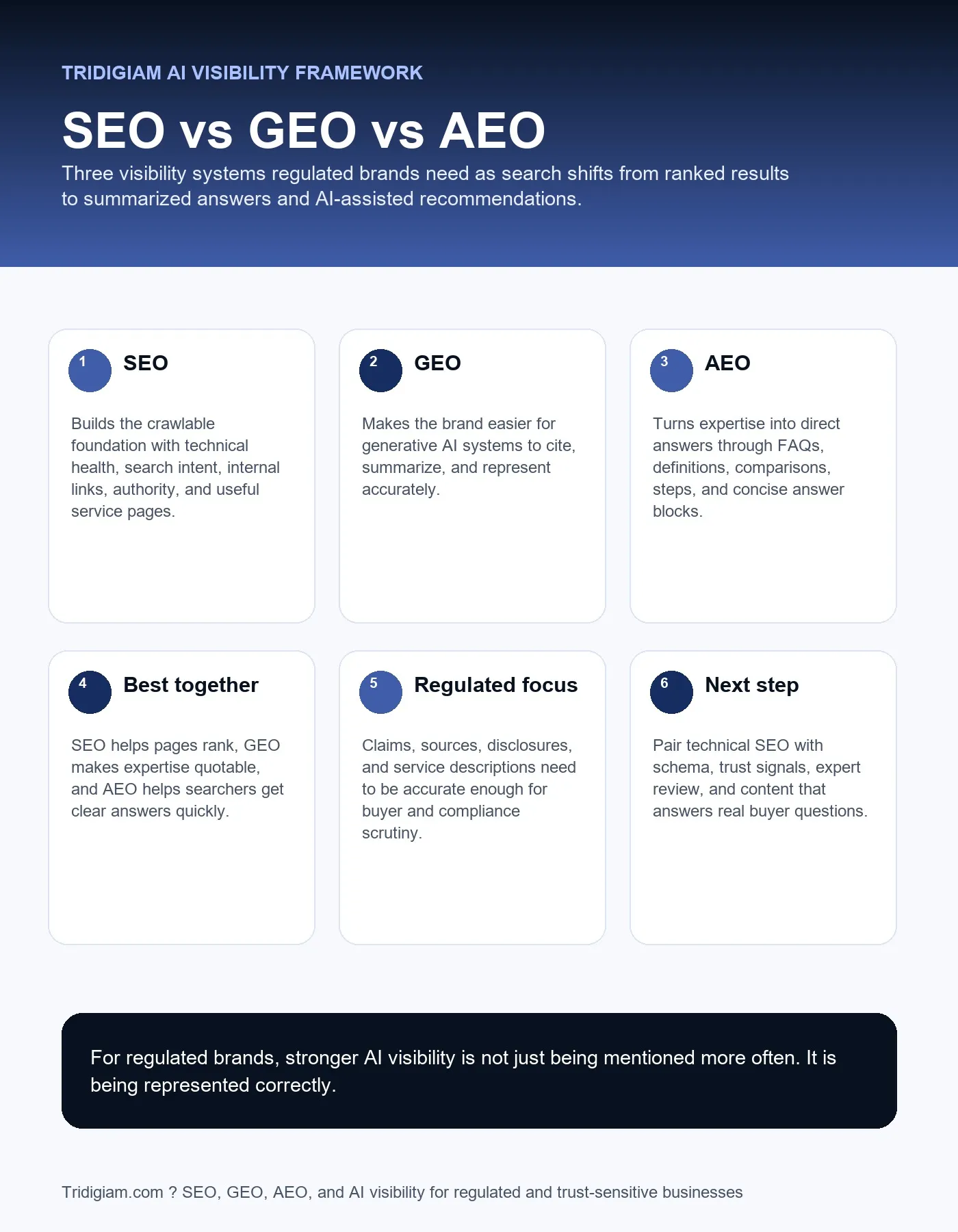
GEO stands for generative engine optimization. It focuses on making content more understandable, useful, and cite-worthy for generative AI systems. Instead of only trying to rank for a keyword, GEO asks whether a page clearly explains the entity, topic, audience, process, proof points, and context behind a business or service.
For regulated businesses, GEO should not mean publishing risky AI-generated content at scale. It should mean improving clarity, factual accuracy, source quality, structured data, author expertise, and internal consistency across the website.
What AEO means
AEO stands for answer engine optimization. It focuses on helping search systems identify direct, reliable answers to specific questions. This includes FAQ content, short definitions, service explanations, local answers, comparison language, and concise summaries that can be understood quickly.
AEO is especially useful when buyers ask questions such as what a service includes, who it is for, what risks to consider, how long a process takes, or how to choose a qualified provider. These are exactly the kinds of questions that regulated organizations should answer carefully.
Why regulated businesses need governance
GEO and AEO can improve visibility, but they also introduce review needs. Teams should define who approves claims, which sources are acceptable, which disclaimers are required, how frequently pages should be refreshed, and how AI-assisted drafts are reviewed before publication.
Governance is not just a legal safeguard. It also supports stronger search performance because consistent, accurate, well-maintained content is easier for search systems to evaluate and trust.
Practical GEO and AEO tactics
- Add clear definitions. Define technical terms, services, audiences, and outcomes in plain language.
- Use answer-first sections. Start important pages with short, direct answers before expanding into detail.
- Build FAQ clusters. Group common buyer questions around core services, locations, risks, and decision criteria.
- Strengthen entity signals. Keep organization details, author information, service names, locations, and credentials consistent.
- Related AI search resources
- Tridigiam Academy: AI Search Optimization Training
- AI Search Optimization for Regulated Businesses: A Practical Starter Guide
- Schema and Trust Signals for AI Search
- Use schema where appropriate. Article, FAQ, Organization, LocalBusiness, Service, and Course schema can help structure meaning.
- Connect related pages. Internal links help search systems understand topical relationships between services, resources, courses, and blog posts.
- Review claims regularly. Update statistics, examples, compliance language, and service details on a recurring schedule.
How to start without overcomplicating it
The simplest starting point is to identify the questions buyers already ask during sales conversations, consultations, intake calls, or onboarding. Turn those questions into concise, accurate answers on the website. Then connect those answers to the relevant service pages and supporting resources.
Tridigiam’s AI Search Optimization services help organizations build this kind of system across technical SEO, GEO, AEO, content governance, schema, internal linking, and reporting.
Teams that want a structured training path can join Tridigiam Academy for $20/month. The membership includes AI Search Optimization for Regulated Businesses, AI Visibility Audit Lab for Regulated Businesses, and practical resources for SEO, GEO, AEO, schema, trust signals, AI visibility monitoring, and compliance-safe implementation.
The goal is not to create more content for its own sake. The goal is to make the business easier to understand, easier to trust, and easier to cite across both traditional search and AI-powered discovery.
Related book: Want a clearer way to audit AI search visibility? See The AI Visibility Audit by Chris Goodman.
Resources
Need marketing that actually moves the needle?
Tridigiam is a Las Vegas marketing and advertising agency built for regulated and growth-focused businesses. Call (702) 748-7005 or request a consultation.

Explore knowledge from Chris Goodman, a marketing expert with extensive agency and small business experience, specializing in innovative advertising strategies. Chris has a Bachelor’s in Marketing from RMIT, years working in advertising agencies servicing clients, and years of experience working with small to medium sized businesses operating within regulated industries.