

Quick answer: OpenAI’s new ChatGPT ads place sponsored results directly inside conversational search answers, a new channel for reaching customers. Regulated businesses in healthcare, finance, and legal should treat this like any other paid channel: verify the ad copy meets industry-specific disclosure and compliance rules before launching, since a conversational format doesn’t loosen the underlying regulations.
OpenAI’s advertising rollout brings paid placements into conversational search experiences, creating a new channel that demands strict compliance for regulated sectors. Businesses in healthcare, finance, and law must ensure their AI-generated ad copy meets industry standards before launching campaigns on this emerging platform.
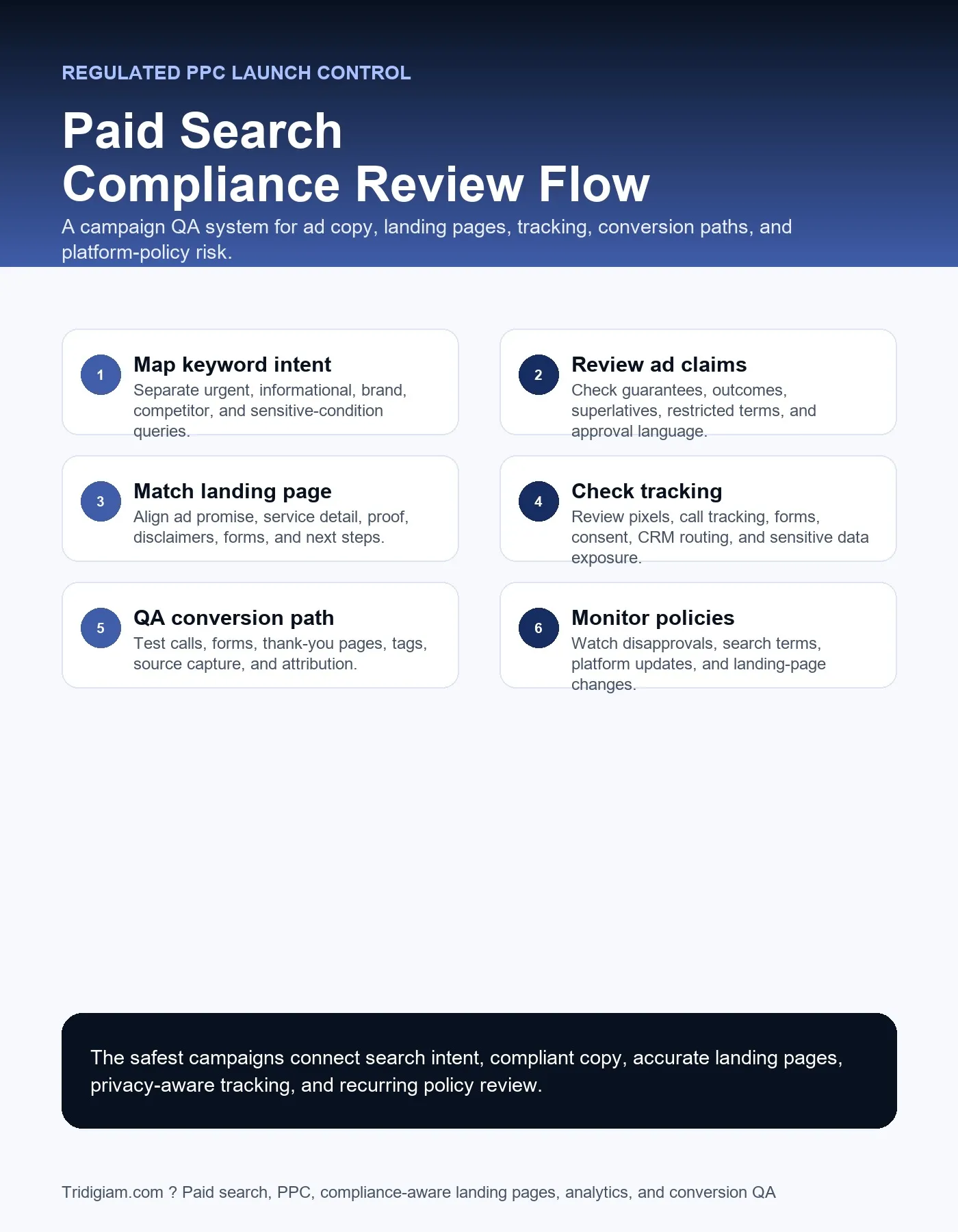
ChatGPT ads for regulated businesses answer map
ChatGPT ads create a new conversational advertising surface where people explore options, compare choices, and make decisions inside an AI assistant. For regulated businesses, the opportunity is high-intent visibility; the risk is applying old search-ad habits to a context where privacy, answer independence, claims, eligibility, and measurement have to be reviewed more carefully.
- Separate ads from organic answers: OpenAI states that ads are labeled and do not influence ChatGPT’s answers, so advertisers should plan for sponsored visibility without assuming control over the assistant’s response.
- Protect sensitive intent: healthcare, addiction treatment, behavioral health, legal, and finance advertisers should avoid targeting, landing pages, or measurement workflows that expose protected or sensitive information.
- Review claims before launch: ads, landing pages, follow-up flows, and comparison claims need substantiation and should avoid guaranteed outcomes or misleading “best” language.
- Measure differently: track assisted conversions, qualified conversations, branded search lift, landing-page quality, and downstream lead quality—not only clicks.
- Prepare content and feeds: strong answer-first pages, compliant landing pages, product/service data, and clear entity signals will matter as ChatGPT commerce and ads mature.
Useful source anchors include OpenAI’s Testing ads in ChatGPT, OpenAI’s New ways to buy ChatGPT ads, OpenAI Help Center’s Ads in ChatGPT: The Basics, the OpenAI Ads advertiser page, OpenAI’s ChatGPT product discovery page, and OpenAI’s crawler documentation. Tridigiam connects ChatGPT advertising strategy to AI Search Optimization, AI Visibility Index, Google Search Console AI data, AI search trust signals, HIPAA-conscious paid ads, and HIPAA-compliant marketing.
Questions to answer before testing ChatGPT ads in regulated industries
Can regulated businesses advertise in ChatGPT?
Potentially yes, but eligibility, policies, formats, and availability should be verified before launch. Regulated businesses should review privacy, claims, targeting, landing pages, measurement, and follow-up workflows before treating ChatGPT ads like ordinary search ads.
Do ChatGPT ads change organic AI answers?
OpenAI says ads do not influence ChatGPT’s answers. That means paid visibility should be planned separately from organic AI visibility, where source quality, answer structure, citations, and entity trust still matter.
What should healthcare or financial advertisers audit first?
Audit the ad claim, landing page, tracking setup, forms, CRM sync, call tracking, retargeting, consent language, privacy notice, and any sensitive data passed into ad, analytics, or follow-up systems.
Key Takeaways
- ChatGPT ads integrate sponsored content directly into conversational search answers for users.
- Regulated industries must align AI ad copy with strict FTC disclosure and compliance rules.
- Brands should audit their content to ensure it supports accurate AI-generated responses.
- Establishing clear measurement foundations helps track performance in this new advertising channel.
- Trust remains the primary driver for success in conversational search marketing campaigns.
What Are ChatGPT Ads and How Do They Work in 2026?
ChatGPT ads integrate directly into the conversational interface where users ask questions. This placement differs from traditional search engine results pages because the advertisement appears within the natural flow of an AI-generated answer rather than in a separate sidebar. The 2026 launch marks a shift from keyword bidding to intent-based contextual matching.
OpenAI structures these ads to match user queries with relevant business offerings in real time. The system analyzes the context of the conversation to determine which brands should appear. This approach allows for higher relevance but requires marketers to think differently about targeting. Instead of focusing solely on search volume, businesses must align their messaging with specific question types and user intents.
The mechanics rely on a new auction model that values contextual fit over simple keyword overlap. Advertisers bid on conversational themes and problem-solving scenarios rather than individual search terms. This change impacts how healthcare providers, legal firms, and med spas structure their campaigns. You need to define your ideal customer profile through the lens of questions they ask an AI assistant.
For regulated industries, this means preparing ad copy that answers specific compliance-heavy questions without violating advertising standards. The platform uses natural language processing to match ads to queries. This creates opportunities for precise targeting but also introduces new complexities in message control. Brands must ensure their automated responses remain accurate and compliant across all potential conversation paths.
AdVenture Media notes that early adopters are focusing on defining clear value propositions for conversational contexts. This preparation helps businesses stand out when the ads go live. Understanding the technical workflow is the first step toward effective campaign management.
Why Regulated Industries Must Prioritize AI Search Advertising
Conversational search interfaces are shifting user intent from broad keyword discovery to direct answer seeking.
This shift changes how healthcare providers, legal firms, and financial advisors connect with potential clients. Users no longer scan a list of blue links. They ask a specific question and expect an immediate, authoritative response within the chat interface. If your brand does not appear in these conversational placements, you lose visibility at the exact moment of high intent.
Regulated industries face stricter scrutiny than general commercial brands. Advertising claims must meet precise compliance standards set by bodies like the FTC or state medical boards. AI search platforms prioritize accuracy and source credibility to maintain user trust. This benefits established professionals who can demonstrate clear expertise and verifiable credentials. It disadvantages competitors relying on aggressive or ambiguous marketing tactics that algorithms may flag as low quality.
Early adoption allows you to refine your messaging before the market saturates. You can test which conversational triggers drive qualified leads for complex services like personal injury law or elective medical procedures. Waiting until every competitor launches these ads increases customer acquisition costs and reduces click-through rates. Proactive preparation ensures your brand appears as a preferred source in AI-generated answers.
Tridigiam.com helps regulated businesses build compliant, high-performance AI search strategies. We focus on measurable results that align with industry regulations and user expectations. Contact us to secure your position in the new conversational advertising ecosystem.
Navigating FTC Compliance and Regulatory Risks in Conversational Ads
The Federal Trade Commission enforces the principle that advertisements must be truthful, non-deceptive, and clearly identifiable as paid promotions regardless of the display format. Conversational AI interfaces blur the line between organic information and sponsored content. Users often assume direct answers from a chat interface are neutral facts rather than marketing messages.
This distinction creates significant liability for regulated industries like healthcare and legal services. If an AI model generates a response that includes your brand name or service offering without clear attribution, you face scrutiny under FTC guidance on native advertising disclosure. The agency requires that the commercial nature of the message be conspicuous enough for consumers to recognize it as an advertisement before they engage with it. Ambiguity in how ChatGPT attributes sponsored insights can lead to enforcement actions against both the platform and the advertiser.
You must audit your ad copy to ensure compliance with specific industry regulations alongside general truth-in-advertising laws. Healthcare advertisers must avoid unverified health claims or testimonials that violate FDA and FTC rules on endorsements. Legal marketers cannot promise case outcomes or use misleading statistics about success rates. Med spa businesses must disclose risks associated with cosmetic procedures rather than focusing solely on aesthetic benefits. The FTC emphasizes that the burden of proof for substantiation rests with the advertiser, not the consumer.
- Audit all conversational ad scripts for implicit endorsements or unverifiable claims before launch.
- Ensure clear visual or textual disclosure mechanisms exist within the ChatGPT interface to identify sponsored content.
- Review industry-specific compliance requirements such as HIPAA for patient data privacy in interactive responses.
Proactive compliance prevents costly penalties and protects brand reputation. Work with legal counsel to review how your ads appear within the conversational flow. The FTC provides resources on digital advertising standards that apply directly to these new formats FTC. Prioritize transparency over cleverness in every interaction.
Optimizing Content for ChatGPT’s Generative Search Experience
Users expect immediate answers to complex questions about medical procedures or legal rights. ChatGPT generates these responses by scanning authoritative sources and synthesizing information into concise summaries. If your firm publishes high-quality content that directly addresses specific user queries, the AI is more likely to cite your work as a primary source.
This process favors structured data over keyword stuffing. Traditional SEO tactics often rely on repeating terms like “best divorce lawyer in Las Vegas” multiple times. Generative engines prioritize clarity, authority, and direct relevance. They extract facts from well-organized pages rather than scanning for density signals. You must rewrite your service pages to answer specific questions clearly and concisely.
Healthcare providers should structure their blog posts around patient concerns. A page explaining recovery times after rhinoplasty should state the average duration in the first paragraph. Legal firms can create FAQ sections that address common client misconceptions about estate planning. This format helps the AI parse your content accurately. It also signals expertise to the underlying language model.
Schema markup provides additional context for search algorithms. Implementing MedicalWebPage or LegalService schema helps bots understand your page type. Jingrey notes that structured data improves visibility in AI-generated answers. You do not need to rewrite your entire website overnight. Start by updating your top-performing landing pages. Focus on clarity and factual accuracy above all else.
Establishing Measurement Foundations for AI-Driven Campaigns
Tracking attribution in conversational interfaces requires moving beyond last-click models to capture the full user journey from query to conversion.
ChatGPT ads blend sponsored content directly into natural language responses, which obscures traditional click paths and complicates standard performance analysis. Businesses must implement server-side tracking or enhanced measurement protocols to maintain visibility into how AI-driven interactions influence patient intake, client consultations, or financial inquiries. Without these adjustments, marketing teams risk losing sight of return on investment as users move seamlessly between informational prompts and commercial outcomes.
Regulated industries face additional scrutiny regarding data privacy and consent management within these new ad formats. Tracking pixels must comply with strict healthcare and legal data handling standards while still providing accurate performance metrics. This balance demands a technical infrastructure that captures necessary conversion data without violating user privacy expectations or regulatory boundaries.
- Implement server-side tagging to bypass browser restrictions and ensure consistent data flow.
- Define clear conversion events that align with high-value actions such as appointment bookings or case evaluations.
- Audit existing analytics platforms for compatibility with conversational ad tracking requirements.
- Establish baseline performance metrics before launching campaigns to enable accurate comparison.
OpenAI’s integration of advertising into its platform creates a unique measurement challenge that traditional web analytics cannot fully address. Marketers need to treat AI search placements as a distinct channel with its own attribution logic and reporting structure. Jingrey notes that early adopters are already adjusting their measurement strategies to account for this shift in user behavior.
The transition requires careful planning and technical preparation to ensure accurate performance tracking. Agencies serving regulated sectors must prioritize data integrity and compliance from the outset. Proper measurement foundations allow businesses to optimize spend effectively while maintaining adherence to industry-specific regulations.
Building Trust and Transparency in Automated Ad Placements
Automated ad placements in conversational AI require explicit disclosure mechanisms to meet federal advertising standards. The Federal Trade Commission mandates that paid promotions be clearly identifiable to consumers at all times FTC Advertising Regulations. This requirement applies equally to traditional display ads and the new native placements within large language models.
Regulated businesses face heightened scrutiny because their services involve significant health, financial, or legal consequences. A med spa owner cannot rely on implied context when an AI summarizes a cosmetic procedure recommendation. The ad unit must visually or verbally distinguish itself from organic search results to avoid deceptive practices. Transparency builds consumer confidence by clarifying the commercial nature of the information source.
OpenAI’s integration of sponsored content into chat interfaces creates unique challenges for attribution and disclosure. Brands must ensure their messaging includes clear sponsor tags that remain visible during interactive exchanges. This prevents users from mistaking paid advice for independent expert opinion. Healthcare providers should verify that patient privacy remains protected even when interacting with branded conversational elements.
Legal firms need to confirm that disclaimers appear consistently across different conversation threads. Inconsistent disclosure can lead to regulatory penalties and reputational damage. Agencies like tridigiam.com help clients design compliant ad structures that maintain brand integrity while meeting strict industry guidelines. Clear labeling protects both the advertiser and the end user from misinformation risks.
Actionable Steps to Prepare Your Brand for the ChatGPT Ads Launch
Begin by auditing your current website content for clarity and accuracy. Conversational AI engines prioritize sources that answer user questions directly without ambiguity or hidden disclaimers. Your site must provide definitive information about services, pricing structures, and compliance credentials to earn trust in generative search results.
You need to create dedicated landing pages for high-intent queries relevant to your industry. A med spa owner should develop specific content addressing laser treatment safety protocols rather than relying on generic service descriptions. Legal firms must structure their practice area pages to clearly define jurisdictional limits and case outcome variables. This specificity helps AI models retrieve and cite your brand as a reliable source when users ask detailed questions.
- Review all existing ad copy for compliance with industry-specific advertising standards.
- Ensure every landing page includes clear contact information and transparent service terms.
- Update meta tags and headers to reflect the specific questions your target audience asks.
- Remove vague superlatives that could be flagged as deceptive in automated placements.
Implement structured data markup across your entire site. Schema markup helps search engines understand the context of your content, making it easier for AI systems to parse and present your information accurately. This technical step is particularly important for healthcare providers who must adhere to strict patient privacy rules while still providing useful public health information. Proper markup ensures that your brand appears in relevant conversational responses without violating regulatory boundaries.
Monitor competitor activity closely as the platform launches. Early movers will establish baseline performance metrics and content standards. Use this data to refine your own strategy and adjust your messaging for maximum impact. Focus on building long-term authority through consistent, high-quality content creation rather than chasing short-term trends.
| Prep Step | What It Requires |
|---|---|
| Review ad copy for compliance | Check existing ad copy against industry-specific advertising standards |
| Add clear contact info & terms | Every landing page must include transparent service terms and contact information |
| Update meta tags & headers | Reflect the specific questions your target audience actually asks |
| Remove vague superlatives | Eliminate language that could be flagged as deceptive in automated ad placements |
Conclusion
OpenAI advertising introduces new compliance risks for healthcare, finance, and legal firms. You must verify every claim against strict regulatory standards before launching campaigns. Tridigiam.com helps regulated businesses build compliant AI search strategies that align with industry rules. We focus on measurable results while avoiding prohibited content triggers. Contact us to review your current ad structure and ensure it meets necessary legal requirements.
Frequently Asked Questions
When do ChatGPT ads officially launch?
ChatGPT advertising placements are scheduled to launch in 2026. This integration allows brands to appear directly within conversational AI search results, marking a significant shift from traditional keyword-based search engines to natural language query environments for user engagement.
How should regulated industries prepare for AI search advertising?
Businesses must refine their content strategies to align with conversational queries and establish robust measurement foundations before the launch. Preparing now ensures that compliance protocols are embedded into ad creative, reducing risk when campaigns go live in 2026.
What compliance risks exist for AI ads?
Regulated sectors face strict scrutiny regarding truthfulness and transparency. Companies must adhere to FTC guidelines on advertising disclosures and ensure all claims are substantiated. Maintaining trust requires rigorous oversight of automated responses and ad placements within the AI interface.
Do ChatGPT ads replace traditional PPC?
ChatGPT ads complement existing digital strategies rather than replacing them entirely. They offer new conversational placements that integrate with user queries. A balanced approach combining traditional search engine marketing and emerging AI placements maximizes reach across different user behaviors.

Written and reviewed by Chris Goodman, CEO of Tridigiam
Founder of a Las Vegas marketing agency building AI-visibility and compliance-aware marketing systems for regulated industries — healthcare, addiction treatment, and aesthetics. LinkedIn
Resources
Need marketing that actually moves the needle?
Tridigiam is a Las Vegas marketing and advertising agency built for regulated and growth-focused businesses. Call (702) 748-7005 or request a consultation.

Explore knowledge from Chris Goodman, a marketing expert with extensive agency and small business experience, specializing in innovative advertising strategies. Chris has a Bachelor’s in Marketing from RMIT, years working in advertising agencies servicing clients, and years of experience working with small to medium sized businesses operating within regulated industries.