AI Visibility Index answer map
An AI Visibility Index measures whether a brand appears, is mentioned, or is cited when AI search systems answer high-value questions in its market. For regulated brands, the index is not just a vanity metric: it shows whether patients, clients, buyers, and referral partners are seeing the brand inside answer engines before they ever reach a traditional search result.- Measure visibility, mentions, and citations separately: a brand can be mentioned without being cited, cited without ranking first, or absent even when it ranks in organic search.
- Track prompt/query classes: compare branded, non-branded, compliance, local, service, comparison, and bottom-funnel questions.
- Watch trusted-source gaps: if AI systems cite competitors, government sources, directories, or publishers instead of the brand, the content likely needs stronger source anchors and entity signals.
- Connect visibility to revenue: track AI visibility alongside impressions, branded search, assisted conversions, lead quality, and sales conversations.
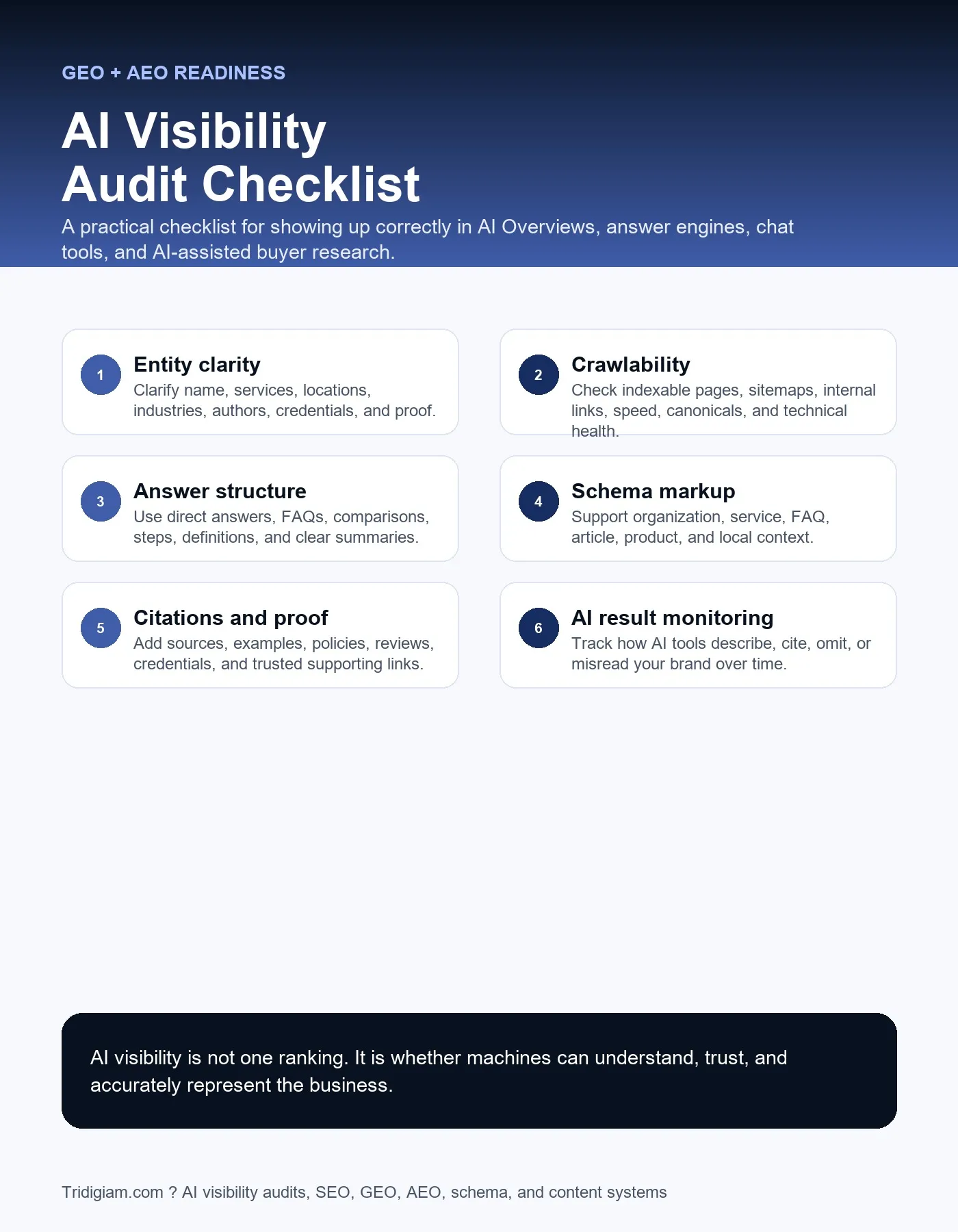
- Build a remediation loop: improve answer-first pages, internal links, schema, source citations, technical accessibility, and measurement dashboards based on missing prompts.
Questions to answer before building an AI Visibility Index
What should an AI Visibility Index measure?
It should measure whether the brand appears in AI answers, whether it is mentioned, whether it is cited as a source, which competitors appear instead, which prompts trigger visibility, and which pages or sources influence those answers.Why does AI visibility matter for regulated brands?
Regulated buyers often search with high-stakes questions about safety, compliance, privacy, pricing, claims, and risk. If a brand is missing from those AI answers, it may never enter the buyer’s consideration set even when it has strong traditional rankings.How often should AI visibility be reviewed?
High-value prompt sets should be reviewed on a recurring schedule because AI answers, cited sources, competitors, and Search reporting features can change quickly. Monthly review is a practical baseline, with faster checks after major content or technical updates.Key Takeaways
- Brands invisible to AI search risk losing market influence and trust with potential customers.
- Integrating SEO with AI strategies helps regulated brands compete effectively in new search environments.
- Semrush Semrush analyzed 126 million prompts to track this visibility shift.
- Most B2B brands currently lack presence in AI-generated answers, creating a competitive gap.
What Is the AI Visibility Index and Why It Matters in 2026
The Semrush 2026 AI Visibility Index measures how often brands appear in answers generated by AI search tools. It analyzes 126 million prompts to determine which entities hold attention when users ask direct questions. This metric replaces traditional keyword ranking as the primary indicator of digital presence for many consumers. Regulated industries face unique challenges with this shift because trust drives their business models. A med spa owner or financial advisor relies on appearing in authoritative, accurate responses to win client confidence. If an AI tool cites a competitor instead of your firm, you lose that initial point of contact without ever generating a click to your website. The index highlights this gap between traditional search engine results pages and the synthesized answers users now prefer. You must understand that visibility in AI answers differs from standard SEO performance. High domain authority does not automatically translate to frequent citations in generative responses. Brands need specific content structures that align with how AI models extract and present information. This index serves as a diagnostic tool for identifying where your current strategy falls short in the new search paradigm. Ignoring this data means accepting reduced market influence over time. The metric provides a clear benchmark for measuring progress against competitors who may already be optimizing for AI inclusion. By tracking your position in the index, you can adjust content strategies to meet the demands of algorithmic citation rather than just organic ranking. This approach ensures your brand remains relevant as user behavior continues to evolve toward conversational and direct-query interfaces.Key Findings from Semrush’s Expanded 2026 Analysis of 126 Million Prompts
Semrush analyzed 126 million prompts to determine how often brands appear in AI-generated answers Semrush. This massive dataset reveals a stark divergence between consumer-facing and business-to-business visibility. Most regulated industries operate in the B2B or high-trust service space. The data shows that 96% of B2B brands remain invisible to AI search engines Semrush. This statistic applies directly to legal firms, financial advisors, and healthcare providers who rely on professional referrals rather than impulse purchases. Their content often lacks the conversational depth or structured data that AI models prioritize for direct answers. Consumer brands dominate the results because they optimize for broad intent and product features. Regulated sectors must shift their strategy to address specific professional queries with authoritative, compliant language. You cannot rely on traditional keyword density alone. AI tools evaluate topical authority and user trust signals differently than legacy search algorithms. The analysis highlights that visibility is not just about being seen but being cited as a source. If your firm does not appear in these synthesized answers, you lose the initial point of contact for high-value clients. This absence creates a compounding disadvantage over time. Competitors who structure their content for AI extraction will capture those leads first. Agency owners must audit their client portfolios against this new standard. Review current content to see if it answers complex questions in a way that an AI model can parse and cite. Implement structured data and clear, direct headings. Focus on creating resources that establish expertise within strict regulatory boundaries. This approach builds the visibility required to compete in 2026.The B2B Blind Spot: Why 96% of Brands Are Invisible to AI Search Engines
B2B brands face a 96% invisibility rate in AI-generated responses according to recent industry data 2X. This statistic highlights a severe disconnect between traditional search optimization and the way artificial intelligence models retrieve information. Most business-to-business entities optimize for keyword density and backlink profiles. They rarely structure content for direct extraction by large language models. Healthcare providers, law firms, and financial advisors rely on high-intent client acquisition. These sectors depend on trust signals that AI engines now prioritize over traditional ranking factors. When an AI model synthesizes an answer about estate planning or HIPAA-compliant telehealth options, it draws from authoritative sources with clear structured data. If your firm lacks this technical clarity, the model skips you entirely. You lose the impression before a user ever clicks through to a search results page. The gap exists because many agencies still treat AI visibility as a secondary concern. They focus on organic traffic metrics while ignoring how generative tools curate information. Regulated industries require precise compliance language in their public-facing content. This precision often conflicts with the concise, direct answers AI systems prefer. Brands must adapt their content architecture to serve both human readers and machine parsers. Structured data markup helps define entity relationships for algorithms. Clear headings improve context extraction for natural language queries. Factual density increases the likelihood of citation in synthesized responses. Tridigiam.com builds these technical foundations into every client strategy. We focus on measurable improvements in brand mention frequency within AI outputs. This approach ensures regulated clients remain visible as search behavior shifts toward conversational interfaces.How AI-Driven Search Is Reshaping User Intent and Click Behavior
Users now expect instant answers rather than lists of links to explore. This shift changes how traffic flows from search engines to brand websites. The traditional click model is breaking down as AI tools prioritize direct responses over referral traffic. Searchers ask questions in natural language and receive synthesized summaries on the results page. They rarely need to visit a third-party site for basic information. This behavior reduces organic click-through rates for informational queries across regulated sectors like healthcare and finance. Brands that rely solely on ranking for high-volume keywords will see their traffic decline as users find answers without clicking. AI models pull data from authoritative sources to build these responses. They cite platforms that demonstrate clear expertise and trustworthiness. A legal firm or medical practice must ensure its content appears in the source material used by these algorithms. If a brand does not appear in the AI’s training data or citation pool, it becomes invisible to the user regardless of traditional SEO metrics. The goal shifts from capturing clicks to earning citations within AI-generated answers.- Focus on providing concise, direct answers to common client questions in your web content.
- Structure data so AI models can easily extract and cite your expertise.
- Monitor which prompts trigger AI summaries that exclude your brand from the source list.
Strategic Shifts: Integrating Traditional SEO with AI Optimization Tactics
Traditional keyword targeting no longer drives organic traffic alone. AI models prioritize structured data and authoritative content signals over simple term matching. Brands in regulated sectors must adjust their technical architecture to support both human readers and machine parsers. This dual approach prevents visibility loss as search interfaces evolve. Medical practices, law firms, and financial advisors rely on precision. Their content often contains dense regulatory language that AI systems struggle to parse correctly without clear markup. Implementing schema markup helps define entities like service areas, practitioner credentials, or legal practice types explicitly. This structure allows AI engines to extract accurate answers directly from your site instead of skipping to a competitor with cleaner data. You do not need to rewrite every page. You need to label existing information so machines understand context immediately. Content strategy shifts from answering single queries to addressing clusters of related intent. A healthcare provider should group patient education pages around specific conditions rather than scattering facts across isolated blog posts. This topical authority signals expertise to AI models evaluating source reliability. Financial institutions can achieve similar results by linking account management guides to broader wealth planning resources.- Audit existing pages for missing structured data fields relevant to your industry vertical.
- Consolidate thin content into comprehensive resource hubs that demonstrate depth of knowledge.
- Monitor AI visibility scores using tools like Semrush to track performance changes over time.
Compliance and Trust: Navigating Regulatory Risks in AI-Generated Answers
AI models cite sources to support their answers. For regulated brands, those citations carry legal weight. A healthcare provider appearing in an AI summary without proper attribution faces immediate compliance risks under FTC guidelines regarding deceptive advertising. The model pulls text from across the web. It does not distinguish between a verified medical fact and an outdated blog post. This creates liability for the brand whose name appears alongside unverified claims. Finance and legal firms face similar exposure when AI agents synthesize complex advice. Regulators scrutinize how digital content influences consumer decisions. The FTC has emphasized that endorsements and testimonials must be clear and conspicuous FTC. If an AI tool summarizes a financial strategy using outdated data from your site, you share the responsibility for that misinformation. Trust erodes quickly when users discover inaccuracies in automated responses. That erosion is permanent. You must audit your digital footprint for compliance before optimizing for visibility. Remove or update content that could be misinterpreted by generative algorithms. Ensure all medical and financial disclaimers are prominent and machine-readable. Structured data helps search engines understand context. It reduces the chance of AI extracting out-of-context advice. This protects your reputation while maintaining access to high-intent users.Action Plan: Steps Regulated Brands Must Take to Reclaim Visibility
Regulated brands must audit their schema markup to ensure AI models can parse professional credentials and service areas without ambiguity. Structured data acts as the primary signal for generative engines verifying authority in healthcare, legal, and financial sectors. Start by marking up specific service pages with LocalBusiness or LegalService schema rather than relying on generic homepage tags. This precision helps AI systems distinguish between a personal injury lawyer and a general corporate attorney when answering niche queries. Semrush data shows that brands with clear, structured information appear more frequently in AI-generated answers because the models can confidently extract relevant facts. Without this technical foundation, your content remains invisible regardless of its quality. Next, consolidate fragmented content into comprehensive topic clusters. AI search favors depth over breadth when sourcing expert advice. Create single authoritative pages that answer common client questions completely instead of scattering information across twenty thin blog posts. This approach reduces confusion for both users and AI parsers.- Audit existing schema markup for accuracy and completeness.
- Consolidate related content into definitive resource guides.
- Monitor brand mentions in AI answers weekly using visibility tracking tools.
| Action Step | What It Accomplishes |
|---|---|
| Audit existing schema markup | Check for accuracy and completeness so AI models can parse credentials and service areas |
| Consolidate related content | Build definitive resource guides instead of scattering thin posts across the site |
| Monitor brand mentions in AI answers | Track visibility weekly using dedicated tracking tools |
Conclusion
AI search changes how users find regulated services. Brands that ignore these shifts lose visibility while competitors capture intent. The transition requires structured data and clear compliance boundaries. Tridigiam helps healthcare, finance, and legal firms adapt their content strategies for new discovery methods. We focus on measurable results through compliant optimization techniques. Contact us to review your current AI readiness and build a sustainable presence in evolving search environments.Frequently Asked Questions
What does the 2026 AI Visibility Index measure?
The index analyzes 126 million AI search prompts to evaluate how brands appear in generative search results. Semrush expanded this metric to track visibility shifts as users rely more on AI answers than traditional links.How many B2B brands are currently invisible in AI search?
Research indicates that 96 percent of B2B brands lack visibility in AI-driven search results. This data highlights a significant gap where most business-to-business entities fail to appear when users ask AI assistants for recommendations.Why must regulated industries adapt their SEO strategies now?
Regulated sectors like healthcare and finance face stricter content guidelines. Adapting ensures compliance while maintaining presence in AI summaries. Brands that ignore this shift risk losing market influence as search behavior moves toward direct answers.Does appearing in AI search replace traditional SEO?
No, it complements it. You must integrate standard SEO tactics with strategies optimized for AI parsing. This dual approach helps maintain visibility across both traditional result pages and emerging generative answer formats.
If you want a practical way to turn AI visibility measurement into an implementation plan, start with Tridigiam Marketing Academy. The $20/month membership includes scorecards, checklists, prompts, audit templates, implementation trackers, and courses for AI search optimization and AI visibility auditing. Start the AI visibility training.
Related book: Want a clearer way to audit AI search visibility? See The AI Visibility Audit by Chris Goodman.
Resources
Need marketing that actually moves the needle?
Tridigiam is a Las Vegas marketing and advertising agency built for regulated and growth-focused businesses. Call (702) 748-7005 or request a consultation.

Explore knowledge from Chris Goodman, a marketing expert with extensive agency and small business experience, specializing in innovative advertising strategies. Chris has a Bachelor’s in Marketing from RMIT, years working in advertising agencies servicing clients, and years of experience working with small to medium sized businesses operating within regulated industries.