AI search is changing how buyers compare vendors, agencies, healthcare providers, financial firms, legal services, and other approval-sensitive organizations. Traditional SEO still matters, but it is no longer the whole picture. Regulated businesses also need content that can be understood, trusted, cited, and summarized by AI-powered search experiences.
This starter guide explains how regulated and approval-sensitive teams can approach AI Search Optimization without creating unnecessary compliance risk.
What AI search optimization means
AI Search Optimization is the process of making a website, brand, and content library easier for search engines and AI answer systems to understand. It includes traditional SEO foundations, generative engine optimization, answer engine optimization, structured data, entity signals, trust markers, and content governance.
For regulated businesses, the goal is not to chase every AI trend. The goal is to publish clear, accurate, reviewable content that can earn visibility while still respecting approval workflows, professional standards, and compliance boundaries.
Why regulated businesses need a different approach
Many SEO playbooks assume that faster publishing is always better. That can be risky for healthcare, legal, financial, insurance, and other regulated teams. These organizations often need claims reviewed, disclaimers checked, authorship clarified, and local or service-area language approved before content goes live.
AI search makes those controls more important, not less. If a page is vague, unsupported, thin, or inconsistent with the rest of the site, it may be harder for AI systems to understand and trust. If content is too aggressive or unsupported, it may create brand and compliance risk.
Core opportunities to improve AI search visibility
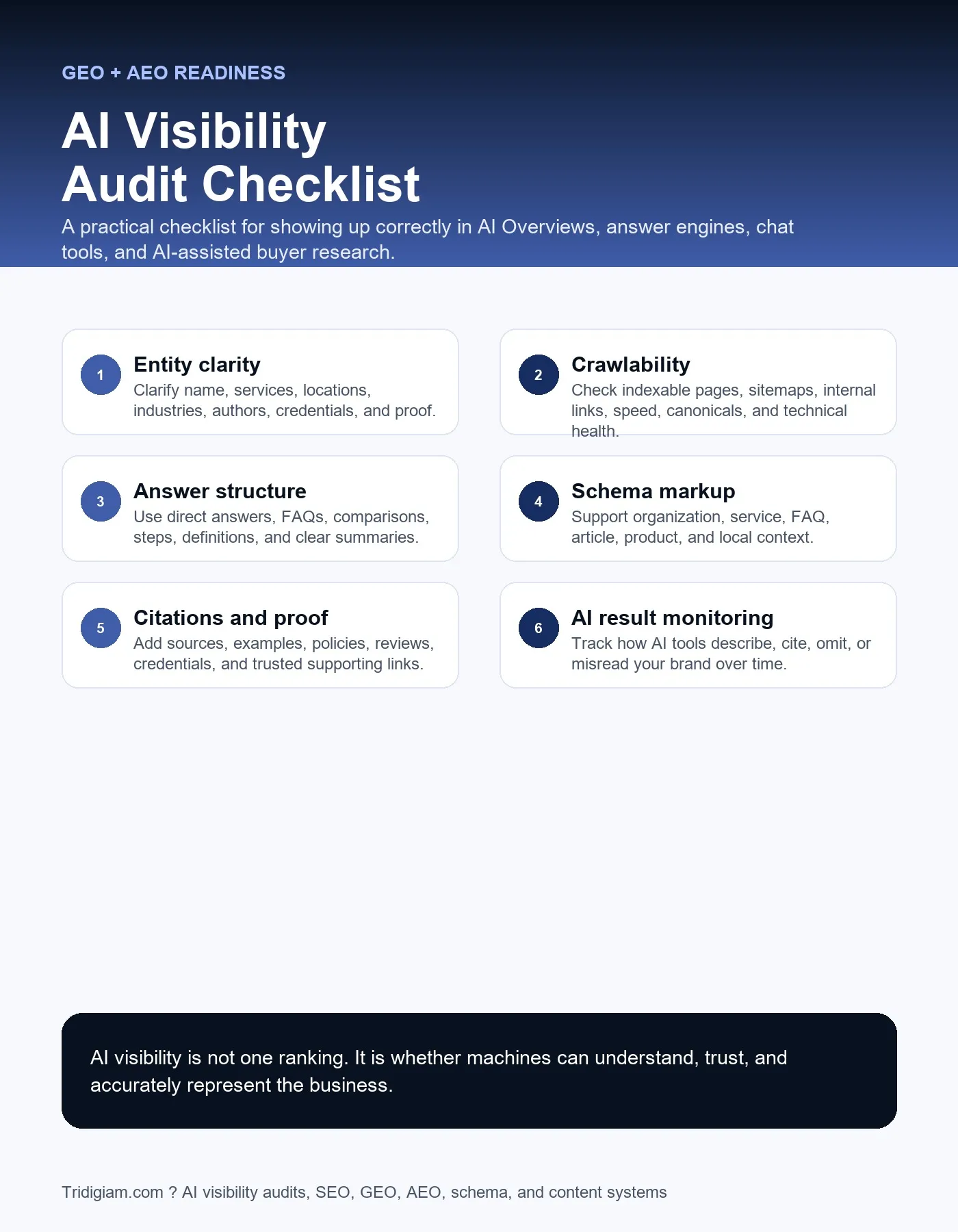
- Clarify entities. Make it obvious who the organization serves, where it operates, what services it provides, and what credentials or proof points support its claims.
- Strengthen service pages. Each core service page should answer real buyer questions, define the problem, explain the process, and link to relevant supporting resources.
- Use structured data. Schema can help search systems understand pages, organizations, services, FAQs, articles, and course content.
- Build answer-first content. Create content that directly answers high-intent questions in clear language before adding nuance.
- Add internal links. Connect blog posts, service pages, resource pages, and educational content so search systems can understand topical relationships.
- Document review workflows. Approval-sensitive organizations should have a repeatable process for reviewing claims, sources, compliance notes, and update schedules.
- Related AI search resources
- Tridigiam Academy: AI Search Optimization Training
- GEO and AEO for Regulated Businesses
- Schema and Trust Signals for AI Search
A simple implementation sequence
A practical AI search optimization plan usually starts with foundations. First, review technical SEO basics such as indexability, crawlability, broken links, page speed, and structured data. Next, improve the main service pages that matter most commercially. Then build supporting articles, FAQs, comparison resources, and proof-of-expertise content that reinforce those pages.
Once those foundations are in place, teams can layer in GEO and AEO tactics such as answer summaries, entity-rich author bios, source-backed explanations, topical content clusters, and AI visibility monitoring.
Where to start
Tridigiam Marketing Academy now offers this framework as a $20/month membership. Members get access to AI Search Optimization for Regulated Businesses, AI Visibility Audit Lab for Regulated Businesses, and practical resources for SEO, GEO, AEO, schema, trust signals, AI visibility monitoring, and compliance-safe implementation.
Join Tridigiam Academy for $20/month, or explore Tridigiam’s AI Search Optimization services if your organization wants hands-on support applying the framework to your own website.
The best next step is simple: identify the five pages most important to your pipeline, check whether they clearly answer buyer questions, and connect each page to relevant supporting content. That creates a stronger foundation for both traditional search and AI-powered discovery.
Resources
Need marketing that actually moves the needle?
Tridigiam is a Las Vegas marketing and advertising agency built for regulated and growth-focused businesses. Call (702) 748-7005 or request a consultation.

Explore knowledge from Chris Goodman, a marketing expert with extensive agency and small business experience, specializing in innovative advertising strategies. Chris has a Bachelor’s in Marketing from RMIT, years working in advertising agencies servicing clients, and years of experience working with small to medium sized businesses operating within regulated industries.