
Quick answer: AI runs modern programmatic advertising by automating real-time bidding, audience matching, and budget pacing across the open web. For marketers, the work shifts to clean data, strong creative, brand-safe inventory, and clear goals. Done right, it buys attention efficiently at scale.
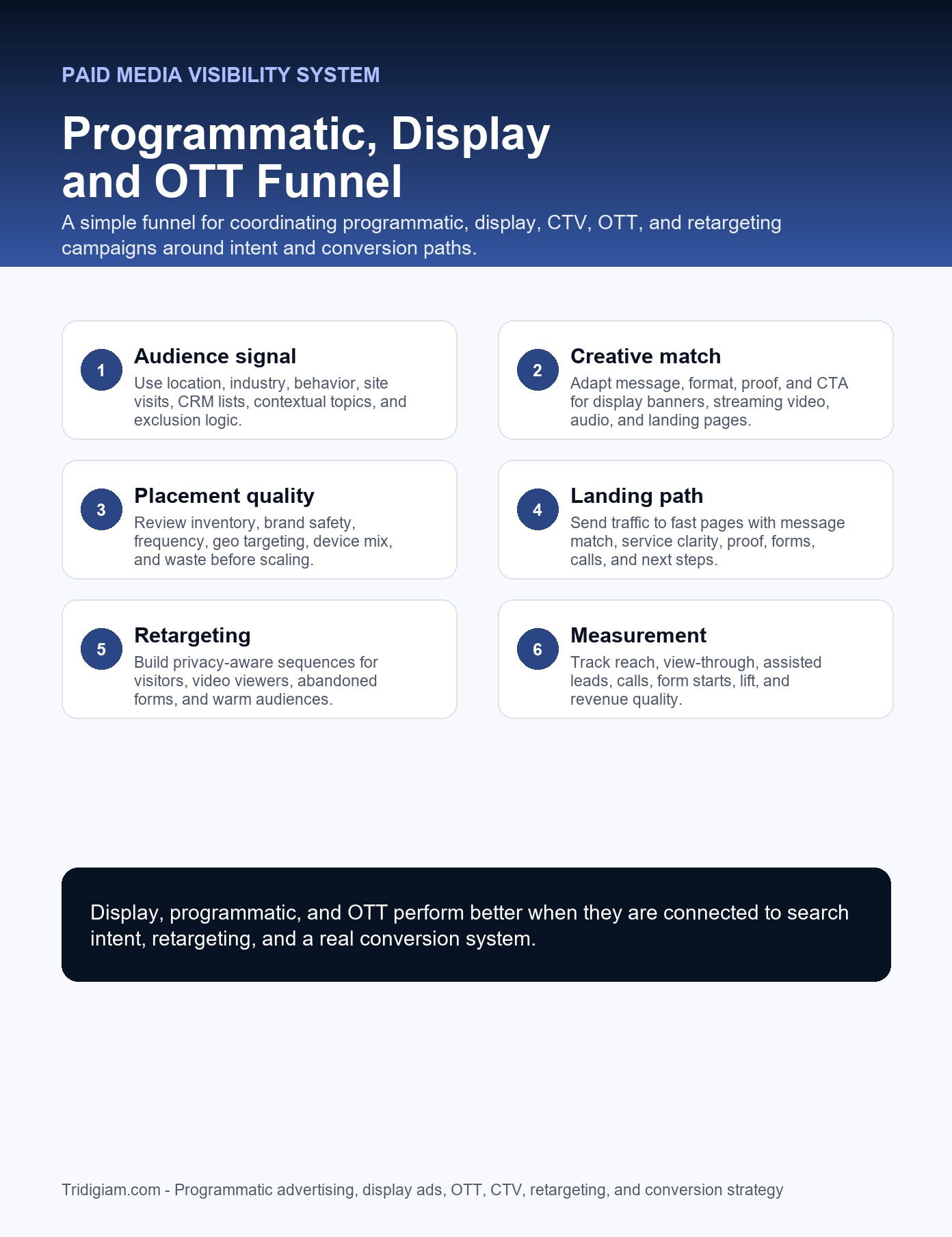
AI programmatic advertising answer map
AI in programmatic advertising helps advertisers decide who to reach, what impression to bid on, how much to bid, and which creative or audience signal should guide the next optimization. The strongest use cases are real-time bidding, predictive audience modeling, budget pacing, creative testing, fraud or placement monitoring, and campaign reporting.
- Bidding: AI and automated bidding models use conversion likelihood, value, context, and campaign goals to adjust bids across auctions.
- Audience discovery: optimized targeting can use real-time campaign data to find relevant users beyond a manually selected audience.
- Creative and messaging: AI can compare formats, messages, and placements, but marketers still need clear offers, compliant claims, and strong landing pages.
- Brand safety: automated buying should be paired with content suitability settings, exclusions, placement reviews, and human oversight.
- Measurement: judge AI programmatic by qualified conversions, cost per acquisition, return on ad spend, incrementality, wasted spend, and lead quality instead of clicks alone.
Useful source anchors include Google Ads guidance on automated bidding, Google Ads guidance on Smart Bidding, Display & Video 360 guidance on optimized targeting, Google Ads guidance on content suitability, and Google’s Privacy Sandbox documentation. Tridigiam connects this topic to data-driven ad insights, advanced audience segmentation, paid social funnel strategy, ethical paid social advertising, and AI in future ad campaigns.
Questions to answer before using AI in programmatic advertising
What business outcome should the AI optimize for?
Define the conversion, value signal, lead-quality rule, or revenue goal before turning on automated bidding or audience expansion. AI works best when the campaign goal is specific enough to guide tradeoffs.
Is the campaign data clean enough for automated decisions?
Review conversion tracking, audience lists, CRM feedback, exclusions, and landing-page events. Weak or noisy data can teach the system to chase cheap activity instead of qualified demand.
Where does human oversight remain necessary?
Keep humans responsible for privacy choices, brand-safety rules, creative claims, budget limits, compliance reviews, and performance interpretation. AI can optimize the auction, but it should not define the business strategy by itself.
Artificial intelligence (AI) has become a major component of programmatic advertising in the last few years. Artificial Intelligence has completely changed the way digital marketing is done by making audience targeting more effective and efficient. Artificial Intelligence (AI) has made it possible for marketers to make better decisions and optimize their advertising campaigns by enabling real-time analysis of massive amounts of data. The process of buying & selling ad space has become more efficient & economical thanks to AI algorithms, which have caused a shift from traditional manual ad buying to programmatic advertising. Also, by giving users more relevant and personalized advertisements, AI has significantly improved the user experience overall.
Key Takeaways
- AI is transforming programmatic advertising by automating the buying and selling of ad space, optimizing targeting, and improving efficiency.
- AI is revolutionizing digital marketing by enabling personalized and targeted advertising, improving customer experience, and increasing ROI.
- Artificial intelligence plays a crucial role in programmatic advertising by analyzing data, predicting consumer behavior, and making real-time decisions.
- AI has a significant impact on targeting and personalization in digital marketing by enabling precise audience segmentation and personalized content delivery.
- The future of programmatic advertising with AI looks promising, with advancements in machine learning, natural language processing, and predictive analytics.
The Role of AI in Digital Marketing
Artificial intelligence (AI) has revolutionized digital marketing by enabling marketers to analyze vast amounts of data and deliver tailored advertisements that resonate with their target audience. By utilizing machine learning algorithms, AI evaluates customer behavior and preferences, resulting in more relevant and personalized ad experiences. This level of personalization has increased customer satisfaction, engagement, and conversion rates, enhancing the overall effectiveness of digital marketing campaigns.
Enhanced Consumer Insights and Campaign Optimization
AI-powered tools and technologies provide marketers with deeper insights into consumer behavior and preferences. This allows for the development of more individualized and targeted marketing strategies. AI can identify patterns and trends in large datasets, helping marketers create more successful advertising campaigns. The ability to analyze and interpret data at this level manually would be nearly impossible, making AI an invaluable tool for digital marketers.
Personalization and Real-Time Optimization
Machine learning algorithms enable marketers to deliver highly personalized ads that cater to individual preferences and behaviors. This personalization enhances the user experience, leading to higher engagement and conversion rates. Additionally, AI allows marketers to optimize bidding and ad placement strategies in real-time, ensuring that ads reach the right audience at the right moment. This real-time optimization improves campaign performance and cost-efficiency.
Programmatic Advertising with AI
AI plays a crucial role in programmatic advertising by automating the real-time buying and selling of ad space. AI algorithms analyze data to identify the most relevant ad placements for each target audience, improving precision and efficiency. This automation saves time and resources while enhancing campaign performance through data-driven decision-making. AI-driven programmatic advertising enables marketers to dynamically adjust ad placement and bidding strategies based on real-time data and insights.
Ethical Considerations and Challenges
While AI-driven advertising offers numerous benefits, it also presents challenges and ethical considerations. Ensuring transparency and accountability in AI algorithms used for ad targeting and personalization is crucial. Marketers must use AI ethically and comply with privacy regulations to protect customer data. Additionally, the potential for bias in AI algorithms can lead to discriminatory ad targeting. Marketers must work to create inclusive and fair advertising strategies.
Future of AI in Digital Marketing
The future of AI in digital marketing looks promising. As machine learning and data analysis technologies advance, AI-powered tools will enable marketers to make better decisions and optimize advertising campaigns more effectively. The shift from traditional manual ad buying to programmatic advertising will become more pronounced, with a greater focus on delivering tailored and relevant ads to customers. This personalization will boost engagement, conversion rates, and the overall effectiveness of digital marketing campaigns.
Conclusion
AI has transformed digital marketing by providing deeper consumer insights, enabling real-time optimization, and revolutionizing programmatic advertising. Marketers can deliver more personalized and effective ad experiences, improving customer satisfaction and campaign performance. While there are challenges and ethical considerations, the benefits of AI-driven advertising far outweigh the drawbacks. By staying informed about best practices and ethical issues, marketers can continue to leverage AI to achieve better results in digital marketing.
If you’re interested in learning more about the impact of AI on programmatic advertising, you should check out Tridigiam’s article on paid advertising & media buying.
FAQs
What is AI in Programmatic Advertising?
AI in programmatic advertising refers to the use of artificial intelligence technology to automate the process of buying and selling ad space in real-time. This technology allows for more efficient and targeted ad placements, as well as the ability to analyze large amounts of data to optimize ad campaigns.
How does AI in Programmatic Advertising work?
AI in programmatic advertising works by using algorithms to analyze data and make decisions about ad placements in real-time. This can include targeting specific audiences, optimizing bids for ad space, and adjusting ad creative based on performance metrics.
What are the benefits of using AI in Programmatic Advertising?
Some of the benefits of using AI in programmatic advertising include improved targeting and personalization, increased efficiency and cost-effectiveness, and the ability to analyze and optimize ad campaigns in real-time.
What are some examples of AI technologies used in Programmatic Advertising?
Some examples of AI technologies used in programmatic advertising include machine learning algorithms for audience targeting, natural language processing for ad creative optimization, and predictive analytics for campaign performance forecasting.
What are the potential challenges of using AI in Programmatic Advertising?
Some potential challenges of using AI in programmatic advertising include concerns about data privacy and security, the need for ongoing monitoring and optimization of AI algorithms, and the potential for bias in AI decision-making.
Related guides from Tridigiam
- DMP vs DSP — How data-management platforms and demand-side platforms differ in modern ad stacks.
- DSP guide — Demand-side platforms explained for marketers buying programmatic at scale.
- OTT advertising — How to add OTT inventory to a programmatic-led campaign mix.
Related service: Learn more about Tridigiam’s creative advertising services.
Resources
Need marketing that actually moves the needle?
Tridigiam is a Las Vegas marketing and advertising agency built for regulated and growth-focused businesses. Call (702) 748-7005 or request a consultation.
Want more like this? Browse our free CRO, SEO, and AI search guides.
Frequently asked questions
What role does AI actually play in programmatic advertising auctions?
AI evaluates each available ad impression in real time, scoring it against targeting criteria and predicted performance, then decides whether and how much to bid, all within the fraction of a second before the page loads.
Does AI in programmatic advertising reduce the risk of ads showing up on brand-unsafe content?
AI-powered brand safety tools can help filter out risky placements, but they aren’t foolproof, so marketers still need to review placement reports and set explicit exclusion lists rather than relying entirely on automated filtering.
What still requires human oversight in AI-driven programmatic campaigns?
Setting clear campaign goals, providing strong creative, and reviewing where ads actually ran still require human judgment, since AI optimizes within the parameters and inputs it’s given rather than defining strategy on its own.

Written and reviewed by Chris Goodman, CEO of Tridigiam
Founder of a Las Vegas marketing agency building AI-visibility and compliance-aware marketing systems for regulated industries — healthcare, addiction treatment, and aesthetics. LinkedIn

Explore knowledge from Chris Goodman, a marketing expert with extensive agency and small business experience, specializing in innovative advertising strategies. Chris has a Bachelor’s in Marketing from RMIT, years working in advertising agencies servicing clients, and years of experience working with small to medium sized businesses operating within regulated industries.